Pages

Friday, 24 December 2021

The Red-Nosed Reindeer

Since Christmas is fast approaching, every shop and radio station is playing Christmas songs all the time, and one which has always stood out for me is Rudolph, the Red-Nosed Reindeer.

I'd always thought Rudolph had started life as a song, but Wikipedia says the story was originally written in verse for the Montgomery Ward chain of department stores in the US in 1939, and only became a song in 1949, popularised by Gene Autry.
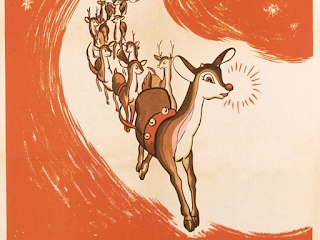
Rudolph leading the other eight

Before Rudolph came along, the names of Santa's other reindeer had come from the familiar poem A Visit From St. Nicholas by Clement C. Moore, first published in 1823. It's the one that begins 'Twas the night before Christmas. The poem gives the names as Dasher, Dancer, Prancer, Vixen, Comet, Cupid, Donder and Blitzen. (Not Donner, although he did name the last two reindeer after thunder and lightning).

In any case, Donder has now become Donner, and the list of reindeer that every scholarly child (such as I was) commits to memory is the eight names above, plus Rudolph, who is of course the youngest.

From the famous song, here's the bit which troubled me then, and still does today, enough to want to write about it here. Everybody knows that Rudolph isn't like the other reindeer. His shiny red nose marks him out as different:
All of the other reindeer used to laugh and call him names.
They wouldn't let poor Rudolph join in any reindeer games
.

When I was a child, I didn't have a shiny red nose, but there was definitely something palpably different about me. I didn't fit in with the boys, no matter how I tried, and therefore I was always an outsider, yearning to be accepted. I remember being lonely and perplexed, wishing I could like football, wishing I could like rough-and-tumble play, and wondering what it was that was so intangible, and yet at the same time so inescapable. Not only were the boys unwilling to play with an atypical boy, so were the girls.

For Rudolph, the story ends happily. One foggy Christmas Eve, Santa realises that Rudolph's shiny red nose is just the thing to light the way for the sleigh. Hurrah.

All of the reindeer loved him, and they shouted out with glee
"Rudolph the red-nosed reindeer, you'll go down in history!"

As a child, I thought the other reindeer were a bunch of two-faced bastards. Santa decides Rudolph is cool, so suddenly they all change their tune? Partly I wanted Rudolph to tell the other reindeer to bugger off: partly I was pleased for Rudolph that he found the acceptance he had craved.

Happy Christmas to all, and to all a good night!
You may say (and you could be right) that I'm completely overthinking all of this. It's just a children's Christmas story, after all, and therefore it requires a happy ending with a perfect resolution.

But there is, I think a deeper interpretation, which is that those people who seem to not fit in--the one that other people laugh at, and call names--not only have something valuable to contribute, but can actually lead, and become popular, and become famous. Can, in fact, "go down in history".

So if I have one Christmas wish for us all, it is this. I wish that we get recognised as being special, and wonderful, and that we are loved, not just by Santa but by everyone.

Wherever you are, I wish you a glorious, sparkly, magical Christmas.

Sunday, 19 December 2021

Ten Year Anniversary, but Still Not Brave Enough...Yet!

Since I started writing this blog, almost exactly ten years ago, so much has changed.

When I first started writing, I was unhappily married, with two small children, to a woman who despised everything to do with crossdressing. We had some counselling, but nothing changed. What really made a difference was coming out to a close friend. My ex-wife was determined that nobody should ever know--I mean, what would people think?

It turns out that people wouldn't mind very much at all, as I found out when I continued to come out to close friends and family members. Then there was the divorce, which was unbearably awful, and then a period of readjustment to my life as a divorced person.

Bluestocking Blue: Ten Years On
Then I met someone, whom I call Missy on this blog. I told her very early on, and to my delight and astonishment, she was completely supportive. We moved in together, and blended our families, with the usual bumps along the way.

Since then, my life is completely transformed. We go out together when I'm dressed. Admittedly, with a bunch of kids who have swimming lessons and sports fixtures and music lessons and all that, there isn't an abundance of opportunity for us, but it's unfailingly amazing and never gets old. We were invited once to a friend's birthday party, and I turned up as Vivienne to meet a houseful of strangers--who were all lovely.

My fem clothes hang in the wardrobe, next to my drab male clothes (not hidden in the suitcase in the attic). My heels are next to my man shoes. My makeup is in the drawer. She borrows my nail polish remover; I borrow her foundation brush. She helps me pick out what to wear.

Once a month I go to a very nice beautician (recommended by Missy) who does my leg waxing. We gossip like she would with any client, and she's super lovely. And I've been getting makeup tips from a local makeup artist, who had never had a trans client before but again is super lovely.

I'd love to say that I can be Vivienne whenever I want, but this isn't true. Overall, though, I could not have envisaged the direction my life would take. Where will it lead? I do not know, of course, but I am reminded of a line from the theme song of Ally McBeal (remember that show?), which resonated with me at the time: One by one, the chains around me unwind.

I even "came out" on this blog and admitted I'm a doctor, having previously pretended to be something else. I've been exploring the situation of transgender doctors, and have now made contact with several, as well as other professionals (an artist, a statistician, a novelist).

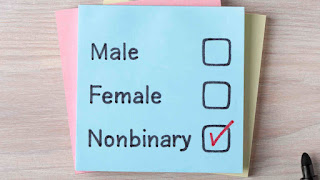
Which box should I be ticking?
I've also seen an increase in rainbow awareness happening around me. The other day, I met a medical student who was wearing a name badge which said "<Name>, Medical Student, Pronouns she/her". Formerly I'd always assumed that people who put their pronouns up front like this were either trans themselves, or had a close friend or family member who was trans. But no. Apparently there are lots of students wearing these badges now.

Once a year, however, my hospital sends around a staff survey. It asks for lots of details, such as what your hours of work are, what mode of transport you take to get to work, whether you feel safe leaving in the dark, and so on. I assume they are trying to make sure that the requirements of staff to get safely to work are met. They also ask about ethnicity, and I'm assuming that they're trying to make sure that the ethnic makeup of the staff is a reflection of the ethnic makeup of the community.

But they also ask about gender orientation.

When that question comes up anywhere else, in online applications, or other form-filling, I click on "non-binary" or "other" or whatever third option they give other than "male" and "female". But at work, I don't. I still click on "male".

I've found myself reflecting on why I do this, but basically, it's a form of cowardice. I know other people, more out than I, who have experienced real difficulties created by their gender identity. Yet, they persist, driven by courage, or determination, or the desire perhaps to blaze a trail for those who follow. Like water on stone, eventually the stone will be worn away. Why don't I click that third box, and prepare myself for whatever follows?

Because a close friend once warned me that our city is still quite conservative. You can only come out once. There could still potentially be adverse consequences of being open. She would know; it's happened to her.

And so, for the moment, I don't click the box. It turns out, that, even ten years on, I am still worried about what people would think.

===

While my input to this blog has dwindled a bit since I started writing (far too much!) on Quora, I'm delighted to find that I'm still ranked at number 55 on the Feedspot Top 60 Crossdressing Blogs and Websites, updated on 11th December 2021, so I suppose I'm still allowed to have my gold medal displayed on the home page.

Tuesday, 8 September 2020

Transgender Actors

Here's a question. You want to make a film where a transgender character is the lead. Do you need to cast a transgender actor or actress in the role?

Victor Polster in Girl (2018)
For mainstream cinema at least, the choice is easy: you pick a cisgender actor or actress and cast them. That has been true over many years, from Felicity Huffman in Transamerica to Cillian Murphy in Breakfast on Pluto, to Terence Stamp in Priscilla, right up to Eddie Redmayne in The Danish Girl and most recently Victor Polster in Girl.

For some trans people, this is definitely a problem. The film Girl, which I haven't yet seen, has stirred up quite a lot of protest, in particular because there seems to be a lot of depiction of genitalia. Several questions about transgender actors have been debated on Quora, and some of the answers and comments are very interesting. All of the quotes come from Quora and are unchanged from the original authors' text, though they are not all in response to the same question.

The first comment people make is that there are plenty of trans actors out there now.
Elliott Mason: There are hundreds of working trans actors, of all stripes and appearances. If none of them are considered "bankable" it's because productions won't cast them to play cis, but won't let them play trans either.
Eddie Redmayne in The Danish Girl (2015)
This is a very fair point: if you are a trans actor, then you might find yourself stuck between a rock and a hard place: no trans roles-- and no cis ones either!

The next point is that it’s not acceptable to have black or Asian parts played by white actors in makeup—and for the same reason we should have trans actors playing trans characters.
Joanne C Wittstock: There was a time when women were not allowed on stage. Then a time when no suitable black actors were available and the roles went to whites. For decades there were apparently no Asians with theatrical skills. The frontier is slowly moving. To a large extent trans people are the visible minority of this moment.
I completely take this point. One of the things which spoils what would otherwise be one of my favourite ever movies, Breakfast at Tiffany's, is the dreadful "comic relief" turn of Mickey Rooney in yellowface as Mr. Yunioshi. And one of the best of the classic Doctor Who stories, The Talons of Weng-Chiang, features John Bennet in the role of the villainous Li H'Sen Chang. This time, it's not played for laughs, but the show still manages to throw in some dreadful Chinese stereotypes. The few actual Asian actors in the production are relegated to non-speaking parts.

Another common theme is the failure of Hollywood to recognise the legitimacy of trans people themselves; instead making them out to be a pretence.
Helena Almagest: The persistent practice of Hollywood to have cis men portray trans women and cis women trans men promotes the misconception that transgender is merely a disguise, and that trans women are merely men dressing up, and trans men, women dressing up. A misconception that gets us killed. (her emphasis).
A trans woman should be portrayed by a woman. It needn’t even be a trans woman (although suitable trans actresses are out there and desperately seeking jobs), it could also be a cis woman. Just not a man.

Likewise, a trans man should be portrayed by a man, trans or cis.

Tara Nitka: Hollywood has made me quite skeptical about the ability of cis people to write and portray trans characters, but that might only be true of Hollywood.

But ultimately, casting cis men and boys to play trans women and girls sends the message that we’re men pretending to be women. If you can’t cast a trans girl, at least cast a girl.

Felicity Huffman in Transamerica
From the (short) list of famous movies at the start of this article, only Transamerica would meet with approval here, with Felicity Huffman cast as a transwoman.

Sara Clarke: When we cast a cis person to play a trans person, we’re at the mercy of that person (and their most likely cis director and writer) to tell us what trans people look and act like, how they feel about things, what choices they would make, etc. Considering how ignorant most cis people are of the trans experience, that’s not doing anybody any favors: either other cis people learning about trans issues through the lens of other cis people who may or may not know what they’re talking about, or other trans people who want to see authentic versions of their lives represented in the media.

These are powerful points. The criticism is that the films don't depict trans people, or how they feel, but only what cisgender people think trans people are like, and how they feel. I definitely share this point of view: several times during The Danish Girl, I found myself thinking that elements of the plot didn't strike me as real.
Chrystal Andros: My issue is what is called agency. With women it used to be (and still is in some aspects) that men define what is good for them. They cannot speak for themselves, so they have to have someone else speaking for them.

In the same way in Hollywood, managers and focus groups define what is good for the audience and define their selection of actors.

With trans-actors and trans-actresses they fit into a certain category - they are becoming more mainstream, but they are considered like women from 1950s who go out and become professionals - the freaks of today.
Three of the films I have mentioned have received very positive reviews. On Rotten Tomatoes, Priscilla has a 96% approval rating; Girl has achieved 84% and Transamerica has 76%.  Meanwhile, The Danish Girl managed only 67% and Breakfast on Pluto achieved 57%. So the filmmakers are doing something right (if not exactly breaking box-office records with any of them). But of course, if these are films made by cisgender film-makers, pitched for a (predominantly) cisgender audience, I suppose that doesn't necessarily mean they please transgender people.

Cillian Murphy in Breakfast on Pluto
But not everyone agrees with the sentiments above. Some commentators reported that, as long as the actor does a decent job, it shouldn't matter whether they are cisgender or transgender.
Mark Grinstein-Camacho: Actors play different characters all the time. It is their job. You can find actors who play straight people, gay people, billionaires, emperors of the galaxy, penniless street urchins, genius computer programmers, or zombies hungry for human flesh.

Studying for those roles and preparing for them is a big part of an actor’s work. Maybe it means watching Hitler’s speeches, or spending a day at a boot camp, or attending a conference. Maybe it means learning to play the violin for a year. Maybe it means watching other movies. Maybe it means interviewing people who were there. Any good actor can do this.
Karissa Cook: One point that most people seem to miss with these questions is that an actor acts. That is what they do.

Would it be a good thing for more transgender actors to get cast? Absolutely! Should we get bent out of shape about who is portraying trans characters? Not unless they are doing a poor job.

Look folks. If you want only trans actors to have trans roles then you aren't really looking for actors, you are looking for representatives.

Actors play a part. Their job is to make us believe that they really are the characters they portray. Stop worrying about who is playing the role, just pay attention to how well or poorly they did.
Benedict Cumberbatch as Alan Turing
This is also a point I have some sympathy with, although my own point of view comes from a different angle. Film-making is driven by economics. Film-makers make films because they want people to pay money to see them. Along the way, they may inspire, entertain, or inform--they may even achieve art--but those are very secondary considerations.

In The Imitation Game, Benedict Cumberbatch plays cryptanalyst Alan Turing (who happens to be one of my heroes). Turing was gay, but Cumberbatch isn’t; nonetheless Cumberbatch gives an extraordinary performance.

People have criticised the considerable liberties with historical events which the director took. But the director Morten Tyldrum has said that the film was really about using the medium of film to give the audience a flavour of what Turing was really like (rather than to just make a historical documentary). In this, I think he succeeds. The role of the tortured genius has been done dozens of times, but Cumberbatch manages to bring a nuanced performance which includes the awkwardness, the vulnerability and the arrogance of the character, without ever feeling forced or unnatural. Though we sympathise deeply with Cumberbatch's portrayal of Turing, he doesn't make the character necessarily likeable.

By casting a star like Cumberbatch in the role of Alan Turing, I believe people will watch the film who otherwise wouldn’t. And I believe that, unless they have hearts of stone, they will come away feeling sympathy for Turing and how he was treated, perhaps in a way they haven’t sympathised with gay people before. Other recent films which show gay men in a very positive light are Rocketman and Bohemian Rhapsody.

Jeffrey Tambor in Transparent
I think that we are in this place right now. I believe it’s more important for the public to see us, and to sympathise with and accept us, (even using the medium of fiction and the artifice of film) than it is for trans actors to be cast in those roles. Some cisgender actors have also done a wonderful job, such as Jeffrey Tambor in Transparent.

I hope that the day will come when trans actors are just actors. We are not there yet. Meanwhile, cisgender actors playing transgender parts is fine by me. What I want, right now, is awareness and exposure, and for people to view us with sympathy rather than scorn or discomfort. I think overall that we should be pleased that films with a transgender theme are being made and released. While they may not be perfect, I think that the casting of cisgender actors in transgender parts is doing more good than harm.


Monday, 31 August 2020

In Search of Beauty

Hallowe'en is a time of year when a lot of closeted cross-dressers feel safe to dress in public. It's acceptable to put on a face and a costume you wouldn't normally wear, and show yourself off. I've read quite a few descriptions of this online. It tends to be more marked in the US, where Hallowe'en is an enormously popular occasion, and where people seem to spend a lot more time and effort on the whole business than the rest of the world, though what I see is that, year on year, Hallowe'en is growing, everywhere.

One leg to rule them all...
So imagine my discomfort when I was invited to a very large and "authentic" Hallowe'en party last year. The party was hosted by a woman I work with. Unfortunately my partner couldn't attend, so it was up to me to go along, with the kids.

I very quickly dismissed the idea that I would go dressed as a woman. First, I'm not out to this woman. Second, I didn't know who else from work might be invited and show up. Third, the irony is not lost on me that Hallowe'en costumes are supposed to be a costume; as I've mentioned before, putting on a costume feels like pretending to be something I'm not, while getting dressed as a woman feels like becoming something I am (even if not every day). I definitely didn't want to do some sort of costume version of Vivienne; I couldn't imagine something less comfortable than turning up dressed as a pantomime dame. While if I dressed nicely, it could be a dead giveaway that this wasn't a once-in-a-year costume, but something I do much more frequently.

Mind you this Gandalf outfit, by Melbourne student Tjitske van Vark, might possibly work for this year. Gandalf the Pink, anyone?

But there was a further catch, which is that the hostess herself is extremely good at both makeup and costume. I've seen some of her work before, in pictures, and it's dazzling. So I knew she was going to set the bar very high, which in turn meant I didn't feel I could just cut two holes in a sheet, put it over my head, and call myself a ghost. In the end, I got a decent fantasy swordsman costume, and some decent props, and I didn't disgrace myself. But that's not what this post is about.

Lex Fleming from MadeYewLook
The hostess had indeed gone to great lengths. Her house was lavishly decorated, inside and out, with skulls and spiders and pumpkins and gravestones. But her own makeup was simply extraordinary; it was clearly professional-quality work. In addition, she had spent a lot of time getting her costume just right. It must have taken weeks of planning to put the whole thing together. While I am not going to include any photographs of the hostess herself, here is a comparable image of a young woman doing something similar, and let me say, the hostess was every bit as striking as this image here; not just her face, but also her costume.

Understandably there were a lot of photographs. The hostess took photos of all the guests; in groups, posed and unposed. And she was also in lots of photos, including photos of me. Standing beside her while those photos were taken made me feel uncomfortable, and I've been reflecting for some time on why this should be.

First, I am extremely conscious of beauty around me. When people talk about beauty privilege, I completely understand exactly what they mean. I cannot help paying attention to beautiful people, and it's almost always female beauty that I am talking about here. So when there is someone beautiful near me, and I want to just have a normal conversation (with someone else, about something else), I can sometimes find it difficult to concentrate unless I sit where I cannot be distracted by the view.

Has anyone got a pen I could borrow?
For me (at least) beauty doesn't necessarily have to be the sort of thing you would put on a magazine cover. There are a thousand things which women around me do which I think are beautiful. It can be as simple as a particular smile, a turn of phrase, or an endearing gesture (such as putting your pencil into your bun, which I think is gorgeous), while others might see nothing particularly special.

Second, beauty is something I really aspire to. Perhaps it's because I had a rough time at school (as a sensitive child I was commonly picked on), I tend to equate beauty with popularity, and I am envious of people who are beautiful.

This is something which I have really struggled with. As I've mentioned before on this blog, it's not enough to look feminine: I really want to look pretty. I don't think that the camera is anywhere near as flattering as the mirror, but I also think the camera comes a lot closer to showing me what other people see when they look at me. I love to take photos when I'm dressed, and I can feel very flat afterward when I look at the photos and don't feel great about what I see.

Meanwhile it's hard not to feel even more dejected when I look at the Internet and see what seem to be thousands of gorgeous images of trans women, and I think that, in a month of Sundays, I could never look that good. I know I am not alone in feeling this. Even Hannah McKnight (whom I admire for many reasons) has posted lately about feeling this way, and I've had conversations with some of my Facebook friends about it. Sometimes I think: why should I even bother? What would be the point?

The third thing which I really noticed about my Hallowe'en friend is that she wasn't just looking spectacular, she was also acting differently. She was definitely acting more flirty, more sexy, especially in front of the camera. She was owning it. She was doing beauty.

So there I was, feeling awkward and foolish in my own costume, seeing my friend completely owning the Hallowe'en femme fatale thing, and knowing I will never look remotely as good. That was a potent stew of emotions indeed. My costume was no disgrace, and I could have been strutting around and posing like Conan the Barbarian--but honestly I just wanted to get it over with and go home.

I know that these feelings are temporary; that there will be times when I feel fantastic--both pretty and feminine--again. I am also enough of a realist to recognise that probably everyone feels a bit like this, when they try to compare themselves to others. And of course the people on the Internet post their best photos--of course they do!-- and they don't show you their mascara malfunctions or their bad hair days or their photos taken at unflattering angles.

Mind you, it's interesting to consider: if I were an attractive man, would I be less bothered about trying to look pretty as a woman? Would I be able to get some of that beauty "fix" in my male persona? It's impossible to know. If Timberland decides to pick up my modelling contract again, perhaps I will be able to let you know.

Tuesday, 24 December 2019

The Medical Profession is Female

A man and his son are terribly injured in an accident. They are taken to hospital requiring surgery. A surgeon is called, but looks at the boy and says "I can't operate on this boy: he's my son!" How is this possible?

Does this riddle perplex you? If so, you may be demonstrating your innate gender bias, that surgeons ought to be male, and therefore you expect the surgeon to be the boy's father. Of course, the common answer is that the surgeon is the boy's mother (though it's becoming increasingly possible that the boy is the child of a gay couple).

My media feed this week sparked my interest with its announcement that the "Medical Profession is Female", and I followed the link.

Professor Elizabeth Loder is a professor of neurology at Harvard, and the head of research at the British Medical Journal. She writes (my italics):
Loder: Soon, most doctors in the US, the UK, and Europe will be women; this is already the case in many countries (...) The stereotype that doctors are men persists at a time when almost half of physicians are female—and it has been internalised by women physicians like me—so it’s a problem that needs to be fixed. How to do this? It would help to retire “he,” “him,” and “his” as the default pronouns for doctors and make a deliberate switch to “she,” “her,” and “hers.” Pronouns are in flux, and it’s possible that “they,” “them,” and “theirs” will become standard. Until that happens, I have a proposal: when in doubt, and the gender of the doctor is unknown, let’s use female pronouns to send a message and open minds.
Professor Elizabeth Loder
There is no doubt that she is right. Women outnumber men at admission to medical school already, and my own belief is that more than half of all doctors are already women.

Loder's piece was prompted by a paper recently published in the BMJ which shows that female scientists are less likely to use positive terms to describe their research findings compared to male scientists. The men tend to use positive-sounding words like novel, unique, or unprecedented, and papers with this more positive language get cited more often.

Academic papers are usually cited in a way which masks the first name of the authors. They are usually given by their initials only: (Lennon J, McCartney P, Harrison G, Starr R), which makes it pretty hard to infer anyone's gender. I had always considered that this made academic publishing encouragingly gender-neutral, but the BMJ paper shows that there is a measurable male-female difference.

As an amusing aside, those of you who are familiar with British English will know the expression "old Uncle Tom Cobley and all", meaning "everyone imaginable". I was delighted to discover that there are several listings in academic journals where Cobley UT has been listed as a co-author!
Loder: Using female pronouns for doctors would force everyone, on a regular basis, to remember that women can be doctors. Soon the default use of female pronouns will make sense for the same reason we’ve defaulted to male pronouns: it will be the best reflection of reality and the new gender makeup of the physician workforce. Furthermore, in situations where most doctors are male (surgical subspecialties, for example), it’s then even more desirable to use a default pronoun of “she” to expand people’s ideas of who can be a doctor.
I'm already doing this very deliberately in my Quora answers, and at work I am careful to deliberately avoid assuming male pronouns for doctors (instead I tend to use they). The very first post I ever wrote on this blog, back in 2011 (!) was about pronouns, although I must say that the invented, gender-neutral pronouns still grate with me wherever I see them.

What I saw, twenty or more years ago, is that to succeed in medicine, women had to outperform the men. That meant that the few female consultants and professors, that I knew then, tended toward the ferocious spinster archetype. I got the impression these were women who had sacrificed a lot (personal life, family life) to get their positions. Many seemed to me to be bitter and battle-hardened: sick of proving themselves right in front of mansplaining men who were not as good as they were.

Before she was that doctor, she was this doctor.
It was considered acceptable for women to do the “touchy-feely” specialties, such as general practice or psychiatry. But women found it very difficult to succeed in the “tougher, harder” specialties such as surgery (especially orthopaedics). The following quote comes from my favourite dark medical drama, the wonderful Cardiac Arrest:
Just because surgery involves a bit of sewing doesn’t mean it’s any job for a housewife!
I personally witnessed the deliberate, ritualised bullying of a highly capable surgical trainee who had committed two grave sins: being a woman, and having brown skin.

But things have changed, and are still changing. Those battle-hardened spinsters have blazed the trail, and women are streaming into specialties which have previously been off limits. And they no longer need to do battle with the boys, which means they are more relaxed and able to express themselves. Some female surgeons operate with little feminine touches: fabulous pink surgical boots (instead of boring white) or operating spectacles with little sparkly bits glued onto the legs and rims. These sound like little things, almost trivial, but they represent ground which was hard-fought for, inch by inch.

The men are, in general, much more respectful and better-behaved. Some of the older ones have ascended to higher echelons, which means that Medical College councils and presidents still tend to be mostly men. But even here I am hearing new dialogue. The president of my Medical College (a man) announced that, considering all the Annual Scientific Meetings our College has ever held, over 100 keynote speakers have presented, and only six were women. Imagine, he said with genuine sincerity, all the talented speakers we have missed out on. (This year nearly all the keynote speakers were women).

That talented surgical trainee I knew back in the day has made it; she was far too talented not to. But she lost something along the way: her compassion is far less now than it was when I knew her. She too has been battle-hardened.

I remain hopeful that these trends continue, and I remain certain that medicine (and hence patients) will benefit from improved gender balance.

But there is one thing still missing: where are the trans doctors? If, as I suspect, there are just as many transgender doctors as there are in the general population, where are they all? This is a subject I intend to explore more fully in a later post, because I've been doing a lot of looking. Meanwhile, if you have a story or viewpoint to share, please leave a comment.

Friday, 6 December 2019

Shifting Sands

Although it's over a year since its release, I came across this amazing publication, and I wanted to give it wider recognition.

The Royal Australian and New Zealand College of Obstetricians and Gynaecologists (RANZCOG) is the medical college responsible for setting training standards for doctors specialising in the field of Obstetrics and Gynaecology in Australasia. So it's a very large, prestigious, academic organisation.

As most medical colleges do, it publishes a flagship academic journal; but also a more informal publication, O&G Magazine, which I admit I had never come across until I saw a pile of them lying in my hospital. The top one caught my eye, because it was colourful, and because it looked like Tetris (which is one of my favourite games). When I looked closer, I saw that the theme of this particular issue was "LGBTQIA", so I picked it up to have a read. I was immediately captivated. Best of all, the entire issue is available free online here.

Let's start with the editorial, from incoming RANZCOG President Dr Vijay Roach:
Roach: This issue of O&G Magazine addresses an important aspect of social, cultural and clinical life in Australia and New Zealand. Members of the LGBTI community have experienced a long history of marginalisation and discrimination, often to the detriment of their physical and mental healthcare. While the College acknowledges a diversity of opinion in the community and among our members on many issues, on one thing we are united: RANZCOG believes that every person, independent of their sexual orientation, has the right to high-quality medical care. 
In 2017, the RANZCOG Board issued a statement on same-sex marriage which read, in part '… the Board affirms its support for marriage equality and calls upon the Australian Parliament to ensure equal opportunity for lesbian, gay, bisexual, transgender and intersex (LGBTI) Australians in same-sex relationships and their families …' I was proud to be a member of that Board and grateful to then-President Prof Steve Robson for his leadership.
In this issue, the O&G Magazine editors have assembled a diverse series of articles relevant to the care of the LGBTI community. It is compelling reading and relevant to everyone’s practice.
The list of articles is impressive:
Fertility options for gender and sexually diverse people (Bronwyn Devine)
Rainbow IVF (Sarah van der Wal)
Gender dysphoria (Simone Buzwell)
Gender dysphoria: a paediatric perspective (Noel Friesen)
Fertility preservation in the transgender child and adolescent (Tamara Hunter)
Intersex: variations in sex characteristics (Jennifer Beale)
What do intersex people need from doctors? (Morgan Carpenter)
Hormonal treatment of the transgender adult (Rosemary Jones)
Surgery for transgender individuals (Charlotte Elder)
LGBTQIA gynaecological screening (Kimberley Ivory)
Takatāpui (Elizabeth Kerekere)
Tekwabi Giz National LGBTI Health Alliance (Rebecca Johnson)
Glass closets and the hidden curriculum of medical school (Amy Coopes)
Australia's queer history (Robert French)
I read these articles with two sets of eyes. The first were my medical eyes: was this the sort of thing that, as a doctor, would be helpful for me to read? The answer is clearly yes. The second were my transgender eyes: was this the sort of thing that, as a trans person myself, I would want doctors to read and know? The answer is also a clear yes. There is no doubt that transgender people are becoming more and more visible; their care has been, in the main, not that great; most doctors have very little training in care of transgender people, and reliable resources for doctors to draw upon are few.

The various authors all have special expertise and interest in their various fields, which is commendable. But it's the range of subjects which strikes me as particularly noteworthy. I've sometimes felt that the T is kind of tacked on to the end of LGB as an afterthought. But here we are, right in the middle, with articles dealing with not just hormones and surgery but issues like fertility and childhood and emotional wellbeing. Amazing.

I was pleased to note that the tone of all the articles was spot on, from the acceptance of the individuals, to recognition that care matters but is frequently lacking, to pragmatic information and guidance for practitioners.
There are several points which are very much worth making about a publication of this type.

(1) First, it's great that a major medical college is being so overtly inclusive. That alone is magnificent. RANZCOG is setting an example for others to follow. There has been lots of Twitter support for the issue.

(2) Second, most medical colleges publish guidelines for the care of patients with X condition. What strikes me about this one is a subtle but powerful shift in tone: not "this is what these patients are like" but "this is us, and that's OK". As Amy Coopes points out in her article, there is still great stigma in medicine if you are gay or non-binary. So a publication like this is extremely affirming. As a transgender person with a medical degree myself, I immediately wanted to reach out and make contact, so I wrote to RANZCOG and congratulated them on their magazine (and I’m not the only one: there is a very heartfelt response from a gay obstetrician in the following issue here).

(3) I wouldn't have necessarily expected O&G to be the specialty which would deal with the care of transwomen. Post-transition, care could potentially be complex, since O&G specialists are more used to the care of people with a uterus and vagina than a prostate gland. But this issue seems to be saying to its readers: don't panic, you can do it! It's started me discussing these issues with some of my colleagues much more openly than previously.

Whether you are medical or not, it's well worth having a browse through this magazine. If you're aware of any other medical organisations being explicitly rainbow-inclusive, please let me know.

Thursday, 10 October 2019

Vivienne at large!

In the last few weeks my desire to express Vivienne has risen enormously, culminating in a series of public outings over the last couple of weeks, which have been unbelievably successful and affirming.

Having Vivienne time isn't easy. We both have full-time jobs, and between us we have a bunch of kids that have all sorts of things on: school, sports, music, social lives, you name it. However, there has been a series of days where I have managed to get some completely free time. It was time--it was past time--for Vivienne to get out and about.

My partner Missy could see that I had been getting cranky because I was feeling increasingly feminine, but had no opportunities to express it. So she asked me what I wanted to do. The top item on the bucket list was to go dressed to the cinema, so that's what we did.

Please turn your phone to silent.
There were a few matinees which I wanted to see. Normally I like thrilling action-adventure blockbusters--but as Vivienne, I feel much more comfortable to watch more emotional, dramatic or historical films, and in my town there is a cinema which specialises in arty-type films. We settled on a historical costume drama, which had no lightsabres or giant robots to be seen anywhere.

Missy helped me to pick out an outfit which would work. My tendency is to do more. More makeup! More nails! More shoes! She suggested that I tone it down to an outfit which a woman would actually wear, and she had a really good point. I've pointed out before how I tend to become voracious when dressing after a drought.

I am naturally aiming for a compromise with both my outfit and makeup. In one direction, there is too much, and I look like a clown, or a bad drag queen, or a caricature of a woman. In the other direction, there is too little, and I look like a man. Somewhere in the middle is a sweet spot, where I can look, if not exactly like a woman, at least like someone who is trying to make a go of looking like one. Previously I only had my own frame of reference to guide my choices; now I have Missy's sensible viewpoint.

Day One

I felt completely comfortable until we got to the mall and I got out of the car. Suddenly I was aware that everyone's eyes would be on me. This wasn't a frightening sensation, but probably the sensation that the meerkat has when out on the Kalahari desert. We walked into the cinema. Missy ordered the tickets, and I stood behind. The attendant (a woman) spotted my nails, and said they were lovely. I was taken aback by this sudden compliment, having been out for a total of about ten minutes. "Thank you!" I responded. Then she looked at me, having not really looked at me at all. She must have clocked my man-voice, and I braced myself for some sign of discomfort, but there was none. (Missy chided me jokingly for my deep manly voice, but I don't have a fem voice, and I was totally unprepared!)

We made our way into the cinema, which of course was dark and quiet. We got the luxury seats and watched the film. I couldn't believe how lovely it felt. I wanted to pinch myself. None of the other people paid us the slightest attention, though I felt as if I had a huge flashing neon sign above my head.

I came out of the cinema floating on air. This is the sensation some people call the pink fog; others gender euphoria. I drank it all in. I wanted to absorb as much of it as I possibly could.

Still getting used to the handbag thing.
Missy had an appointment for about an hour. I could retreat home, or I could go to a cafe and wait for her. Cafe of course! This meant two new things: going somewhere on my own (already!) and also visiting the ladies' room. But I felt pretty comfortable and pretty confident, and I walked into the cafe. The ladies' room was near the entrance, so I went straight in. It was empty, so I just used a stall, straightened up my clothing, checked my makeup, and came out. I took a table, ordered a drink, and sat looking out of the window, unable to believe this was actually happening. My interactions with the wait staff (male and female) were pleasant and ordinary; again they must have clocked me instantly, but they seemed completely comfortable with me for a customer. When Missy came back to pick me up I was still happy and floaty, and this feeling lasted for the rest of the day and into the evening.

Day Two

The following day, Missy was at work. I had the option to dress again--or I could do ordinary stuff (as if!). I decided to dress and go out on my own. I wore the same outfit as I had before, and I went back to the same mall. It was much more crowded than the day before!

I was so nervous at first that I decided to just stroll around. I was extremely self-conscious! There were so many things to remember, including a whole new way to walk and carry myself. I had, of course, been practising, but it's one thing to practise when there is nobody looking, and it's a different kettle of fish if you feel like everyone is looking at you!

At first I jumped at every noise. As I passed a sports store, I heard a burst of male laughter from within. At the time I was sure it was directed at me, but in retrospect, there is no reason at all to think it was. I began to look up and take notice of the people around me more. A woman coming the other way caught my eye, and smiled. I smiled back. Was it because she clocked me, and was being reassuring? Or was it because women sometimes smile at one another when they make brief eye contact in the mall? I was especially fearful of large, muscular men. I fear that, of all people, they are the ones who would express their discomfort most vocally.

I braced myself for strange looks; for weird expressions; for expressions of distaste. Nothing. Nothing at all. Nobody seemed to pay me the slightest notice. Was that, I wonder now, because they were silently sniggering and pointing behind my back? Maybe. Or maybe I just didn't stand out enough for people to notice me (and I am sure most people are wrapped in their own business, so that if you mostly blend in, you become effectively invisible). Or maybe (and here's the kicker) they did actually notice, and clock me, but were not bothered in the slightest?

Hot as any Hottentot?
My self-imposed task was to buy sunglasses for Vivienne. The weather has been bright and sunny lately. I could hardly buy sunglasses for Vivienne in male mode ("Do you think these would look good on me if I was wearing a wig and a frock?"). And sunglasses add a layer of disguise.

I went into the sunglasses shop, and approached the counter. The assistant, a young woman, said "Can I help you?" I smiled and said "Yes, I'm looking for sunglasses to go with this look," and indicated myself. She didn't seem fazed in the slightest, but asked me how much I wanted to spend, and then showed me lots and lots of frames, several of which I tried on.

Every time--every time--I looked in the mirror, it was a surprise to see Vivienne's face looking back out at me. The assistant was lovely. I told her I wanted large round lenses, but she suggested a few alternate frames. Some of them didn't work at all, but some of them looked really good. Eventually, I settled on a pair, and bought them. She asked me if I had shopped there before, and I laughed and said "Yes, but I didn't look like this!" and she laughed too.

When it came time to pay for my parking ticket, the attendant smiled and asked if I was having a nice day, and I said "Yes, it's lovely, thanks!"

In the afternoon I went for a long stroll round the park. With my sunglasses on, nobody looked at me at all, and I seemed to blend right in. I went into the little cafe next to the park and ordered a drink, and sat writing my journal with my lovely fountain pen and its lovely sparkly ink. Other patrons came and went, and nobody seemed in the least troubled. I once wrote in this blog I considered this simple activity to be pie in the proverbial sky, and here I was, doing it and loving every moment.

Reflections

You would think that no human being could stand this amount of pink fog, and perhaps you would be right. There is a definite sense in which Vivienne time seems to stand apart from ordinary time; no work, no commitments, no obligations. It's probably the same sense of "getting away from it all" that some men enjoy when golfing or fishing--but surely it's much more pleasurable than either of those activities? In any case, after a couple of days, I had to come back down to Earth.

But my reflections are these. First, going out as Vivienne seems to be OK. That is, nobody seems offended or horrified. The people of my town seem very tolerant, which is extraordinarily gratifying to me. Why should this come as a surprise? Perhaps because I've had about 20 years of being told how disgusting crossdressing is (by my ex-wife), and though I knew that her view was very skewed, some of it had inevitably sunk in. To discover that it isn't right; that people are apparently totally fine with it, has come as a revelation, and a delightful one. My biggest goal, in all of this, is simply acceptance, as I have written before.

Second, I think for me, the key is to not pretend to be a woman: I shall surely fall short. Instead, I can simply be myself, and let people make of me what they will. The woman in the sunglasses shop didn't seem remotely uncomfortable with my attitude or presentation. I am hopeful that with time and practice the anxiety will fade and the pleasure and comfort will grow, but even if it doesn't, where I am right now is fabulous.

So far, everything has been completely wonderful. I fear that there may yet be an event, which in my mind I am calling The Puncture, where I have a truly unpleasant encounter with someone, or some other experience which really puts me off going out like this. The reason I think such a thing will happen is that a part of me thinks that moments of bliss must be balanced out somehow, for the universe to keep turning. But the reason I think it might not, is that very few people (and I've read a lot of stories) mention events like this.

In any case, for each time I go out, and meet smiles and acceptance, it adds to the store of goodwill and optimism in the bank. As these experiences accumulate, it will become harder and harder to demolish the pile, and easier and easier to accept that an occasional uncomfortable encounter represents the exception, not the norm.