Pages

Showing posts with label comics. Show all posts

Saturday, 15 January 2022

Doctors as Gatekeepers

Let me open this first post of 2022 by wishing all of you a very happy and productive New Year, and let me also hope that COVID-19, in whichever variant, doesn't interfere too much with your plans and your lifestyle.

I came across a cartoon this week on my Facebook feed*. It was drawn by Sophie Labelle at Serious Trans Vibes. She also has a Facebook feed called Assigned Male Comics. Some of her comics have been anthologised into printed volumes which are available from her website store in both English and French.

According to the Wikipedia page, the comics have been produced since 2014, and have received positive reviews from critics. Certainly she seems to attract very positive and supportive comments on Facebook, although she has also occasionally been the target of hate. From my perspective, the medium of comics is a very effective way of communicating transgender topics, and I've written about this before, here and here.
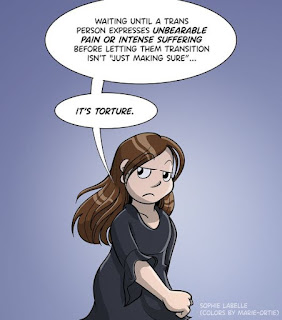
Here's the cartoon which caught my eye*. I hadn't come across any of Labelle's work before. I did not recognise the character depicted (it turns out to be one of Labelle's main characters, a young trans-girl called Stephie).

As of today, 15th January 2022, this cartoon has had over 6,700 likes, 172 comments, and 1,700 shares, although these numbers seem to be par for the course for Labelle's cartoons on Facebook.

But what troubled me about it was the implication that that doctors are deliberately obstructive to trans people; deliberately causing them to experience "unbearable pain or intense suffering"; and deliberately inflicting "torture" upon them. This view struck me as unfair and I wanted to explore it further.

Being both a trans person myself, and a doctor, I'm aware of the tension that exists between the two groups. I'm aware (of course) of the frustration that exists from trans people who cannot get doctors to listen to them, believe them, or treat them. And I'm aware (of course) of the antics which some trans people sometimes resort to, such as lying or manipulation, to try to get their way. Others resort to hormones they buy online, or travel overseas to get surgery.

And I want to explain why I think "gatekeeper" is very much the wrong metaphor for what doctors are doing.

There is definitely a problem

Before I go further, I want to state that there is definitely a problem in the medical treatment of transgender people. I am, in my professional and online lives, trying to help to put it right, and I have discussed this matter before on this blog, for example here.

I wrote a long comment on Labelle's page, attempting to explain a more balanced view. She deleted it, and posted this:
Labelle: got a few truscums who wrote 10 pages long comments on how gatekeeping is essential to be truly trans, I got to delete their comments before anyone saw them, as a morning treat! I hope they didn't save their essays anywhere and they're lost forever.
I had no idea what a truscum is, although it's obviously intended to be an insult. You can find a discussion of its meaning here on Wikipedia. From what I have read, that description doesn't apply to me.

This exchange was not the most heartening opening to a discussion I've ever had. I contacted Sophie Labelle again for her comments, and she blocked me. But I nonetheless thought it was worth exploring the two aspects of it: why do (some) trans people feel that they are being tortured by doctors, and what could actually be going on from the doctors' point of view? And, most pertinently, can anything be done to fix it?

Why is it so hard to get good transgender medical care?

I want to begin this section by pointing out that I believe most doctors genuinely want to help transgender people, and that good gender treatment is fully in accordance with good medical practice. But there are several obstacles to achieving this, some larger than others.

Road ahead closed
First, most doctors have very little or no training in gender treatment. That means that few doctors have personal experience to draw upon. In addition, guidance from professional bodies is extremely sparse. When I was a medical student, in the last century, gender identity problems were not taught at all, though we did learn about intersex conditions in paediatrics. In endocrinology, we learned about people with hormone disorders: too much of this, or too little of that, and how to help, but none of this was in the context of people who want hormones to help with their gender.

Second, many (but not all) doctors are commonly faced with patients asking for (even demanding) treatments which could be potentially harmful. Strong painkillers are a great example, and I've seen patients who have resorted to ingenious methods to circumvent the system to obtain them. We've all been bitten, sometimes very hard, by such patients, and therefore many of us are understandably suspicious of people who don't seem genuine.

Put another way, if you are lying to your doctor, there is a very good chance that your doctor knows or suspects that, and this is likely to erode their sympathy and work against getting their cooperation. There is often a distrustful undertone to the relationship between the doctor and the transgender patient, where neither of them feels that the other is being completely open or completely helpful. The whole purpose of this post is to try to improve that situation.

Third, there is a very good rule of medicine: first, do no harm. This advice is so old and venerable that people think it was written by Hippocrates. (It wasn’t). But the meaning of the statement is clear: before you give a treatment you hope will help, you need to really make sure it isn’t going to make things worse. It encapsulates a theme of being cautious in the practice of medicine, which in general is a good thing (I believe). And its core is the patient’s wellbeing, which is paramount. If you are asking for a treatment which your doctor thinks may harm you, they are very unlikely to comply.
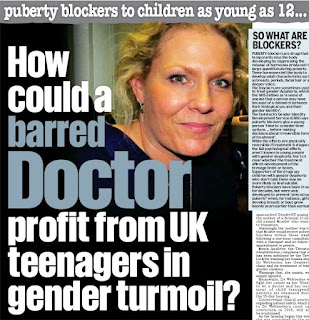
No doctor wants headlines like this.
Fourth, there is little good science in the field of gender treatment. What good science there is is drowned amid flag-waving, virtue-signalling, politics and wishful thinking. See my post here for a detailed discussion of these issues. This is especially true for gender treatment in children.

Fifth, those few doctors who have courageously taken on the treatment of transgender people sometimes run into serious professional trouble, threatening their career or livelihood.
Dr Helen Webberley (whom I interviewed here) has been treating thousands of transgender patients (including children) for some years, but has got into some serious hot water with medical authorities in the UK. (As I write, Webberley is still under suspension from practising as a doctor, and her tribunal is ongoing).

This sort of thing acts as a powerful disincentive to doctors to advocate for transgender people or treat them. Those doctors who are interested in training in gender issues will be looking at Webberley's case, and some will decide that the risk of getting into trouble is just too great. 

All of these things make it very difficult for doctors to effectively treat transgender patients.

The fictional case of "Bob"

I've created this fictional scenario to illustrate how an ordinary family doctor, without any training in gender treatments, might approach a consultation with a late-transitioning person. I'm not trying to suggest every transgender patient presents like this. I'm not trying to suggest every doctor would feel the same (and in particular, I would not). But hopefully this scenario will illustrate some potential ways of medical thinking.

Imagine you are that ordinary family doctor, and a patient comes to see you. You have known Bob and his family for 10 years. He is 52. He likes golf and fishing. He was a bank manager until last year, when he lost his job. Since then he has put on a lot of weight and begun to drink more heavily.

Bob tells you he is transgender. He is actually a woman inside, something he has felt for his whole life, but kept hidden from everyone, including his wife. He has been cross-dressing in secret for many years. But now he feels he cannot remain hidden any more, and wants to transition. He wants hormones. He wants surgery. He wants a legal name change.
Burdened: Bob
How do you react? You’ve been Bob’s doctor for years, but he has never mentioned this before. Nothing about him seems remotely feminine.

From one perspective, the story is true. Bobbie could have kept her feelings and behaviour hidden successfully for years, but could carry the burden no longer. This is her chance to be true to herself; to finally become a woman. You look up the referral pathway to the nearest gender clinic, which has a waiting list of two years. Bobbie says she can’t wait that long and wants to travel to Thailand for surgery. She asks you to prescribe female hormones for her, but you are not familiar with these treatments, their doses, or their side-effects. You really want to help Bobbie, and you tell her you will try talking to some colleagues for advice, and you will do what you can, but from Bobbie’s perspective, what you are offering is not enough, and far too slow.

Are you acting as a “gatekeeper” here? I argue not, though Bobbie might feel that you are. Who is right?

From another perspective, Bob’s story doesn’t ring true for you. Bob has always looked and acted like a man’s man: coaching the football team, golf, fishing, powerful cars. Losing his job hit him really hard. He is probably clinically depressed. He is certainly drinking too much, and you suspect his marriage is in trouble. He certainly isn’t the first middle-class, middle-aged guy who has had an unexpected mid-life crisis, even if most of them buy a motorbike or get a tattoo. You think that it would be better for Bob to sort himself out: cut down the drinking, get another job, lose a bit of weight, take more care of himself. You offer him antidepressants and recommend exercise. You tell him that if he still feels the same once those other things are sorted out, you will help him with his request to change sex, but you think in a year or so Bob’s feelings could well have changed and he might feel very differently.

Are you acting as a “gatekeeper” here? Maybe yes (Bob would certainly think so), but are you a bad doctor for doing so? For listening to your patient, making the very best, compassionate, objective assessment of what you think is really wrong, and trying to put it right? I would certainly argue no.

Aye, there's the rub!

And that's where the scissor-point is. Bob's story is fictional, of course, but there is enough truth to it that many elements are recognisable. A doctor, with either perspective of dealing with Bob, is practising good medicine. They are not being a bastard. They are not being cruel. They are not, in any way, deliberately attempting to hurt Bob or cause him distress. They are not torturing Bob! And they are not acting from a perspective that "gatekeeping is essential to be truly trans".
No way, sucka!
The image of the doctor as gatekeeper requires that there is this wondrous place, filled with bountiful hormones and surgery and unlimited gender treatments, but there's a huge steel door, and like a big mean bouncer, your doctor is looking you up and down and saying in a gravelly voice: Yer name's not down, yer not coming in.

But no such bounty exists! From a doctor's perspective, the official pathways are swamped and waiting lists are long. Some transgender people have other issues: depression, drug and alcohol use, self-harm, which can complicate the picture. (If you treat Bob’s depression, will his desire to transition go away?) Some transgender people point to gender as their one biggest problem, and play down other concerns, even though they seem important from the doctor's viewpoint. Some transgender people seem to have unrealistic expectations of how rosy their lives will be after treatment, even though this isn’t necessarily what happens. And some people change their minds about what’s best for them, as their lives unfold.

I'm not saying that trans people who are trying to get treatment are not suffering. I am not trying to suggest they should just suck it up and forget the whole thing. Instead I am trying to point out that what doctors do is not deliberate cruelty. The situation involving children is even more fraught. Gender services for children are even fewer than for adults, and a child who is growing rapidly creates even more pressure in an already pressured situation.

So what's the solution?

The solutions are clear, but none of them is easy. First we need good science to inform medical practice. That, in itself, is difficult, slow and expensive. As I've written here, if your science produces conclusions which some transgender people find unpalatable, you are likely to face powerful negative repercussions. That in turn provides powerful disincentives to scholars to pursue the science around transgenderism.

Second, we need better training for doctors in the treatment of gender conditions. The good news is that there is some evidence that this is starting to happen, although obviously it will take a while to work through the system.

Third, we need clear professional guidance from professional bodies to existing doctors, about treatment regimes, referral pathways, and so on. Again, this is happening, with organisations such as WPATH setting out standards of care (currently brewing up their 8th edition) for transgender people worldwide.

Fourth, we need better investment and funding for those systems which currently exist, to match the increasing demand for their services, cut waiting lists, and improve access to treatment. For these outcomes, you need to lobby your politicians, not your doctors.

Meanwhile, transgender people, and the doctors looking after them, will struggle to make anything successful happen with what already exists out there.

How can I get the best out of my doctor?

The first thing to say is that doctors are people, which means there are some who are brilliant, some who are dreadful (sadly I've met some of them), and most of the rest are perfectly OK in the middle somewhere. Most of us went into medicine because we actually want to help people, after all. We are also aware that the power-balance in the doctor-patient relationship very much favours the doctor. While medical paternalism is still (unfortunately) a thing, the old notion that "doctor knows best" is obsolete, and practised only by a few, aging doctors.

But if you understand how your doctor is thinking, it is likely to result in a better outcome all round. You will be able to reassure them and defuse some of their reluctance. You will be able to put forward your goals in a way which seem to be in accordance with good medical practice, not against it.

It doesn't have to be a conflict.
If you happen to run into a dreadful doctor, get another doctor! If your doctor is uncaring, brusque, unsympathetic, or otherwise unsuitable, vote with your feet. Change to another doctor in the practice, or change to another practice entirely. There is likely to be a social media page for trans people in your area. Ask around for recommendations about a supportive doctor near you.

If your doctor seems willing to help, but unsure what to do, point them to the WPATH website, which is positively bursting with resources to help: medical guidance, standards of care, a comprehensive reading list, a search facility for colleagues and experts around the world. If they really want to talk to an actual transgender doctor, I'm happy for them to contact me by email.

Try to work with your doctor, not against them. Try not to take it as a personal attack if they don't fall over themselves to do whatever you ask. It's fine to negotiate, with statements like "I know that if I start with the higher dose, I might have more side-effects, but I'm willing to accept that risk for myself, and I will cut down the dose if I start to run into problems". Most doctors will respond very well to this approach, and many doctors like it if you've done your homework first: "I know I will have to keep an eye on my blood pressure and my blood sugar too, but I've been losing weight and keeping fit".

Plain honesty is likely to work very positively. "Look, I know it wasn't very smart, but I'm desperate, and I've been taking these hormones I got from the Internet. I brought you the box so you can take a look at them. They don't seem to be working very well. I really want to be on something safer and more effective".

Manipulation, lies ("Oh no, doctor, I would never take anything that I bought online") and subtle threats ("If you don't prescribe these for me, I'm going to start getting them online anyway, so you might as well") are likely to make things very rocky.

The hardest part (understandably) is to be patient with your doctor if they seem too slow. You may well be that doctor's first ever transgender patient. Your interaction with them will likely colour all future interactions with trans patients. Most doctors (as I've said before) will be willing to work together with you toward you meeting your goals, which will be rewarding for you both, and will likely make things easier for the next trans person that doctor has to treat.

The situation is changing. I know it's too slow for many people, but it's going to be better. Meanwhile, let's all try to understand one another a little better.

===

* I believe that my sharing of this image on this page consitutes Fair Use. The original cartoon was published on a public forum (Facebook), where it has been viewed many thousands of times. I have not changed or altered the image in any way. I have attributed the artist, and added links to her Facebook stream, her website, and her Wikipedia page. I have not attacked the artist or the image, but used it to illustrate a discussion point which is very strongly in the interests of the trans community--in other words, my use is in alignment with the implied original purpose of the image. I do not earn money or other reward for this blog. The image has already been shared over 1800 times without apparent objection from the artist, which indicates implied permission for its being shared online.

Wednesday, 4 September 2013

Transgender superheroes

If you haven't read the original novel Watchmen, which planet have you been living on? It's one of the finest pieces of fiction I've ever read. But don't take my word for it: it made it to Time magazine's 100 greatest novels list. Not graphic novels. Novels.

Did the costumes make it good?
There is a powerful scene where Laurie Juspeczyk and Dan Dreiberg (both costumed heroes) attempt to make love in Dan's apartment, but Dan is unable to perform. They go down to the basement, where they don their costumes and take Dan's "owlship" out for a flight. As it happens, they end up rescuing some people from a building on fire. Afterwards, with the owlship hovering over the city, they make love again in the owlship, with the illustrated result. That's supposed to be a flamethrower, by the way.

A presumably somewhat breathless Laurie remarks: "Did the costumes make it good? Dan...?"

Wow! Where to begin with this? Watchmen has been described as the moment comics came of age, and this is the sort of thing which reminds people of that. The main plot involves a villain, and a group of costumed heroes in pursuit. But that's where the novel departs from the cliches. It tackles head-on the ideas we have all had about costumed crimefighters: doesn't it make you feel silly? What happens when you get old? What happens if the public turns against you? What makes someone want to put on a costume and fight bad guys? This scene is one which hints at the notion that it's sometimes about the costume, though there are other parts of the book which give different interpretations.

Princess Koriand'r
The subtlety and sophistication of the story is just dazzling. Among many brilliant aspects of it is the utter abandonment of moral certainty. In the old days, the good guys were good, and the bad guys were bad. End of. Why were the bad guys bad? Who cares? They were just there to give the good guys something to do. Watchmen shows us good guys which are not quite as good as we might wish; and bad guys... well, you'll just have to read it. Incidentally, the film is also excellent, being as it is basically a love-letter to the book (though the dialogue in the owlship scene is different).

As someone who is very interested in the power of costumes (and was really into comics for a while there), I can't help drawing a parallel between costumed heroes and crossdressing. Crossdressing makes me feel different on a fundamental level. It allows me access to a range of emotional expression which is usually denied me. I have discussed elsewhere that perhaps costume, the temporary assumption of some other identity, is powerfully alluring all of its own, even aside from crossdressing.

Superheroes (at least as they are drawn in comics) are inherently profoundly sexist. Comics basically exist to provide eye candy for nerdy geeks (like me). Comics can illustrate anything; special effects are no object. There is a tendency to depict both male and female heroes as athletes at the pinnacle of human achievement (for the purposes of this discussion, let's stick to human beings!). Nonetheless, where male heroes tend to wear whole-body costumes (think of Batman, Spiderman, Superman), female heroes tend to wear next to nothing, and be displayed in alluring poses. One of my favourites (though there is no shortage of other examples) was for a while Princess Koriand'r, shown here. Maybe it was the green eyes.

So the women are all drawn, more or less, the same: beautiful, incredibly buxom and curvaceous, with long flowing hair (impractical though this may be when fighting crime), and with some sort of revealing, bikini-like costume (where do you keep your gadgets? Your keys?), and in poses which accentuate the inherent sexuality of their costumes.
Batgirl, issue 19.

Male heroes, on the other hand, are ridiculously well-muscled. Square of jaw, steely of gaze, tousled of hair. There isn't a hint, from any of them, that they are anything less than uber-masculine. The occasional slim wiry one may be allowed, rather than the brute. For an amusing take on the sexism inherent in comic illustration, I refer you to The Hawkeye Initiative, where artists, some professional, and some amateur, redraw published comic illustrations of female heroes with a male figure, Hawkeye, in the same pose. There's even a dude out there taking photos of himself, with the same intent.

So where are the transgender superheroes? The answer is: it's pretty hard to find any. Quite understandably, they don't really belong, in a universe of such powerful male or female archetypes. And in addition, open depictions of homosexuality, bisexuality and transgenderism were overtly banned in the USA (which means the world, in comic book terms), until 1989. And yet, among comic-reading audiences, there is a powerful mix of people of all stripes, and since 1989 there has been a bit of catching up to do for comic book writers, incorporating LGBT characters into their storylines. Some well-known characters have been updated to incorporate same-sex relationships; for example, Batwoman is now depicted as a lesbian.

But don't get mixed up between Batwoman and Batgirl. Batgirl, whose mild-mannered alter-ego is Barbara Gordon, daughter of Commissioner James Gordon. It's here we find the first mainstream transgender comic character, Batgirl's flatmate, Alysia Yeoh. What's the background to Alysia? No idea. From the little I have read, she seems to be a full-time male-to-female character, but beyond that, there seems to be nothing solid. She seems also to have no super powers, but of course, they are only a zap with some novel kind of radiation away. The character has only existed for a few months, and it remains to be seen how she will develop. Will she end up looking like Princess Koriand'r? Or perhaps like The Thing? It's impossible to tell.
Maidman

Let me say now that I welcome this development. It's an acknowledgement that trans people exist, even in the uber-sexist world of comics. For them to be accepted openly (as Batgirl does), is a powerful statement of welcome. Alysia weeps at Batgirl's immediate acceptance of her.

But how about transgender superheroes? The character of Maidman can be found in the pages of Empowered, a comic-book series which has been going since 2007, authored by Adam Warren. Part of the theme of Empowered is to deconstruct comic book stereotypes in a humorous manner, so Maidman, a costumed hero whose superpowered costume is a French Maid outfit, is deliberately poking in the eye of the traditional costumed hero:
Maidman: I'd be far more embarrassed to dress up like, say, an animal. Now that would be silly. Face it. The hundreds of would-be badass capes who practice species crossdressing as various theoretically intimidating animals? That's one step removed from being a furry. Talk about embarrassing.
Maidman is depicted as clearly a man (including his blue chin and muscly physique) but wearing a ridiculous frilly maid outfit, and carrying a feather duster and broom (which are of course supergadgets in their own right). Check out those shaved legs and combat stilettoes. Does Maidman count as a transgender superhero? I don't think so. Although in the Empowered universe, Maidman is depicted as a powerful hero, whom the bad guys clearly fear, it is clear in the real universe that Maidman is a caricature, designed to look ridiculous as a means of poking fun at costumed superheroes in general. The pink speech bubbles which he has, suggest that he affects a sexy feminine voice too. Does he poke fun at crossdressers? I personally don't find it in the least offensive, although perhaps you have different views. For me, the point (as expressed eloquently by Maidman himself) is that it's no more weird for a man to dress as a maid to fight crime than it is for him to dress as a bat, or a spider, or any one of a hundred other odd themes.
SheZow!

No, for a real transgender superhero, we need to turn to the world of children's entertainment. I am indebted to Ralph for drawing my attention to this character, the superhero SheZow!

SheZow is a Canadian-Australian co-production, a series of (so far) 26 short cartoon episodes aimed at kids between the ages of 6 and 11. The basic premise of the story is that Guy(!) Hamdon, a typical 12-year old boy, finds a magic ring which turns him into the superhero SheZow. In the universe, the character is well-known, admired and popular. Guy is initially reluctant, but after discovering the supercool car (the "She-hicle"), and the hi-tech underground batcave, with its supercomputer, "Sheila", he comes to embrace the role. Nobody knows his secret identity except his sister and best (male) friend.

SheZow has the hair, the eyeshadow, the costume (thankfully non-revealing, but nonetheless pink and sparkly) and the heels. She also has super-strength, and a light-sabre-like weapon, laser lipstick. She is resolutely pink, girly and uber-feminine. This, I suppose, is one of the essential points of the show: making SheZow as feminine as possible to highlight Guy's discomfort at assuming the role. The show is essentially light-hearted and comic in tone. To drive up the femininity, the dialogue is full of excruciating puns, such as "she-vitalised", "she-riffic", "she-S-P" (SheZow's "spider sense"), and even "she you later!". Guy can assume the identity of SheZow by reciting the magic phrase "You go girl!".

SheZow seems naturally invulnerable. Her kryptonite is her hair: for her hair to become disarrayed leads to loss of her super powers, though they can be restored by the use of "she-lac" hair spray from her utility belt.
SheZow, mighty SheZow!

My two youngest kids are between 6 and 11, and so I sat them down to watch it with me. We watched for over an hour, which was about half a dozen episodes. As a fairly conservative parent myself (believe it or not!), there was nothing in it to trouble me. There is nothing overtly sexual or suggestive. Beyond the basic premise, there is nothing untoward: the good guys are resolutely good, the villains resolutely dastardly, the predicaments humorous, and the outcomes predictably favourable. I enjoyed it very much. A special mention to the actress who voices the computer Sheila, in a very sexy, British accent. Hell-low!

I think from the point of view of a child, it’s no more bizarre than any other superhero cartoon. In many ways, it echoes other fiction I have come across. The novel Boy2Girl, by Terence Blacker, and the comic strip Cuckoo in the Nest (from an obsolete girls’ comic) both explore the situation of a boy, reluctantly compelled by circumstance to adopt the role of a girl, who is initially unwilling but ultimately finds unexpected advantages or insights in doing so. Both of those are aimed at children (and are explored more here on my blog). SheZow is very faithful to that trope.

So then, is it good? Does it do our sons good to consider aspects of femininity to be positive? I suppose so, although I don’t really think it does any better than She-Ra (or my personal favourites, Jana of the Jungle, and Cheetara). Girls can be superheroes too, but I’ve known this since childhood anyway. Does it give confidence or esteem to girls? I don’t really think so. Does it make children more trans-friendly? I guess so, though one cartoon will not be enough to overcome their own upbringing, whether hostile or accepting.

Does it do harm? I can’t honestly see how. If it’s OK for kids to watch Batman punch the villain’s lights out, then it surely should be OK to watch a boy putting on a magic ring and becoming a girl. Is it going to make our sons grow up gay, or camp, or effeminate? Gracious me, no!

What did my kids think of it? My youngest son watched it with interest, although he hasn't been bothered about it since. My youngest daughter enjoyed it more, and has since spoken about it, and asked to see more of it. I asked her: How do you like the show? "It's cool". Is it OK for girls to be superheroes? "Yes." Is it OK for a boy to be a girl superhero? She paused: "I don't know". I get the impression that, from her point of view, SheZow is just a cool girl. The fact that SheZow is a boy seems to be incidental.

However, almost inevitably, the show has attracted criticism from the usual suspects, people who are convinced this show will institute moral collapse on a national, perhaps global, scale. I suspect (as is usual in these sorts of instances), just about everyone who protests hasn't even sat down and watched the show.

So, for a fairly thorough trawl through the potential places to find transgender superheroes, we come up pretty short. SheZow gets the prize: cool, powerful, and unavoidably transgendered. But surely we can do better? Surely trans people can be powerful and cool too?

Addendum: 18th October 2013

I came across this article from journalist Kasey Edwards, discussing SheZow. The article is interesting and provocative, written as it is by a woman, and a mother. Overall, Edwards seems to basically agree with my angle.

My thanks also to Grok, for drawing my attention to Captain Cross-Dresser, an amusing (and sadly one-off) animated short. I wasn't able to follow Grok's link, but I was able to find the whole ten minutes on YouTube, split up into three parts. It has some very clever and amusing points to make, although (unlike SheZow) I wouldn't try showing it to young kids. I quote:
This is just what our city needs: a superhero for the 21st century!
 Addendum: 2nd October 2015

I came across this excellent article by Cindi May in Scientific American. Entitled The Problem With Female Superheroes, it points out that female superheroes have gone "from helpless damsel to powerful heroine, but [are] still hypersexualised". Well worth a read.

Monday, 7 November 2011

School Days

As a child, I read voraciously. Naturally, I read girls' stories and comics as well as boys' ones. I was astonished to come across a story serial called Cuckoo in the Nest, in the girls' comic Tammy. In this serial, a boy is forced by his wide-boy uncle Fred to enrol at the prestigious Nesterfield Girls' School (known as "the Nest"). If he succeeds in passing as a girl, he will inherit a large bequest from his great aunt Hermione, who expects to visit her "niece" in the school at the end of term.

As a boy, I recognised that there was something very powerful about this story. The protagonist, Leslie, is naturally unwilling to begin with. He is embarrassed and angry, and struggles with his complete unfamiliarity with being a girl: how to dress, how to talk, how to behave. Naturally the school is a traditional English public school complete with all sorts of rules, and a very strict headmistress. However, after a while he begins to prosper, after a fashion.

Worth a read: Boy2Girl
I can find very little on the Internet about this obscure story from a comic book which went out of business years ago. However, there is an interesting critique here at Booksmonthly. On the face of it, the story is a comedy. (Though crossdressing and drag are often used as a vehicle for comedy, I just don't find crossdressing funny in itself). On a more intellectual level (which I totally missed as a child), there is a positive message about feminism: Leslie manages to shake up the school and its old-fashioned ways, and introduce some more modern ideas to the girls.

It's been thirty years since I read this story, yet I still remember it very clearly. Obviously what set it apart for me was its central theme of crossdressing; not merely crossdressing but forced crossdressing, with the spicy thrill of the consequences of discovery. As a child I was simultaneously appalled and enthralled by what might happen if Leslie were ever outed. (Unfortunately I don't ever remember reading a denouement to the story, so I never found out if he made it to the end of term safely!). I frequently thought about what I would do in his circumstances.

More recently, Terence Blacker wrote a novel called Boy2Girl. As you can tell by its textish title, this book is much more modern than Cuckoo in the Nest. However, some of its underlying principles are similar. Sam, a prepubescent 13 year old American boy (who conveniently has long blond hair) is enrolled as a girl at a London school by way of a dare. The book touches on many aspects of the emotional turbulence of adolescence, and allows both boys and girls a glimpse of what the "other side" is feeling. The underlying theme of the book appears to be that Sam gets on better as a girl: he is able to express his emotions more freely (including crying), and becomes popular at school (having never been so as a boy). The book also treats cross-gender behaviour with sympathy rather than ridicule.


Schoolgirls: archetypal
I find myself wondering what it is about schoolgirls which is attractive to crossdressers. I suspect that it's because so many of us become aware of our crossdressing feelings in school, and find those feelings mixed up amid crushes and enfatuations and powerful sexual awakenings. "We covet what we see every day". Like the maid, the bride, the nurse, and other female archetypes, the schoolgirl (with her irresistable mixture of innocence and powerful sexuality) is something some crossdressers aspire to.

Naturally girls themselves play on that same theme: an unforgettable example is Britney Spears's ...Baby One More Time video. This girl here is also having fun with the stereotype: you're not going to tell me that's her real school uniform!

The other fiction I read as a child (and adored) was the Famous Five series, by Enid Blyton. The Famous Five were Julian, Anne, Dick, Timmy the dog, and George. Except, of course, George was a girl whose real name was Georgina, and she liked to dress as a boy and wear her hair short, and she adopted boyish mannerisms and characteristics. It seemed perfectly acceptable, even laudable, for George to behave in this manner, and adults were often very indulging. (There is a school of thought that Blyton based the character of George on herself; certainly it seems pretty likely that she wasn't the warm cheery children's storyteller that we all expect her to be). I seem to remember identifying most with Anne, who was the most feminine of the group, although I also identified with Julian, who was always a sensible leader. But gender roles aside, I thought it was wonderful how free the children seemed from adult interference when they had their adventures.
Forced: Cuckoo in the Nest

How would it have been if Julian had insisted on dressing as a girl, and calling himself Julia? Why should that be any different? And yet it clearly is. I am certain that Blyton would never have dreamed of such a character back then, and even today it would be hard to pull off (both the authors of Cuckoo in the Nest and Boy2Girl seem to take pains to highlight the irrepressible boyish tendencies of both their lead characters. Enjoy it? Gosh no! They are forced to crossdress by circumstances, but they don't want to do it, let alone take any pleasure in it. How could you think otherwise?)

While tomboy carries certain positive connotations, its opposite, sissy, has none (I am not referring to sissy in its fetishistic sense here). And this is something I realised very early in life. It's fine, even praiseworthy, for girls to adopt certain aspects of male behaviour, but it still isn't fine for boys to adopt any aspects of female behaviour.

From a very early age I was schooled both implicitly and explicitly that boys were expected to behave in certain ways. That pattern of behaviour was considered so meritorious that even girls who chose to emulate it were praised. It was not considered acceptable for boys to behave in any remotely girly way. As a boy I recognised that I was very unlike other boys in lots of ways (and indeed as a man I am quite far removed from the "typical" man). Finding I had to suppress my feminine side caused me tremendous unhappiness, and those occasions when it unavoidably escaped caused me great stress and guilt, a guilt which still persists (and may be part of the reason for this blog).

So it is not really a surprise that Cuckoo in the Nest stays in my memory. There was a boy who was not only able to express his femininity, he was required to. A lucky boy indeed.

Further Reading

Georgia at BroadBlogs has a couple of relevant posts here and here and even here, which touch on these themes. In essence, her point of view (and I agree) is that gender ranking makes male attributes more desirable than female ones.