Pages

Showing posts with label fiction. Show all posts

Saturday, 1 June 2024

JK Rowling - Part Two

You know that thing, when you have something you're in the middle of, and you keep promising yourself you'll come back to it and finish it off, because it's only been a few weeks? Well, this is exactly how I felt when I came back to the keyboard to write the the second part of my blog article about JK Rowling--except that it's been over a year since the first instalment!

Mind you, this span of time has allowed me to think a little more about some of the issues raised in the previous part of the article. I've also been collecting quotes and snippets from around the web to inform this discussion, and of course, it's clear that JK Rowling hasn't mellowed in her views.

Ironic: Robert Galbraith
Moving on from the last two articles, the next thing which I think is pertinent is the publication of Troubled Blood, the fifth in Rowling's series of crime novels. While the book was published in September 2020, early reviews noted that there was a scene where a serial killer approaches a victim wearing a wig and a woman's coat. The Telegraph reviewer Jake Kerridge couldn't resist commenting on this:

Kerridge: One wonders what critics of Rowling's stance on trans issues will make of a book whose moral seems to be: never trust a man in a dress.

The thing is, the "man in a dress" passage is one paragraph long, in a book of 900 pages. One can hardly call this the moral of the whole novel! Predictably, however, there was a storm of hatred about JK Rowling on Twitter and other social media platforms, from people who could not possibly have read the book, because it hadn't yet been published. Nick Cohen reviewed the novel in the Spectator:

Cohen: The 'evidence' that provoked the malice was so flimsy, even Twitter should have been embarrassed to publish it. (...) No honest person who takes the trouble to read it can see the novel as transphobic. But then honest people are hard to find in a culture war. The men and women pouring out their loathing of Rowling online could not have read the unreleased book: not that their ignorance bothered them in the slightest, as no mob on rampage in history has ever stopped to read a novel. 

Does anyone else find it terribly ironic that JK Rowling is so opposed to trans people, what she considers men pretending to be women, and yet she herself has adopted a male nom de plume, Robert Galbraith, in her crime writing? Agatha Christie never did that!

Where Rowling is wrong

In the previous article, I point out some points that Rowling has made which I believe genuinely have merit. I do have concerns about the role and status of women in our society. I do worry about some people weaponising trans rights in order to further their own toxic agenda. And I'm completely in support of free speech, and open debate.

There's one more point she makes, in Episode 4 of The Witch Trials of JK Rowling:

Rowling: People are terrified, terrified of speaking up. So I really was starting to feel this moral obligation. I knew what was coming, but I thought other people, there are people who probably, if I’m honest, probably could speak and don’t want to speak.

This point resonated with me, and my views after reading Galileo's Middle Finger: that hardly anyone is pursuing good science about trans people, because if they dare to reach a conclusion which the trans activists find unpalatable, they will be mercilessly hounded for it, as Michael Bailey was. Rowling is talking here about women who oppose trans rights, but I think her point is broader: that there are people who are fearful of speaking out because of the consequences of doing so.

Orwellian views: Rowling
But let's start to pull apart where JK Rowling is wrong, because realistically there is plenty. It boils down to this view (quoted from here):

Rowling: I want trans women to be safe. At the same time, I do not want to make natal girls and women less safe. When you throw open the doors of bathrooms and changing rooms to any man who believes or feels he’s a woman – and, as I’ve said, gender confirmation certificates may now be granted without any need for surgery or hormones – then you open the door to any and all men who wish to come inside. That is the simple truth.

So ultimately, Rowling is saying that if you have a penis, even if you are a trans woman, you are at least a potential threat to "natal" girls and women. And this Orwellian tweet, from December 2021, really doubles down on that view.

The thing is, though, this theory doesn't stand up to any scrutiny whatever. If a predatory man really wants to get access to women, there's literally nothing to stop him putting on overalls and carrying a mop, and pretending to be the janitor. He's likely to meet far less resistance than if he puts on a wonky wig and a badly-fitting dress. And if he's really a predator, he's going to attack women in any place they may be vulnerable, such as coming out of the pub late at night.

Professor Judith Butler, a gender studies scholar, makes this point in The New Statesman:

Butler: The feminist who holds such a view presumes that the penis does define the person, and that anyone with a penis would identify as a woman for the purposes of entering such changing rooms and posing a threat to the women inside. It assumes that the penis is the threat, or that any person who has a penis who identifies as a woman is engaging in a base, deceitful, and harmful form of disguise.

Other commentators have rightly pointed out the absurdity of checking people's genitals before they're allowed into a public bathroom. Another issue is that, in many parts of Europe, public swimming-pool changing rooms are not segregated by gender, and in Scandinavia it's normal to enter the sauna naked, for men and women, and has been for decades.

Get your stickers here!
In Ireland, it became the law in 2015 that you could legally change your gender simply by filling in a form: no medical testing or declaration from your doctor is required. How many attacks on women have there been in Ireland, since 2015, by transwomen? None--that I could find. There are a few transwomen in prison in Ireland, and there is one individual in Scotland who raped two women prior to transitioning and was convicted in 2023 (causing the government to halt plans to allow legal gender transition in a similar way to Ireland). (And how many women have been jailed for sexual assault during this time?)

What that means, in my view, is that Rowling is purporting to be concerned about women, but is using this concern to mask her prejudices. The data simply do not bear out her concerns.

So how do we handle all this?

So what are we to do? Those of us who love the stories of Harry Potter, who admire the literary achievements of JK Rowling, and her philanthropic work, but can't agree with her views on trans women? I admit, it's really hard! Is it possible to both like Harry Potter and disagree with JK Rowling?

I think there's a genuine disconnect between the message that JK Rowling seems to have put into her books--

Rowling: The amazing thing about the Wizarding World is, you walk through that wall in Diagon Alley. And while human nature remains the same--and that’s something that I was setting out to depict, human nature remains the same--if you can do magic, the ludicrous things that we discriminate about in the Muggle world really are utterly immaterial.

--and Rowling's deep-seated anti-trans views:

Rowling: I’m constantly told I don’t understand my own books. I’m constantly told that I have betrayed my own books. My position is that I am--absolutely I am--holding the positions that I took in Potter. My position is that this [trans] activist’s movement, in the form that it’s currently taking echoes the very thing that I was warning against in Harry Potter.

Again it must be really difficult for Rowling: she's created this beautiful thing, that so many people value so highly, and yet now she has a viewpoint which is at odds with it--or at least, with nearly everyone else's view of it-- and she's trying to double down to say that trans activism equates with the forces of evil in Harry Potter. How many trans children have read the books, and imagined what they would see if they looked into the magic Mirror of Erised?

What the Mirror of Erised shows
I would argue that, of course it's possible to enjoy Harry Potter while disagreeing with JK Rowling's views on trans people. I further argue that debates (especially ones on the internet) easily become too polarised: you're either fully in support of JK Rowling, or you are sending her death threats, no middle ground. The truth, of course, is that we're all capable of being more nuanced than that, and that is the central message of my article. Even Rowling herself is capable of nuance:

Rowling: I believe the majority of trans-identified people not only pose zero threat to others, but are vulnerable for all the reasons I’ve outlined. Trans people need and deserve protection. Like women, they’re most likely to be killed by sexual partners. Trans women who work in the sex industry, particularly trans women of colour, are at particular risk. Like every other domestic abuse and sexual assault survivor I know, I feel nothing but empathy and solidarity with trans women who’ve been abused by men.

Is JK OK?

I actually think JK Rowling is hurting. She was once the powerless victim of an abusive husband. Now she has become enormously powerful and influential in her own right. She's used her status to make a point, no doubt well-meaning, in defence of women, and it has blown up in her face, resulting in painful backlashes, not just from the radical trans activists on the internet, but from her beloved fans, the actors who were in her movies, and other writers. It must be very difficult to face up to that hatred, when you were only trying to help, and it must really hurt.

Now, of course, she's dug herself in. She can't back out now. And why should she (she may ask herself)? She's JK Rowling! She's far bigger and more important than these losers on the internet! And by engaging with the haters, and by digging herself in deeper, she has got herself into a position she cannot possibly win, and cannot get out of. And people who are hurting lash out, and say hurtful things, which is what she's doing. I envy her enormous success in the literary world, but I do not envy the position she is in. You cannot fight hatred with hatred.

Is there a way to fix this? The most obvious way would be for JK Rowling to back down, to recant some of her views. From everything I've read (and it's been a lot) about this topic, I do not believe she can, or will. In her most recent article, published only a few days ago in the Independent, she says that loved ones "begged" her to keep her views on trans women to herself. It's likely they predicted exactly the shit-storm that she now finds herself in.

The next-best way would be for JK Rowling to do two things: first, stop making statements about trans women completely (let things settle down), and second, stop engaging with social media platforms. Rowling is wealthy and privileged enough that she can absolutely afford to isolate herself completely from social media, and surround herself with people who love her. I think, for her own emotional health, that's what she should do. That daily barrage of internet hatred is just too corrosive; the trolls too hungry to not be fed.

But I think she won't do either of those things. She has come to see herself as a champion of oppressed women, a defender of voiceless and downtrodden victims. As long as she casts herself in this role, she won't step back without feeling she's abandoning her needy followers, however imaginary their number may be.

Trans students at Hogwarts?

Not quite real: Sirona Ryan
The immersive computer game Hogwarts Legacy, released in 2023, features the Harry Potter franchise's first openly transgender character, Sirona Ryan, voiced by trans actress Rebecca Root. Apparently this character was introduced without any input from JK Rowling, though it's not clear if she actually objected. I was disappointed that the reviews were affected (according to the Wikipedia article) by perceptions of JK Rowling's views, even though she plainly had basically nothing to do with the creation of the video game.

Sirona Ryan isn't a student at Hogwarts (we haven't come that far) but a character that the player can encounter in the game.

There are so many ironies here. JK Rowling was once poor, powerless and unhappy. Now she is wealthy, powerful--and still unhappy. She wrote a series of books about inclusion and acceptance and discovering your true self--and then goes on to upset many of her fans by denying that acceptance to trans women. A trans character has been put into a Harry Potter game without her involvement. She protests about people she considers men posing as women, yet has adopted a male pseudonym for her crime writing.

But the final irony comes from Rowling herself, in Episode 2 of The Witch Trials, where she talks about certainty (my italics for emphasis):

Rowling: There’s a huge appeal--and I try to show this in the Potter books--to black and white thinking. It’s the easiest place to be, and in many ways is the safest place to be. If you take an all-or-nothing position on anything, you will definitely find comrades. You will easily find a community, I’ve sworn allegiance to this one simple idea.

What I tried to show in the Potter books--and what I feel very strongly myself--we should mistrust ourselves most when we are certain. And we should question ourselves most when we receive a rush of adrenaline by doing or saying something. Many people mistake that rush of adrenaline for the voice of conscience. “I’ve got a rush from saying that, I’m right.”

In my worldview, conscience speaks in a very small and inconvenient voice, and it’s normally saying to you “think again, look more deeply, consider this.”

I wonder if JK Rowling could take a look in the mirror, and reflect on those words. No magic would be required.

While writing this, I've come across quite a lot more of JK's statements on trans people, and I'm certain they're going to be cropping up in future posts!

Sunday, 9 April 2023

JK Rowling - Part One

The controversy around J.K. Rowling and her comments about the trans community is continuing to rumble on. There are passionate people on both sides, and the issue is not going away. The Independent writes that "The situation has now become a toxic brew of prejudice, misinformation and tragedy. How has it come to this?" It's finally time for me to take a proper look at the whole business. And, as I've often discovered when writing about a complex subject, there just isn't room in one article to put it all in, so I've decided to split this one into two parts.

The background

First, it's well worthwhile starting at the beginning. J.K. Rowling was (basically) a penniless single mother when she wrote Harry Potter and the Philosopher's Stone. The book and its many sequels have gone on to be stratospherically successful, making her the most popular author ever. Along with this success, there have been several very positive externalities. Her books became popular with children, which encouraged them to read--many kids (including sadly, one of mine) will only read stuff on a screen, not on a page. Along with this welcome boost in literacy, the translations of the books into other languages (you can even get the first one in Latin) has improved linguistic skill too.

Joanne Rowling, the artist known as JK
Second, the popularity of Harry Potter affected the publishing industry too. The manuscript for Harry Potter and the Philosopher's Stone was rejected by twelve publishers (I bet they're all sorry!), before being picked up by Bloomsbury, who were, at the time, a very small publishing company. The success of Harry Potter has made Bloomsbury one of the largest publishing companies in the world. And many other authors, such as Philip Pullman, have experienced a welcome boost in their reading figures, as the newly-invigorated reading public started looking for other books while they were waiting for the next Harry Potter book. It's no exaggeration to say that Harry Potter has changed the face of publishing.

Third, adults have got in on the books too. They even started to print Harry Potter books with more "adult" covers, so that adults reading them in public places wouldn't be embarrassed by being seen reading what was ostensibly a children's book. I have devoured all seven of the Harry Potter books, and loved reading every page, and plainly I'm not alone.

Fourth, while Rowling has earned a huge fortune, she has also given away literally millions, to all sorts of charities and good causes. So her career as a philanthropist is not to be sneezed at either. And she's more than a little bit gorgeous, if I may say so. And I know two people who have interacted with her for a decent period of time and said she was thoroughly lovely in person.

Rowling and Gender

Rowling's first (publicised) encounter with gender was the name on the cover of her books. Bloomsbury decided that her books would be most popular among boys, and it was felt that they would be less likely to read a book if they thought it was written by a woman. Therefore, she was asked to put her initials on instead, to conceal her gender. Unfortunately, Rowling has no legal middle initial, so she chose the initial K from her paternal grandmother Kathleen, and the name J.K. Rowling was born.

...and stand well back.
But the big problem began on June 6th, 2020, when Rowling read an article on Devex which spoke about "people who menstruate", and took to Twitter with her response.

She's clearly using (clumsy) humour to drive home her point. This tweet was the blue touchpaper which led to the massive explosion of anger from (it seems) almost every quarter; not least many of her loyal fans, who had found great resonance in the story of Harry Potter, a lonely, unloved outcast boy who finds his true identity and place in the world. At that point, Rowling doubled down, again in a series of tweets:

Rowling: If sex isn’t real, there’s no same-sex attraction. If sex isn’t real, the lived reality of women globally is erased. I know and love trans people, but erasing the concept of sex removes the ability of many to meaningfully discuss their lives. It isn’t hate to speak the truth.

The idea that women like me, who’ve been empathetic to trans people for decades, feeling kinship because they’re vulnerable in the same way as women—i.e., to male violence—‘hate’ trans people because they think sex is real and has lived consequences—is a nonsense.

I respect every trans person’s right to live any way that feels authentic and comfortable to them. I’d march with you if you were discriminated against on the basis of being trans. At the same time, my life has been shaped by being female. I do not believe it’s hateful to say so.

Putting it in a nutshell: Rubin
I'm interested by the statement "I know and love trans people". This statement sounds a bit like the vague "some of my best friends" statement that people make when they are unsuccessfully trying to pretend they're not prejudiced against another group of people.

Since then many prominent people, including many actors from the Harry Potter films, and several large fan groups, have made statements either in opposition to Rowling's position, or in support of trans people. These are people who owe their own success and fame (and wealth) to Rowling's work, so for them to come out so publicly in opposition to her views is not trivial.

I don't need to spell out all the ructions blow by blow. There's a lot of detail on the Wikipedia page, and also excellent summary articles on Glamour.com and The Scotsman which go into much more depth.

"I don't believe it's hateful to say so"

While all this was unfolding, I wasn't too troubled. I admit, as a fan of both her stories and the woman herself, I was disappointed to hear her make these statements, but I wasn't angry or hurt. It's worth picking them apart a little. First, what she was saying was clinging to the old idea that biological sex denotes gender and that this situation is immutable. Some of the tweets she received, as quoted in The Scotsman, point out that there are plenty of women who don't menstruate.

Tweeter: I, a 37 year old woman with a uterus, have not menstruated in a decade. Women are not defined by their periods.

Not a joke: death threats
But, she isn't directly attacking anyone. It's worth re-reading her statement above, that she recognises that trans women are vulnerable to male violence, and that she supports their right to live in any way which feels "authentic and comfortable"--except she goes on to then say "but I'm female; you're not the same as me".

"I don't believe it's hateful to say so". Actually, I don't either. I think she's expressing an opinion. I think that opinion is wrong (and surely this blog has plenty of material to back up why I think that!), but the opinion is hers to express, and I believe she should be free to do so.

Of course, I don't know what was going through Rowling's mind when she met that backlash. I genuinely think she meant well. I think she probably has had sympathy for trans women. I think she meant to support women like herself, who have been the victim of male violence (and she has). I think she has been surprised, and probably hurt, by what has happened. People have showered her with hate messages; made death threats; burned her books (!). But when you're hurting, and you're one of the wealthiest, and most influential people in the world, then it must be really difficult not to hit back--and this is where she started digging in, and making things worse. She wrote this essay on her website, and it's worth a read.

Rowling: Immediately, activists who clearly believe themselves to be good, kind and progressive people swarmed back into my timeline, assuming a right to police my speech, accuse me of hatred, call me misogynistic slurs and, above all – as every woman involved in this debate will know – TERF. (...)

But accusations of TERFery have been sufficient to intimidate many people, institutions and organisations I once admired, who’re cowering before the tactics of the playground. ‘They’ll call us transphobic!’ ‘They’ll say I hate trans people!’ What next, they’ll say you’ve got fleas? Speaking as a biological woman, a lot of people in positions of power really need to grow a pair (which is doubtless literally possible, according to the kind of people who argue that clownfish prove humans aren’t a dimorphic species).

Here she goes again, using clumsy ridicule to put down her opponents. Of course nobody is suggesting that people are like clownfish--but it's clear she's unwilling to consider that her position may be wrong, or at least that she shouldn't use biology to attempt to back it up. Otherwise, her essay is articulate (of course!) and reasoned.

Where Rowling is right

I need to say that, from my perspective, some of what Rowling says is right (which is to say, that I think it is right!). I just want to unpick some of that just now.

Got a point: Rowling
First, I do have concerns about the position of women in our society. I see, for example, that hospitals have renamed their facilities from things like Labour Ward to things like Birthing Suite; the former term emphasising the medicalisation of an unpleasant experience; the latter term being more positive and welcoming. Departments of Obstetrics and Gynaecology have been renamed things like Women's Health, again to stress the positive aspects of what they are trying to do: to promote the health of women. This isn't just a trivial rebranding: it's the outward manifestation of hard-won gains in the status of women over the decades. It's partly a recognition that pregnancy isn't a disease, which needs to be treated in hospitals, but a natural (and positive!) state for women to be in.

But now, with the rise of transmen becoming pregnant (this is definitely a future subject for this blog), we're having to change our language. In my hospital, we're now talking about "pregnant people" rather than "pregnant women", so that we don't inadvertently exclude those who are pregnant but identify as men. We're doing this to include a tiny percentage of our patient population, but I do worry that we may be making these concessions to the few, at the expense of the many; robbing them of our overt recognition of their status as women. If we want to include everyone, that needs to come without a cost to existing groups.

Second, I do worry about how some people (including some trans people) are weaponising what should be a welcome progression toward a more open and inclusive society, in order to further their own toxic agendas. There are examples here on this blog.

I definitely think the response to anything which is vaguely transphobic is pounced upon, and it is widely circulated on social media, in order to stir up hatred. A core group of hardliners seemingly just waits to find something--anything!--to hit out at. I have absolutely encountered this personally. Whenever I dare to disagree with a trans person on social media or Quora, on any topic, their knee-jerk response is to call me transphobic--when in fact the complete opposite is the case. It makes it very difficult to actually have a dialogue, because people see any statement which is not wholly supportive of their position as an out-and-out attack.

Misinterpreting: Wiens
One personal example comes from Quora. The question was How do you feel about the rise of pre-teen children coming out as transgender? and my answer begins "Surprisingly uncomfortable, even as a trans person myself. Why? Because the right research hasn't been done. It hasn't even been done in adults." This statement was pounced upon by a Quoran called Tamara Wiens, who called me "infuriating" and "deeply transphobic". Eventually, however, she gave up. The upper part of this screenshot is Tamara's words, although you can read the whole conversation if you're a Quora member. (Be warned; like all social media, Quora is pretty addictive!).

I'm using this example for several reasons; first, as an illustration of how a mild statement ("uncomfortable") can be misinterpreted as hatred or transphobia by someone who is looking for an argument. Second, to highlight my own view that we do need to be pretty careful about how we treat transgender children. This is something that JK Rowling has expressed concerns about. Third, because it actually remained a conversation, rather than degenerating into a slanging match (I don't participate in those). Some people become very offensive, or block me completely.

The third point I want to make is that I'm absolutely in support of free speech. In this, Rowling and I are completely aligned:

Rowling: The third is that, as a much-banned author, I’m interested in freedom of speech and have publicly defended it, even unto Donald Trump.

She's referring, of course, not just to banning her books before the gender furore, but because her books were banned in some parts of the US because some people believed that children's stories about magic being cool are un-Christian. I wish I were making this up.

Alamogordo, New Mexico, 2001
That's why, of course, I'm arguing that JK Rowling should be free to make her points. They are hers to make. She does not deserve hatred; she does not deserve death threats. And in the magnificent words of Henry Jones, Sr: "Goose-stepping morons like yourself should try reading books, instead of burning them".

This article is already quite long enough, and there's lots more to talk about! The interesting (recent) development is that Rowling has teamed up with podcaster Megan Phelps-Roper, to produce an extended interview to put her points across: The Witch-Trials of JK Rowling. I've already listened to the first episode (there are seven). I must say I thought the podcast would be an extended, fawning hagiography of Rowling; after all, she's not going to grant a lengthy audience with someone who is really going to challenge her, or to present her in a bad light.

The Guardian has it absolutely right:

Guardian: The Witch Trials of JK Rowling is a strange podcast. Rowling’s careful, crisp mind contrasts with host Megan Phelps-Roper’s mushy Christian desire to be as kind and evenhanded as possible. That’s not to say that the podcast isn’t interesting – it is – just that it’s uneven and reeeally streeetched out. It needs a far tougher editor.

But my full thoughts on all of that will need to wait for next time. Click here for the next thrilling instalment!


Saturday, 15 January 2022

Doctors as Gatekeepers

Let me open this first post of 2022 by wishing all of you a very happy and productive New Year, and let me also hope that COVID-19, in whichever variant, doesn't interfere too much with your plans and your lifestyle.

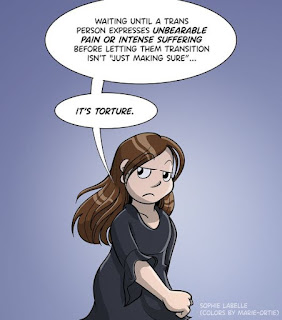
I came across a cartoon this week on my Facebook feed*. It was drawn by Sophie Labelle at Serious Trans Vibes. She also has a Facebook feed called Assigned Male Comics. Some of her comics have been anthologised into printed volumes which are available from her website store in both English and French.

According to the Wikipedia page, the comics have been produced since 2014, and have received positive reviews from critics. Certainly she seems to attract very positive and supportive comments on Facebook, although she has also occasionally been the target of hate. From my perspective, the medium of comics is a very effective way of communicating transgender topics, and I've written about this before, here and here.

Here's the cartoon which caught my eye*. I hadn't come across any of Labelle's work before. I did not recognise the character depicted (it turns out to be one of Labelle's main characters, a young trans-girl called Stephie).

As of today, 15th January 2022, this cartoon has had over 6,700 likes, 172 comments, and 1,700 shares, although these numbers seem to be par for the course for Labelle's cartoons on Facebook.

But what troubled me about it was the implication that that doctors are deliberately obstructive to trans people; deliberately causing them to experience "unbearable pain or intense suffering"; and deliberately inflicting "torture" upon them. This view struck me as unfair and I wanted to explore it further.

Being both a trans person myself, and a doctor, I'm aware of the tension that exists between the two groups. I'm aware (of course) of the frustration that exists from trans people who cannot get doctors to listen to them, believe them, or treat them. And I'm aware (of course) of the antics which some trans people sometimes resort to, such as lying or manipulation, to try to get their way. Others resort to hormones they buy online, or travel overseas to get surgery.

And I want to explain why I think "gatekeeper" is very much the wrong metaphor for what doctors are doing.

There is definitely a problem

Before I go further, I want to state that there is definitely a problem in the medical treatment of transgender people. I am, in my professional and online lives, trying to help to put it right, and I have discussed this matter before on this blog, for example here.

I wrote a long comment on Labelle's page, attempting to explain a more balanced view. She deleted it, and posted this:
Labelle: got a few truscums who wrote 10 pages long comments on how gatekeeping is essential to be truly trans, I got to delete their comments before anyone saw them, as a morning treat! I hope they didn't save their essays anywhere and they're lost forever.
I had no idea what a truscum is, although it's obviously intended to be an insult. You can find a discussion of its meaning here on Wikipedia. From what I have read, that description doesn't apply to me.

This exchange was not the most heartening opening to a discussion I've ever had. I contacted Sophie Labelle again for her comments, and she blocked me. But I nonetheless thought it was worth exploring the two aspects of it: why do (some) trans people feel that they are being tortured by doctors, and what could actually be going on from the doctors' point of view? And, most pertinently, can anything be done to fix it?

Why is it so hard to get good transgender medical care?

I want to begin this section by pointing out that I believe most doctors genuinely want to help transgender people, and that good gender treatment is fully in accordance with good medical practice. But there are several obstacles to achieving this, some larger than others.

Road ahead closed
First, most doctors have very little or no training in gender treatment. That means that few doctors have personal experience to draw upon. In addition, guidance from professional bodies is extremely sparse. When I was a medical student, in the last century, gender identity problems were not taught at all, though we did learn about intersex conditions in paediatrics. In endocrinology, we learned about people with hormone disorders: too much of this, or too little of that, and how to help, but none of this was in the context of people who want hormones to help with their gender.

Second, many (but not all) doctors are commonly faced with patients asking for (even demanding) treatments which could be potentially harmful. Strong painkillers are a great example, and I've seen patients who have resorted to ingenious methods to circumvent the system to obtain them. We've all been bitten, sometimes very hard, by such patients, and therefore many of us are understandably suspicious of people who don't seem genuine.

Put another way, if you are lying to your doctor, there is a very good chance that your doctor knows or suspects that, and this is likely to erode their sympathy and work against getting their cooperation. There is often a distrustful undertone to the relationship between the doctor and the transgender patient, where neither of them feels that the other is being completely open or completely helpful. The whole purpose of this post is to try to improve that situation.

Third, there is a very good rule of medicine: first, do no harm. This advice is so old and venerable that people think it was written by Hippocrates. (It wasn’t). But the meaning of the statement is clear: before you give a treatment you hope will help, you need to really make sure it isn’t going to make things worse. It encapsulates a theme of being cautious in the practice of medicine, which in general is a good thing (I believe). And its core is the patient’s wellbeing, which is paramount. If you are asking for a treatment which your doctor thinks may harm you, they are very unlikely to comply.

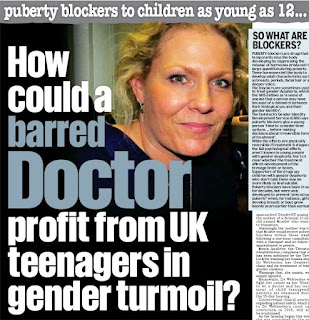
No doctor wants headlines like this.
Fourth, there is little good science in the field of gender treatment. What good science there is is drowned amid flag-waving, virtue-signalling, politics and wishful thinking. See my post here for a detailed discussion of these issues. This is especially true for gender treatment in children.

Fifth, those few doctors who have courageously taken on the treatment of transgender people sometimes run into serious professional trouble, threatening their career or livelihood.
Dr Helen Webberley (whom I interviewed here) has been treating thousands of transgender patients (including children) for some years, but has got into some serious hot water with medical authorities in the UK. (As I write, Webberley is still under suspension from practising as a doctor, and her tribunal is ongoing).

This sort of thing acts as a powerful disincentive to doctors to advocate for transgender people or treat them. Those doctors who are interested in training in gender issues will be looking at Webberley's case, and some will decide that the risk of getting into trouble is just too great. 

All of these things make it very difficult for doctors to effectively treat transgender patients.

The fictional case of "Bob"

I've created this fictional scenario to illustrate how an ordinary family doctor, without any training in gender treatments, might approach a consultation with a late-transitioning person. I'm not trying to suggest every transgender patient presents like this. I'm not trying to suggest every doctor would feel the same (and in particular, I would not). But hopefully this scenario will illustrate some potential ways of medical thinking.

Imagine you are that ordinary family doctor, and a patient comes to see you. You have known Bob and his family for 10 years. He is 52. He likes golf and fishing. He was a bank manager until last year, when he lost his job. Since then he has put on a lot of weight and begun to drink more heavily.

Bob tells you he is transgender. He is actually a woman inside, something he has felt for his whole life, but kept hidden from everyone, including his wife. He has been cross-dressing in secret for many years. But now he feels he cannot remain hidden any more, and wants to transition. He wants hormones. He wants surgery. He wants a legal name change.

Burdened: Bob
How do you react? You’ve been Bob’s doctor for years, but he has never mentioned this before. Nothing about him seems remotely feminine.

From one perspective, the story is true. Bobbie could have kept her feelings and behaviour hidden successfully for years, but could carry the burden no longer. This is her chance to be true to herself; to finally become a woman. You look up the referral pathway to the nearest gender clinic, which has a waiting list of two years. Bobbie says she can’t wait that long and wants to travel to Thailand for surgery. She asks you to prescribe female hormones for her, but you are not familiar with these treatments, their doses, or their side-effects. You really want to help Bobbie, and you tell her you will try talking to some colleagues for advice, and you will do what you can, but from Bobbie’s perspective, what you are offering is not enough, and far too slow.

Are you acting as a “gatekeeper” here? I argue not, though Bobbie might feel that you are. Who is right?

From another perspective, Bob’s story doesn’t ring true for you. Bob has always looked and acted like a man’s man: coaching the football team, golf, fishing, powerful cars. Losing his job hit him really hard. He is probably clinically depressed. He is certainly drinking too much, and you suspect his marriage is in trouble. He certainly isn’t the first middle-class, middle-aged guy who has had an unexpected mid-life crisis, even if most of them buy a motorbike or get a tattoo. You think that it would be better for Bob to sort himself out: cut down the drinking, get another job, lose a bit of weight, take more care of himself. You offer him antidepressants and recommend exercise. You tell him that if he still feels the same once those other things are sorted out, you will help him with his request to change sex, but you think in a year or so Bob’s feelings could well have changed and he might feel very differently.

Are you acting as a “gatekeeper” here? Maybe yes (Bob would certainly think so), but are you a bad doctor for doing so? For listening to your patient, making the very best, compassionate, objective assessment of what you think is really wrong, and trying to put it right? I would certainly argue no.

Aye, there's the rub!

And that's where the scissor-point is. Bob's story is fictional, of course, but there is enough truth to it that many elements are recognisable. A doctor, with either perspective of dealing with Bob, is practising good medicine. They are not being a bastard. They are not being cruel. They are not, in any way, deliberately attempting to hurt Bob or cause him distress. They are not torturing Bob! And they are not acting from a perspective that "gatekeeping is essential to be truly trans".

No way, sucka!
The image of the doctor as gatekeeper requires that there is this wondrous place, filled with bountiful hormones and surgery and unlimited gender treatments, but there's a huge steel door, and like a big mean bouncer, your doctor is looking you up and down and saying in a gravelly voice: Yer name's not down, yer not coming in.

But no such bounty exists! From a doctor's perspective, the official pathways are swamped and waiting lists are long. Some transgender people have other issues: depression, drug and alcohol use, self-harm, which can complicate the picture. (If you treat Bob’s depression, will his desire to transition go away?) Some transgender people point to gender as their one biggest problem, and play down other concerns, even though they seem important from the doctor's viewpoint. Some transgender people seem to have unrealistic expectations of how rosy their lives will be after treatment, even though this isn’t necessarily what happens. And some people change their minds about what’s best for them, as their lives unfold.

I'm not saying that trans people who are trying to get treatment are not suffering. I am not trying to suggest they should just suck it up and forget the whole thing. Instead I am trying to point out that what doctors do is not deliberate cruelty. The situation involving children is even more fraught. Gender services for children are even fewer than for adults, and a child who is growing rapidly creates even more pressure in an already pressured situation.

So what's the solution?

The solutions are clear, but none of them is easy. First we need good science to inform medical practice. That, in itself, is difficult, slow and expensive. As I've written here, if your science produces conclusions which some transgender people find unpalatable, you are likely to face powerful negative repercussions. That in turn provides powerful disincentives to scholars to pursue the science around transgenderism.

Second, we need better training for doctors in the treatment of gender conditions. The good news is that there is some evidence that this is starting to happen, although obviously it will take a while to work through the system.

Third, we need clear professional guidance from professional bodies to existing doctors, about treatment regimes, referral pathways, and so on. Again, this is happening, with organisations such as WPATH setting out standards of care (currently brewing up their 8th edition) for transgender people worldwide.

Fourth, we need better investment and funding for those systems which currently exist, to match the increasing demand for their services, cut waiting lists, and improve access to treatment. For these outcomes, you need to lobby your politicians, not your doctors.

Meanwhile, transgender people, and the doctors looking after them, will struggle to make anything successful happen with what already exists out there.

How can I get the best out of my doctor?

The first thing to say is that doctors are people, which means there are some who are brilliant, some who are dreadful (sadly I've met some of them), and most of the rest are perfectly OK in the middle somewhere. Most of us went into medicine because we actually want to help people, after all. We are also aware that the power-balance in the doctor-patient relationship very much favours the doctor. While medical paternalism is still (unfortunately) a thing, the old notion that "doctor knows best" is obsolete, and practised only by a few, aging doctors.

But if you understand how your doctor is thinking, it is likely to result in a better outcome all round. You will be able to reassure them and defuse some of their reluctance. You will be able to put forward your goals in a way which seem to be in accordance with good medical practice, not against it.

It doesn't have to be a conflict.
If you happen to run into a dreadful doctor, get another doctor! If your doctor is uncaring, brusque, unsympathetic, or otherwise unsuitable, vote with your feet. Change to another doctor in the practice, or change to another practice entirely. There is likely to be a social media page for trans people in your area. Ask around for recommendations about a supportive doctor near you.

If your doctor seems willing to help, but unsure what to do, point them to the WPATH website, which is positively bursting with resources to help: medical guidance, standards of care, a comprehensive reading list, a search facility for colleagues and experts around the world. If they really want to talk to an actual transgender doctor, I'm happy for them to contact me by email.

Try to work with your doctor, not against them. Try not to take it as a personal attack if they don't fall over themselves to do whatever you ask. It's fine to negotiate, with statements like "I know that if I start with the higher dose, I might have more side-effects, but I'm willing to accept that risk for myself, and I will cut down the dose if I start to run into problems". Most doctors will respond very well to this approach, and many doctors like it if you've done your homework first: "I know I will have to keep an eye on my blood pressure and my blood sugar too, but I've been losing weight and keeping fit".

Plain honesty is likely to work very positively. "Look, I know it wasn't very smart, but I'm desperate, and I've been taking these hormones I got from the Internet. I brought you the box so you can take a look at them. They don't seem to be working very well. I really want to be on something safer and more effective".

Manipulation, lies ("Oh no, doctor, I would never take anything that I bought online") and subtle threats ("If you don't prescribe these for me, I'm going to start getting them online anyway, so you might as well") are likely to make things very rocky.

The hardest part (understandably) is to be patient with your doctor if they seem too slow. You may well be that doctor's first ever transgender patient. Your interaction with them will likely colour all future interactions with trans patients. Most doctors (as I've said before) will be willing to work together with you toward you meeting your goals, which will be rewarding for you both, and will likely make things easier for the next trans person that doctor has to treat.

The situation is changing. I know it's too slow for many people, but it's going to be better. Meanwhile, let's all try to understand one another a little better.

===

* I believe that my sharing of this image on this page consitutes Fair Use. The original cartoon was published on a public forum (Facebook), where it has been viewed many thousands of times. I have not changed or altered the image in any way. I have attributed the artist, and added links to her Facebook stream, her website, and her Wikipedia page. I have not attacked the artist or the image, but used it to illustrate a discussion point which is very strongly in the interests of the trans community--in other words, my use is in alignment with the implied original purpose of the image. I do not earn money or other reward for this blog. The image has already been shared over 1800 times without apparent objection from the artist, which indicates implied permission for its being shared online.

Tuesday, 8 September 2020

Transgender Actors

Here's a question. You want to make a film where a transgender character is the lead. Do you need to cast a transgender actor or actress in the role?

Victor Polster in Girl (2018)
For mainstream cinema at least, the choice is easy: you pick a cisgender actor or actress and cast them. That has been true over many years, from Felicity Huffman in Transamerica to Cillian Murphy in Breakfast on Pluto, to Terence Stamp in Priscilla, right up to Eddie Redmayne in The Danish Girl and most recently Victor Polster in Girl.

For some trans people, this is definitely a problem. The film Girl, which I haven't yet seen, has stirred up quite a lot of protest, in particular because there seems to be a lot of depiction of genitalia. Several questions about transgender actors have been debated on Quora, and some of the answers and comments are very interesting. All of the quotes come from Quora and are unchanged from the original authors' text, though they are not all in response to the same question.

The first comment people make is that there are plenty of trans actors out there now.
Elliott Mason: There are hundreds of working trans actors, of all stripes and appearances. If none of them are considered "bankable" it's because productions won't cast them to play cis, but won't let them play trans either.
Eddie Redmayne in The Danish Girl (2015)
This is a very fair point: if you are a trans actor, then you might find yourself stuck between a rock and a hard place: no trans roles-- and no cis ones either!

The next point is that it’s not acceptable to have black or Asian parts played by white actors in makeup—and for the same reason we should have trans actors playing trans characters.
Joanne C Wittstock: There was a time when women were not allowed on stage. Then a time when no suitable black actors were available and the roles went to whites. For decades there were apparently no Asians with theatrical skills. The frontier is slowly moving. To a large extent trans people are the visible minority of this moment.
I completely take this point. One of the things which spoils what would otherwise be one of my favourite ever movies, Breakfast at Tiffany's, is the dreadful "comic relief" turn of Mickey Rooney in yellowface as Mr. Yunioshi. And one of the best of the classic Doctor Who stories, The Talons of Weng-Chiang, features John Bennet in the role of the villainous Li H'Sen Chang. This time, it's not played for laughs, but the show still manages to throw in some dreadful Chinese stereotypes. The few actual Asian actors in the production are relegated to non-speaking parts.

Another common theme is the failure of Hollywood to recognise the legitimacy of trans people themselves; instead making them out to be a pretence.
Helena Almagest: The persistent practice of Hollywood to have cis men portray trans women and cis women trans men promotes the misconception that transgender is merely a disguise, and that trans women are merely men dressing up, and trans men, women dressing up. A misconception that gets us killed. (her emphasis).
A trans woman should be portrayed by a woman. It needn’t even be a trans woman (although suitable trans actresses are out there and desperately seeking jobs), it could also be a cis woman. Just not a man.

Likewise, a trans man should be portrayed by a man, trans or cis.

Tara Nitka: Hollywood has made me quite skeptical about the ability of cis people to write and portray trans characters, but that might only be true of Hollywood.

But ultimately, casting cis men and boys to play trans women and girls sends the message that we’re men pretending to be women. If you can’t cast a trans girl, at least cast a girl.

Felicity Huffman in Transamerica
From the (short) list of famous movies at the start of this article, only Transamerica would meet with approval here, with Felicity Huffman cast as a transwoman.

Sara Clarke: When we cast a cis person to play a trans person, we’re at the mercy of that person (and their most likely cis director and writer) to tell us what trans people look and act like, how they feel about things, what choices they would make, etc. Considering how ignorant most cis people are of the trans experience, that’s not doing anybody any favors: either other cis people learning about trans issues through the lens of other cis people who may or may not know what they’re talking about, or other trans people who want to see authentic versions of their lives represented in the media.

These are powerful points. The criticism is that the films don't depict trans people, or how they feel, but only what cisgender people think trans people are like, and how they feel. I definitely share this point of view: several times during The Danish Girl, I found myself thinking that elements of the plot didn't strike me as real.
Chrystal Andros: My issue is what is called agency. With women it used to be (and still is in some aspects) that men define what is good for them. They cannot speak for themselves, so they have to have someone else speaking for them.

In the same way in Hollywood, managers and focus groups define what is good for the audience and define their selection of actors.

With trans-actors and trans-actresses they fit into a certain category - they are becoming more mainstream, but they are considered like women from 1950s who go out and become professionals - the freaks of today.
Three of the films I have mentioned have received very positive reviews. On Rotten Tomatoes, Priscilla has a 96% approval rating; Girl has achieved 84% and Transamerica has 76%.  Meanwhile, The Danish Girl managed only 67% and Breakfast on Pluto achieved 57%. So the filmmakers are doing something right (if not exactly breaking box-office records with any of them). But of course, if these are films made by cisgender film-makers, pitched for a (predominantly) cisgender audience, I suppose that doesn't necessarily mean they please transgender people.

Cillian Murphy in Breakfast on Pluto
But not everyone agrees with the sentiments above. Some commentators reported that, as long as the actor does a decent job, it shouldn't matter whether they are cisgender or transgender.
Mark Grinstein-Camacho: Actors play different characters all the time. It is their job. You can find actors who play straight people, gay people, billionaires, emperors of the galaxy, penniless street urchins, genius computer programmers, or zombies hungry for human flesh.

Studying for those roles and preparing for them is a big part of an actor’s work. Maybe it means watching Hitler’s speeches, or spending a day at a boot camp, or attending a conference. Maybe it means learning to play the violin for a year. Maybe it means watching other movies. Maybe it means interviewing people who were there. Any good actor can do this.
Karissa Cook: One point that most people seem to miss with these questions is that an actor acts. That is what they do.

Would it be a good thing for more transgender actors to get cast? Absolutely! Should we get bent out of shape about who is portraying trans characters? Not unless they are doing a poor job.

Look folks. If you want only trans actors to have trans roles then you aren't really looking for actors, you are looking for representatives.

Actors play a part. Their job is to make us believe that they really are the characters they portray. Stop worrying about who is playing the role, just pay attention to how well or poorly they did.
Benedict Cumberbatch as Alan Turing
This is also a point I have some sympathy with, although my own point of view comes from a different angle. Film-making is driven by economics. Film-makers make films because they want people to pay money to see them. Along the way, they may inspire, entertain, or inform--they may even achieve art--but those are very secondary considerations.

In The Imitation Game, Benedict Cumberbatch plays cryptanalyst Alan Turing (who happens to be one of my heroes). Turing was gay, but Cumberbatch isn’t; nonetheless Cumberbatch gives an extraordinary performance.

People have criticised the considerable liberties with historical events which the director took. But the director Morten Tyldrum has said that the film was really about using the medium of film to give the audience a flavour of what Turing was really like (rather than to just make a historical documentary). In this, I think he succeeds. The role of the tortured genius has been done dozens of times, but Cumberbatch manages to bring a nuanced performance which includes the awkwardness, the vulnerability and the arrogance of the character, without ever feeling forced or unnatural. Though we sympathise deeply with Cumberbatch's portrayal of Turing, he doesn't make the character necessarily likeable.

By casting a star like Cumberbatch in the role of Alan Turing, I believe people will watch the film who otherwise wouldn’t. And I believe that, unless they have hearts of stone, they will come away feeling sympathy for Turing and how he was treated, perhaps in a way they haven’t sympathised with gay people before. Other recent films which show gay men in a very positive light are Rocketman and Bohemian Rhapsody.

Jeffrey Tambor in Transparent
I think that we are in this place right now. I believe it’s more important for the public to see us, and to sympathise with and accept us, (even using the medium of fiction and the artifice of film) than it is for trans actors to be cast in those roles. Some cisgender actors have also done a wonderful job, such as Jeffrey Tambor in Transparent.

I hope that the day will come when trans actors are just actors. We are not there yet. Meanwhile, cisgender actors playing transgender parts is fine by me. What I want, right now, is awareness and exposure, and for people to view us with sympathy rather than scorn or discomfort. I think overall that we should be pleased that films with a transgender theme are being made and released. While they may not be perfect, I think that the casting of cisgender actors in transgender parts is doing more good than harm.


Sunday, 27 November 2016

If I Was Your Girl

I was browsing in an airport bookshop lately, and noticed the cover of this book, If I Was Your Girl, by Meredith Russo. The book was displayed reasonably prominently, and was featured as part of the Zoella book club, as a work of fiction for young adults (which is what they are calling teenagers these days, apparently).

If I were your girl: subjunctive, people!
Normally I wouldn't be too interested in fiction for young adults. When I was a young adult myself, I just read fiction for adults. My sister used to read books by Judy Blume, and she would usually show me the juicy parts. These astonished me in two ways. They astonished me because these were books marketed at teenagers, containing detailed descriptions of sexual activity that would likely cause many parents (including ours) to have conniptions. Second, they astonished me because they were depicting a world where teenagers seemed to have no trouble having sex; lots of sex. This seemed like a glimpse into some alien world. As a teenager who was having real trouble finding someone willing even to snog me, reading the books made me feel envious and uncomfortable.

Now that I am an adult, I don't see any reason to read young adult fiction at all. Unless it seems to feature the transgender flag on the cover, which is what drew my eye.

Naturally I bought it, and read it on the flight, all the way through. And now I thought I would write a review of it.

The book centres around the life of Amanda, an 18-yr old girl in her final year of high school. She joins a new school, and falls in love with Grant, a football player. The hook (at least from a transgender point of view) is that Amanda used to be Andrew. Their relationship goes through some ups and downs, before the big reveal, and the aftermath.

I read to the end of the book before I realised that the author herself, Meredith Russo, is a transwoman. She even includes a page of comments for cisgendered readers, as well as another page of comments for transgendered readers. She explains some of the fictional devices she required to use to make the story work. One obvious one is that nobody ever doubts or guesses Amanda's trans nature, because she is already "fully formed": post-surgery, post-hormones, and with a completely realistic face and body. Russo admits this is pretty unrealistic, and I am pleased that she did; for me it was one of the most difficult parts of the story to accept.

Meredith Russo
Russo was raised in Tennessee, and sets the story in a district she is familiar with. I can't help associating that region of the southern United States with God-fearin', gun-totin', Republican-votin' good-ole-boys. To be a transgender child growing up in that environment would be, no doubt, exceptionally difficult, lonely and painful. Amanda, our protagonist, is exposed to a series of very unpleasant events: parental rejection, violent beatings at school (where she is considered to be gay by the other students), and a failed suicide attempt. These events are described starkly (in a series of flashbacks), and the writing is powerful. I dare say they will resonate with young adults who feel different (for any reason), isolated and desperate. Even I got a few pangs.
I brought my wrist up to my chest and looked down. The identification bracelet said my name was Andrew Hardy. If I died, I realized, Andrew would be the name they would put on my tombstone. I thought of the words I wrote down for the counsellor: I should have been a girl.
Amanda begins to settle into her new school, and begins to make friends. She is pleased and gratified to find that she is accepted, though this pleasure is tempered with the knowledge that, if the truth of her background were known, she would surely be rejected.
The cicadas buzzed persistently in the growing dusk. I had read once that they lived underground for most of their lives, only emerging as adults to live out their final days. Was that going to be me? Was I going to live underground for the better part of my life, never coming out into the world? (...) I wondered if joy could ever be felt by itself without being tainted with fear and confusion, or if some level of misery was a universal constant, like the speed of light.
Trans model Kira Conley on the US cover
The parts of the story with which I found most resonance are where Amanda discovers her trans identity, and meets other trans people for the first time. She is mentored in her early journey by Virginia, who introduces her to members of her local transgender support group.
A woman with broad shoulders and a faint shadow of a beard under her make-up entered next. She looked strong and stout, but the longer I looked, the more I saw the beauty in her--here a light step, here a brief touch of the hair, here a wide, open smile. Boone said, "Evening, Rhonda," to greet her.
This resonates with me because of my preoccupation with how people see Vivienne. Since I started my journey, I have come out to a couple of dozen people, and they have all been complimentary about my appearance, even the ones who met Vivienne face to face. But did they have to make an effort to see past the man in the dress to really see Vivienne? And how much of an effort did they make?
I looked Virginia up and down and saw two separate people. One was the beautiful, statuesque angel who had been there to guide me through some of the hardest steps of my transition. The other was a woman with a jaw just a little too strong, forehead just a little too high, shoulders just a little too wide, and hands just a little too big.
Without giving the story away, Amanda begins to find fulfilment and happiness in her new life. Her relationship with her parents improves. She realises other students have their secrets too: one girl takes drugs; another is a lesbian. For me, Amanda's parents and schoolmates are somewhat simple and one-dimensional. Grant, the love interest, is more interesting, though again he is cast as someone who is all goodness: good-looking, pleasant, sensitive, humble, hard-working, popular, kind to his family. The most interestingly subtle character (Amanda aside) is the villain, Parker, another student, whose complex feelings and motives are explored.
His shadow stretched out past mine. I remembered Mom telling me how frightening men were, all men really, how helpless it often felt to be a woman among men, and for the first time I understood what she meant.
The romantic aspects of the plot are well-drawn: the breathless first kiss, and other faltering steps as the relationship between Grant and Amanda begins to play out. I am relieved beyond measure to report that Judy Blume's intimate depictions are largely absent. Though the book doesn't insult its readers by pretending everyone is a virgin when they leave high school, the sexual content is handled deftly and with subtlety, just as (in my opinion) it ought to be.

So in summary, what can I say about the book? I cannot judge it as a piece of young adult fiction, since I have so little knowledge of that genre with which to compare it. I have a friend who writes romantic fiction for a living, and she tells me there is a remarkably strict pattern that her books are expected to follow. I hope the same is not true of young adult fiction, but I wouldn't be surprised (only disappointed) to find that there is. Overall, I think the story is compelling enough, and readable enough (certainly I didn't get bored or struggle to finish it). I think some of the characters are a bit flat. I think that the story of Amanda's life is told with enough sympathy and emotional resonance that transgendered readers (like me) will find much to resonate with, and there is a reasonably positive ending to look forward to.

Blazing the trail: Luna in 2004
Russo clearly hopes that cisgendered young adults will also read the book and come away with more awareness and more sympathy towards transgendered people (of all ages). And it's this, I think, which holds the book back slightly for me. It just has a hint of being slightly contrived for this purpose; as if Amanda's relationship with Grant is shown to be completely pure and perfect to show just how much of a real girl Amanda actually is.

Nonetheless, Russo deserves encouragement. I think this book represents one more snowflake in the blizzard of transgender-related material in the popular media, to which we are now exposed, and it can only do us good to get more exposure, more sympathy and more conversations started. This is Russo's first book, and I hope she writes many more. I also hope that she isn't the "token trans writer" when young adult fiction is considered.

And there are very few other similar books out there. One which Russo mentions is Luna, by Julie Anne Peters. Another is a book which I have touched on before on this blog, Boy2Girl by Terence Blacker. To my knowledge, neither Peters nor Blacker are transgendered, and both have had success with many other books; therefore they are not as brave as Russo. They can afford to experiment with new themes, while Russo has put all her chips on this debut novel. Thankfully it seems to have gone down very well, and it has favourable reviews on GoodReads and Amazon, but the Guardian reviewer (like me) had some reservations.

I haven't read Luna, but I will order it and let you know my thoughts in due course. Meanwhile, I recommend that you get hold of If I Was Your Girl and give it a read. Or perhaps wave it under the nose of a nearby young adult for their comments. And yours, of course, are always welcome below.