Pages

Showing posts with label medicine. Show all posts

Monday, 16 May 2022

Bits and Bobs

I've been collecting a few items of news, which aren't really worthy of a blog post all by themselves, but I have decided to put them together here.

Ukraine

Obviously, as much of the rest of the world is, I am appalled by Russia's invasion of Ukraine.

Zi Faámelu
Before this invasion, I knew very little of Ukraine. On the other hand, I was surprised to find that if you rank my blog hits by country, Ukraine comes in 10th. This is almost three times higher than my own country, New Zealand! It won't come as a surprise that hits from Ukraine have all but disappeared since the start of the invasion.

The number of hits from Ukraine made me realise that there is a trans population in Ukraine which is trying to reach out across international boundaries. I took comfort from this--until I started reading. Until recently, being trans in Ukraine could result in you being institutionalised. Ukraine ranks 39th among the 49 countries in Europe for LGBT+ freedoms and rights. Gay marriage, for example, is still illegal.

Then I read stories like this one, which describe how transwomen attempting to flee Ukraine have been detained and turned back at borders. One transwoman, Zi Faámelu, describes in Rolling Stone magazine how she was repeatedly turned back at the border, because in Ukraine, military service is now mandatory for all males, and her passport still states she is male. Eventually she escaped by swimming across the Danube river into Romania. She is now living safely in Germany.

I can understand how the presence of war, plus a country just beginning to experience a little awareness and acceptance of rainbow people, is making life extremely difficult for trans and other rainbow people. But if Ukraine isn't friendly to trans people, Russia would undoubtedly be a lot worse. Russia ranks 46th on that list, and Vladimir Putin has described gender fluidity as "a crime against humanity".

One thing is for sure: the Ukrainians are showing that they are not willing to give up their freedoms and submit to the oppression and restrictions of Mother Russia. Hopefully once they send Mr Putin back to Moscow with a bloody nose, they can get on and grow in freedom and tolerance, as they have been over the last few years.

Ukraine has also won the Eurovision Song Contest for this year. As I've written before, the contest isn't so much a competition of musical talent as a sort of political popularity contest. This victory is definitely a message of support and encouragement from the rest of Europe to the people of Ukraine.

Meanwhile, to any Ukrainian people reading this blog, I salute your courage, and I hope that the war ends soon and you can rebuild your country.

PATHA

As a doctor, I'd known that the World Professional Association for Transgender Health was a thing. However, because I was still being very stealth, I didn't really want to put my hand up, because I thought I might be traced, and that might be a "bad thing".

However, that's changed now. New Zealand has an affiliated branch of WPATH, called the Professional Association for Transgender Health Aotearoa, PATHA. I got in touch with them, and they were delightful. I've paid my membership fee, and Dr Vivienne Marcus is now a full member of PATHA.

I'm not sure what this will mean for my future. At the moment I'm just trying to cautiously reach out to the other members. It's that equivalent of slipping in at the back of the lecture theatre and hoping nobody notices you. But I'm confident of full acceptance from them.

What's not so clear is how I can contribute to the cause. I don't particularly look after trans people in my daily work. I don't think being a PATHA member is going to really change anything about how I do my job. What I am good at is writing and teaching, and I've explained that to the executive on my application. It remains to be seen what (if any) contribution I can make. I will certainly notify you of anything momentous I end up doing.

Lofi Girl

I can't remember where I first saw an animation of Lofi Girl, but it struck me immediately as being both pleasing and familiar.

Lofi Girl is the name of a French YouTube channel and music label, which, which provides an endless stream of what Wikipedia calls lo-fi hip-hop, accompanied by an endless animation of a young woman sitting writing in a diary. The music is intended to be relaxing, background music, which can be used to accompany study, relaxing or other activity; in essence, audible wallpaper.

I like lots of things about this. First, I like the animation, which is clearly inspired by the sort of Japanese anime typical of the wonderful Studio Ghibli, whose work I adore. In fact, Wikipedia says they originally used a short segment from the film Whisper of the Heart, before being legally required to take it down. Since then, they have commissioned an artist to recreate an anime-like character (whose official name is Jade) to feature.

Vivienne as Lofi Girl
The Lofi Girl sits, looking thoughtfully at her book and writing by hand. She's listening through headphones (presumably to what we hear), deep in thought. From time to time, she pauses and looks up at the cat, which sits on the windowsill looking out of the window. Then she carries on. This provides just enough action for me to sit and watch it for hours. From time to time, the weather changes outside the window, and day turns to night and vice versa.

What I love about this is that she sits exactly the way I do. I love to write in my journal; I use a gorgeous fountain pen, and delicious inks from Jacques Herbin in Paris. And while Lofi Girl is a leftie and I'm not, I do sit with my chin in my hand while I write. And from time to time I pause and look up into the middle distance. Journal writing is my happy place; both an intellectual and a sensual pleasure.

Surprisingly, the part about Lofi Girl which attracts me least is the music. There's nothing particularly wrong with it, but I find it quite samey after a few hours.

Amazingly, the Lofi Girl website allows you to customise the appearance of the Lofi Girl and create a still image. So this is what she would look like if she were Vivienne--complete with dog!

Saturday, 15 January 2022

Doctors as Gatekeepers

Let me open this first post of 2022 by wishing all of you a very happy and productive New Year, and let me also hope that COVID-19, in whichever variant, doesn't interfere too much with your plans and your lifestyle.

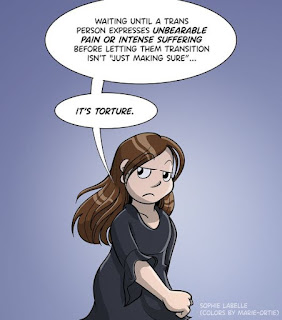
I came across a cartoon this week on my Facebook feed*. It was drawn by Sophie Labelle at Serious Trans Vibes. She also has a Facebook feed called Assigned Male Comics. Some of her comics have been anthologised into printed volumes which are available from her website store in both English and French.

According to the Wikipedia page, the comics have been produced since 2014, and have received positive reviews from critics. Certainly she seems to attract very positive and supportive comments on Facebook, although she has also occasionally been the target of hate. From my perspective, the medium of comics is a very effective way of communicating transgender topics, and I've written about this before, here and here.

Here's the cartoon which caught my eye*. I hadn't come across any of Labelle's work before. I did not recognise the character depicted (it turns out to be one of Labelle's main characters, a young trans-girl called Stephie).

As of today, 15th January 2022, this cartoon has had over 6,700 likes, 172 comments, and 1,700 shares, although these numbers seem to be par for the course for Labelle's cartoons on Facebook.

But what troubled me about it was the implication that that doctors are deliberately obstructive to trans people; deliberately causing them to experience "unbearable pain or intense suffering"; and deliberately inflicting "torture" upon them. This view struck me as unfair and I wanted to explore it further.

Being both a trans person myself, and a doctor, I'm aware of the tension that exists between the two groups. I'm aware (of course) of the frustration that exists from trans people who cannot get doctors to listen to them, believe them, or treat them. And I'm aware (of course) of the antics which some trans people sometimes resort to, such as lying or manipulation, to try to get their way. Others resort to hormones they buy online, or travel overseas to get surgery.

And I want to explain why I think "gatekeeper" is very much the wrong metaphor for what doctors are doing.

There is definitely a problem

Before I go further, I want to state that there is definitely a problem in the medical treatment of transgender people. I am, in my professional and online lives, trying to help to put it right, and I have discussed this matter before on this blog, for example here.

I wrote a long comment on Labelle's page, attempting to explain a more balanced view. She deleted it, and posted this:
Labelle: got a few truscums who wrote 10 pages long comments on how gatekeeping is essential to be truly trans, I got to delete their comments before anyone saw them, as a morning treat! I hope they didn't save their essays anywhere and they're lost forever.
I had no idea what a truscum is, although it's obviously intended to be an insult. You can find a discussion of its meaning here on Wikipedia. From what I have read, that description doesn't apply to me.

This exchange was not the most heartening opening to a discussion I've ever had. I contacted Sophie Labelle again for her comments, and she blocked me. But I nonetheless thought it was worth exploring the two aspects of it: why do (some) trans people feel that they are being tortured by doctors, and what could actually be going on from the doctors' point of view? And, most pertinently, can anything be done to fix it?

Why is it so hard to get good transgender medical care?

I want to begin this section by pointing out that I believe most doctors genuinely want to help transgender people, and that good gender treatment is fully in accordance with good medical practice. But there are several obstacles to achieving this, some larger than others.

Road ahead closed
First, most doctors have very little or no training in gender treatment. That means that few doctors have personal experience to draw upon. In addition, guidance from professional bodies is extremely sparse. When I was a medical student, in the last century, gender identity problems were not taught at all, though we did learn about intersex conditions in paediatrics. In endocrinology, we learned about people with hormone disorders: too much of this, or too little of that, and how to help, but none of this was in the context of people who want hormones to help with their gender.

Second, many (but not all) doctors are commonly faced with patients asking for (even demanding) treatments which could be potentially harmful. Strong painkillers are a great example, and I've seen patients who have resorted to ingenious methods to circumvent the system to obtain them. We've all been bitten, sometimes very hard, by such patients, and therefore many of us are understandably suspicious of people who don't seem genuine.

Put another way, if you are lying to your doctor, there is a very good chance that your doctor knows or suspects that, and this is likely to erode their sympathy and work against getting their cooperation. There is often a distrustful undertone to the relationship between the doctor and the transgender patient, where neither of them feels that the other is being completely open or completely helpful. The whole purpose of this post is to try to improve that situation.

Third, there is a very good rule of medicine: first, do no harm. This advice is so old and venerable that people think it was written by Hippocrates. (It wasn’t). But the meaning of the statement is clear: before you give a treatment you hope will help, you need to really make sure it isn’t going to make things worse. It encapsulates a theme of being cautious in the practice of medicine, which in general is a good thing (I believe). And its core is the patient’s wellbeing, which is paramount. If you are asking for a treatment which your doctor thinks may harm you, they are very unlikely to comply.

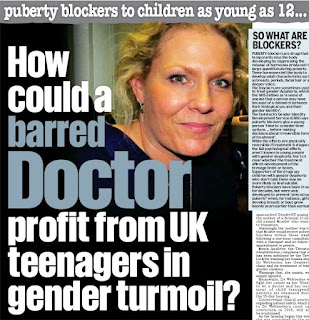
No doctor wants headlines like this.
Fourth, there is little good science in the field of gender treatment. What good science there is is drowned amid flag-waving, virtue-signalling, politics and wishful thinking. See my post here for a detailed discussion of these issues. This is especially true for gender treatment in children.

Fifth, those few doctors who have courageously taken on the treatment of transgender people sometimes run into serious professional trouble, threatening their career or livelihood.
Dr Helen Webberley (whom I interviewed here) has been treating thousands of transgender patients (including children) for some years, but has got into some serious hot water with medical authorities in the UK. (As I write, Webberley is still under suspension from practising as a doctor, and her tribunal is ongoing).

This sort of thing acts as a powerful disincentive to doctors to advocate for transgender people or treat them. Those doctors who are interested in training in gender issues will be looking at Webberley's case, and some will decide that the risk of getting into trouble is just too great. 

All of these things make it very difficult for doctors to effectively treat transgender patients.

The fictional case of "Bob"

I've created this fictional scenario to illustrate how an ordinary family doctor, without any training in gender treatments, might approach a consultation with a late-transitioning person. I'm not trying to suggest every transgender patient presents like this. I'm not trying to suggest every doctor would feel the same (and in particular, I would not). But hopefully this scenario will illustrate some potential ways of medical thinking.

Imagine you are that ordinary family doctor, and a patient comes to see you. You have known Bob and his family for 10 years. He is 52. He likes golf and fishing. He was a bank manager until last year, when he lost his job. Since then he has put on a lot of weight and begun to drink more heavily.

Bob tells you he is transgender. He is actually a woman inside, something he has felt for his whole life, but kept hidden from everyone, including his wife. He has been cross-dressing in secret for many years. But now he feels he cannot remain hidden any more, and wants to transition. He wants hormones. He wants surgery. He wants a legal name change.

Burdened: Bob
How do you react? You’ve been Bob’s doctor for years, but he has never mentioned this before. Nothing about him seems remotely feminine.

From one perspective, the story is true. Bobbie could have kept her feelings and behaviour hidden successfully for years, but could carry the burden no longer. This is her chance to be true to herself; to finally become a woman. You look up the referral pathway to the nearest gender clinic, which has a waiting list of two years. Bobbie says she can’t wait that long and wants to travel to Thailand for surgery. She asks you to prescribe female hormones for her, but you are not familiar with these treatments, their doses, or their side-effects. You really want to help Bobbie, and you tell her you will try talking to some colleagues for advice, and you will do what you can, but from Bobbie’s perspective, what you are offering is not enough, and far too slow.

Are you acting as a “gatekeeper” here? I argue not, though Bobbie might feel that you are. Who is right?

From another perspective, Bob’s story doesn’t ring true for you. Bob has always looked and acted like a man’s man: coaching the football team, golf, fishing, powerful cars. Losing his job hit him really hard. He is probably clinically depressed. He is certainly drinking too much, and you suspect his marriage is in trouble. He certainly isn’t the first middle-class, middle-aged guy who has had an unexpected mid-life crisis, even if most of them buy a motorbike or get a tattoo. You think that it would be better for Bob to sort himself out: cut down the drinking, get another job, lose a bit of weight, take more care of himself. You offer him antidepressants and recommend exercise. You tell him that if he still feels the same once those other things are sorted out, you will help him with his request to change sex, but you think in a year or so Bob’s feelings could well have changed and he might feel very differently.

Are you acting as a “gatekeeper” here? Maybe yes (Bob would certainly think so), but are you a bad doctor for doing so? For listening to your patient, making the very best, compassionate, objective assessment of what you think is really wrong, and trying to put it right? I would certainly argue no.

Aye, there's the rub!

And that's where the scissor-point is. Bob's story is fictional, of course, but there is enough truth to it that many elements are recognisable. A doctor, with either perspective of dealing with Bob, is practising good medicine. They are not being a bastard. They are not being cruel. They are not, in any way, deliberately attempting to hurt Bob or cause him distress. They are not torturing Bob! And they are not acting from a perspective that "gatekeeping is essential to be truly trans".

No way, sucka!
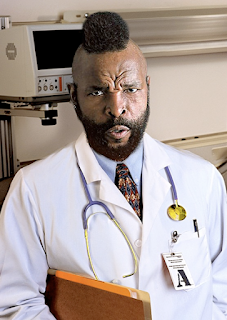
The image of the doctor as gatekeeper requires that there is this wondrous place, filled with bountiful hormones and surgery and unlimited gender treatments, but there's a huge steel door, and like a big mean bouncer, your doctor is looking you up and down and saying in a gravelly voice: Yer name's not down, yer not coming in.

But no such bounty exists! From a doctor's perspective, the official pathways are swamped and waiting lists are long. Some transgender people have other issues: depression, drug and alcohol use, self-harm, which can complicate the picture. (If you treat Bob’s depression, will his desire to transition go away?) Some transgender people point to gender as their one biggest problem, and play down other concerns, even though they seem important from the doctor's viewpoint. Some transgender people seem to have unrealistic expectations of how rosy their lives will be after treatment, even though this isn’t necessarily what happens. And some people change their minds about what’s best for them, as their lives unfold.

I'm not saying that trans people who are trying to get treatment are not suffering. I am not trying to suggest they should just suck it up and forget the whole thing. Instead I am trying to point out that what doctors do is not deliberate cruelty. The situation involving children is even more fraught. Gender services for children are even fewer than for adults, and a child who is growing rapidly creates even more pressure in an already pressured situation.

So what's the solution?

The solutions are clear, but none of them is easy. First we need good science to inform medical practice. That, in itself, is difficult, slow and expensive. As I've written here, if your science produces conclusions which some transgender people find unpalatable, you are likely to face powerful negative repercussions. That in turn provides powerful disincentives to scholars to pursue the science around transgenderism.

Second, we need better training for doctors in the treatment of gender conditions. The good news is that there is some evidence that this is starting to happen, although obviously it will take a while to work through the system.

Third, we need clear professional guidance from professional bodies to existing doctors, about treatment regimes, referral pathways, and so on. Again, this is happening, with organisations such as WPATH setting out standards of care (currently brewing up their 8th edition) for transgender people worldwide.

Fourth, we need better investment and funding for those systems which currently exist, to match the increasing demand for their services, cut waiting lists, and improve access to treatment. For these outcomes, you need to lobby your politicians, not your doctors.

Meanwhile, transgender people, and the doctors looking after them, will struggle to make anything successful happen with what already exists out there.

How can I get the best out of my doctor?

The first thing to say is that doctors are people, which means there are some who are brilliant, some who are dreadful (sadly I've met some of them), and most of the rest are perfectly OK in the middle somewhere. Most of us went into medicine because we actually want to help people, after all. We are also aware that the power-balance in the doctor-patient relationship very much favours the doctor. While medical paternalism is still (unfortunately) a thing, the old notion that "doctor knows best" is obsolete, and practised only by a few, aging doctors.

But if you understand how your doctor is thinking, it is likely to result in a better outcome all round. You will be able to reassure them and defuse some of their reluctance. You will be able to put forward your goals in a way which seem to be in accordance with good medical practice, not against it.

It doesn't have to be a conflict.
If you happen to run into a dreadful doctor, get another doctor! If your doctor is uncaring, brusque, unsympathetic, or otherwise unsuitable, vote with your feet. Change to another doctor in the practice, or change to another practice entirely. There is likely to be a social media page for trans people in your area. Ask around for recommendations about a supportive doctor near you.

If your doctor seems willing to help, but unsure what to do, point them to the WPATH website, which is positively bursting with resources to help: medical guidance, standards of care, a comprehensive reading list, a search facility for colleagues and experts around the world. If they really want to talk to an actual transgender doctor, I'm happy for them to contact me by email.

Try to work with your doctor, not against them. Try not to take it as a personal attack if they don't fall over themselves to do whatever you ask. It's fine to negotiate, with statements like "I know that if I start with the higher dose, I might have more side-effects, but I'm willing to accept that risk for myself, and I will cut down the dose if I start to run into problems". Most doctors will respond very well to this approach, and many doctors like it if you've done your homework first: "I know I will have to keep an eye on my blood pressure and my blood sugar too, but I've been losing weight and keeping fit".

Plain honesty is likely to work very positively. "Look, I know it wasn't very smart, but I'm desperate, and I've been taking these hormones I got from the Internet. I brought you the box so you can take a look at them. They don't seem to be working very well. I really want to be on something safer and more effective".

Manipulation, lies ("Oh no, doctor, I would never take anything that I bought online") and subtle threats ("If you don't prescribe these for me, I'm going to start getting them online anyway, so you might as well") are likely to make things very rocky.

The hardest part (understandably) is to be patient with your doctor if they seem too slow. You may well be that doctor's first ever transgender patient. Your interaction with them will likely colour all future interactions with trans patients. Most doctors (as I've said before) will be willing to work together with you toward you meeting your goals, which will be rewarding for you both, and will likely make things easier for the next trans person that doctor has to treat.

The situation is changing. I know it's too slow for many people, but it's going to be better. Meanwhile, let's all try to understand one another a little better.

===

* I believe that my sharing of this image on this page consitutes Fair Use. The original cartoon was published on a public forum (Facebook), where it has been viewed many thousands of times. I have not changed or altered the image in any way. I have attributed the artist, and added links to her Facebook stream, her website, and her Wikipedia page. I have not attacked the artist or the image, but used it to illustrate a discussion point which is very strongly in the interests of the trans community--in other words, my use is in alignment with the implied original purpose of the image. I do not earn money or other reward for this blog. The image has already been shared over 1800 times without apparent objection from the artist, which indicates implied permission for its being shared online.

Sunday, 19 December 2021

Ten Year Anniversary, but Still Not Brave Enough...Yet!

Since I started writing this blog, almost exactly ten years ago, so much has changed.

When I first started writing, I was unhappily married, with two small children, to a woman who despised everything to do with crossdressing. We had some counselling, but nothing changed. What really made a difference was coming out to a close friend. My ex-wife was determined that nobody should ever know--I mean, what would people think?

It turns out that people wouldn't mind very much at all, as I found out when I continued to come out to close friends and family members. Then there was the divorce, which was unbearably awful, and then a period of readjustment to my life as a divorced person.

Bluestocking Blue: Ten Years On
Then I met someone, whom I call Missy on this blog. I told her very early on, and to my delight and astonishment, she was completely supportive. We moved in together, and blended our families, with the usual bumps along the way.

Since then, my life is completely transformed. We go out together when I'm dressed. Admittedly, with a bunch of kids who have swimming lessons and sports fixtures and music lessons and all that, there isn't an abundance of opportunity for us, but it's unfailingly amazing and never gets old. We were invited once to a friend's birthday party, and I turned up as Vivienne to meet a houseful of strangers--who were all lovely.

My fem clothes hang in the wardrobe, next to my drab male clothes (not hidden in the suitcase in the attic). My heels are next to my man shoes. My makeup is in the drawer. She borrows my nail polish remover; I borrow her foundation brush. She helps me pick out what to wear.

Once a month I go to a very nice beautician (recommended by Missy) who does my leg waxing. We gossip like she would with any client, and she's super lovely. And I've been getting makeup tips from a local makeup artist, who had never had a trans client before but again is super lovely.

I'd love to say that I can be Vivienne whenever I want, but this isn't true. Overall, though, I could not have envisaged the direction my life would take. Where will it lead? I do not know, of course, but I am reminded of a line from the theme song of Ally McBeal (remember that show?), which resonated with me at the time: One by one, the chains around me unwind.

I even "came out" on this blog and admitted I'm a doctor, having previously pretended to be something else. I've been exploring the situation of transgender doctors, and have now made contact with several, as well as other professionals (an artist, a statistician, a novelist).

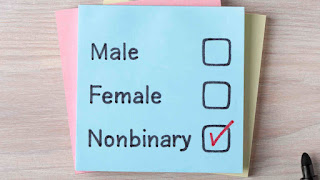
Which box should I be ticking?
I've also seen an increase in rainbow awareness happening around me. The other day, I met a medical student who was wearing a name badge which said "<Name>, Medical Student, Pronouns she/her". Formerly I'd always assumed that people who put their pronouns up front like this were either trans themselves, or had a close friend or family member who was trans. But no. Apparently there are lots of students wearing these badges now.

Once a year, however, my hospital sends around a staff survey. It asks for lots of details, such as what your hours of work are, what mode of transport you take to get to work, whether you feel safe leaving in the dark, and so on. I assume they are trying to make sure that the requirements of staff to get safely to work are met. They also ask about ethnicity, and I'm assuming that they're trying to make sure that the ethnic makeup of the staff is a reflection of the ethnic makeup of the community.

But they also ask about gender orientation.

When that question comes up anywhere else, in online applications, or other form-filling, I click on "non-binary" or "other" or whatever third option they give other than "male" and "female". But at work, I don't. I still click on "male".

I've found myself reflecting on why I do this, but basically, it's a form of cowardice. I know other people, more out than I, who have experienced real difficulties created by their gender identity. Yet, they persist, driven by courage, or determination, or the desire perhaps to blaze a trail for those who follow. Like water on stone, eventually the stone will be worn away. Why don't I click that third box, and prepare myself for whatever follows?

Because a close friend once warned me that our city is still quite conservative. You can only come out once. There could still potentially be adverse consequences of being open. She would know; it's happened to her.

And so, for the moment, I don't click the box. It turns out, that, even ten years on, I am still worried about what people would think.

===

While my input to this blog has dwindled a bit since I started writing (far too much!) on Quora, I'm delighted to find that I'm still ranked at number 55 on the Feedspot Top 60 Crossdressing Blogs and Websites, updated on 11th December 2021, so I suppose I'm still allowed to have my gold medal displayed on the home page.

Tuesday, 24 December 2019

The Medical Profession is Female

A man and his son are terribly injured in an accident. They are taken to hospital requiring surgery. A surgeon is called, but looks at the boy and says "I can't operate on this boy: he's my son!" How is this possible?

Does this riddle perplex you? If so, you may be demonstrating your innate gender bias, that surgeons ought to be male, and therefore you expect the surgeon to be the boy's father. Of course, the common answer is that the surgeon is the boy's mother (though it's becoming increasingly possible that the boy is the child of a gay couple).

My media feed this week sparked my interest with its announcement that the "Medical Profession is Female", and I followed the link.

Professor Elizabeth Loder is a professor of neurology at Harvard, and the head of research at the British Medical Journal. She writes (my italics):
Loder: Soon, most doctors in the US, the UK, and Europe will be women; this is already the case in many countries (...) The stereotype that doctors are men persists at a time when almost half of physicians are female—and it has been internalised by women physicians like me—so it’s a problem that needs to be fixed. How to do this? It would help to retire “he,” “him,” and “his” as the default pronouns for doctors and make a deliberate switch to “she,” “her,” and “hers.” Pronouns are in flux, and it’s possible that “they,” “them,” and “theirs” will become standard. Until that happens, I have a proposal: when in doubt, and the gender of the doctor is unknown, let’s use female pronouns to send a message and open minds.
Professor Elizabeth Loder
There is no doubt that she is right. Women outnumber men at admission to medical school already, and my own belief is that more than half of all doctors are already women.

Loder's piece was prompted by a paper recently published in the BMJ which shows that female scientists are less likely to use positive terms to describe their research findings compared to male scientists. The men tend to use positive-sounding words like novel, unique, or unprecedented, and papers with this more positive language get cited more often.

Academic papers are usually cited in a way which masks the first name of the authors. They are usually given by their initials only: (Lennon J, McCartney P, Harrison G, Starr R), which makes it pretty hard to infer anyone's gender. I had always considered that this made academic publishing encouragingly gender-neutral, but the BMJ paper shows that there is a measurable male-female difference.

As an amusing aside, those of you who are familiar with British English will know the expression "old Uncle Tom Cobley and all", meaning "everyone imaginable". I was delighted to discover that there are several listings in academic journals where Cobley UT has been listed as a co-author!
Loder: Using female pronouns for doctors would force everyone, on a regular basis, to remember that women can be doctors. Soon the default use of female pronouns will make sense for the same reason we’ve defaulted to male pronouns: it will be the best reflection of reality and the new gender makeup of the physician workforce. Furthermore, in situations where most doctors are male (surgical subspecialties, for example), it’s then even more desirable to use a default pronoun of “she” to expand people’s ideas of who can be a doctor.
I'm already doing this very deliberately in my Quora answers, and at work I am careful to deliberately avoid assuming male pronouns for doctors (instead I tend to use they). The very first post I ever wrote on this blog, back in 2011 (!) was about pronouns, although I must say that the invented, gender-neutral pronouns still grate with me wherever I see them.

What I saw, twenty or more years ago, is that to succeed in medicine, women had to outperform the men. That meant that the few female consultants and professors, that I knew then, tended toward the ferocious spinster archetype. I got the impression these were women who had sacrificed a lot (personal life, family life) to get their positions. Many seemed to me to be bitter and battle-hardened: sick of proving themselves right in front of mansplaining men who were not as good as they were.

Before she was that doctor, she was this doctor.
It was considered acceptable for women to do the “touchy-feely” specialties, such as general practice or psychiatry. But women found it very difficult to succeed in the “tougher, harder” specialties such as surgery (especially orthopaedics). The following quote comes from my favourite dark medical drama, the wonderful Cardiac Arrest:
Just because surgery involves a bit of sewing doesn’t mean it’s any job for a housewife!
I personally witnessed the deliberate, ritualised bullying of a highly capable surgical trainee who had committed two grave sins: being a woman, and having brown skin.

But things have changed, and are still changing. Those battle-hardened spinsters have blazed the trail, and women are streaming into specialties which have previously been off limits. And they no longer need to do battle with the boys, which means they are more relaxed and able to express themselves. Some female surgeons operate with little feminine touches: fabulous pink surgical boots (instead of boring white) or operating spectacles with little sparkly bits glued onto the legs and rims. These sound like little things, almost trivial, but they represent ground which was hard-fought for, inch by inch.

The men are, in general, much more respectful and better-behaved. Some of the older ones have ascended to higher echelons, which means that Medical College councils and presidents still tend to be mostly men. But even here I am hearing new dialogue. The president of my Medical College (a man) announced that, considering all the Annual Scientific Meetings our College has ever held, over 100 keynote speakers have presented, and only six were women. Imagine, he said with genuine sincerity, all the talented speakers we have missed out on. (This year nearly all the keynote speakers were women).

That talented surgical trainee I knew back in the day has made it; she was far too talented not to. But she lost something along the way: her compassion is far less now than it was when I knew her. She too has been battle-hardened.

I remain hopeful that these trends continue, and I remain certain that medicine (and hence patients) will benefit from improved gender balance.

But there is one thing still missing: where are the trans doctors? If, as I suspect, there are just as many transgender doctors as there are in the general population, where are they all? This is a subject I intend to explore more fully in a later post, because I've been doing a lot of looking. Meanwhile, if you have a story or viewpoint to share, please leave a comment.

Friday, 6 December 2019

Shifting Sands

Although it's over a year since its release, I came across this amazing publication, and I wanted to give it wider recognition.

The Royal Australian and New Zealand College of Obstetricians and Gynaecologists (RANZCOG) is the medical college responsible for setting training standards for doctors specialising in the field of Obstetrics and Gynaecology in Australasia. So it's a very large, prestigious, academic organisation.

As most medical colleges do, it publishes a flagship academic journal; but also a more informal publication, O&G Magazine, which I admit I had never come across until I saw a pile of them lying in my hospital. The top one caught my eye, because it was colourful, and because it looked like Tetris (which is one of my favourite games). When I looked closer, I saw that the theme of this particular issue was "LGBTQIA", so I picked it up to have a read. I was immediately captivated. Best of all, the entire issue is available free online here.

Let's start with the editorial, from incoming RANZCOG President Dr Vijay Roach:
Roach: This issue of O&G Magazine addresses an important aspect of social, cultural and clinical life in Australia and New Zealand. Members of the LGBTI community have experienced a long history of marginalisation and discrimination, often to the detriment of their physical and mental healthcare. While the College acknowledges a diversity of opinion in the community and among our members on many issues, on one thing we are united: RANZCOG believes that every person, independent of their sexual orientation, has the right to high-quality medical care. 
In 2017, the RANZCOG Board issued a statement on same-sex marriage which read, in part '… the Board affirms its support for marriage equality and calls upon the Australian Parliament to ensure equal opportunity for lesbian, gay, bisexual, transgender and intersex (LGBTI) Australians in same-sex relationships and their families …' I was proud to be a member of that Board and grateful to then-President Prof Steve Robson for his leadership.
In this issue, the O&G Magazine editors have assembled a diverse series of articles relevant to the care of the LGBTI community. It is compelling reading and relevant to everyone’s practice.
The list of articles is impressive:
Fertility options for gender and sexually diverse people (Bronwyn Devine)
Rainbow IVF (Sarah van der Wal)
Gender dysphoria (Simone Buzwell)
Gender dysphoria: a paediatric perspective (Noel Friesen)
Fertility preservation in the transgender child and adolescent (Tamara Hunter)
Intersex: variations in sex characteristics (Jennifer Beale)
What do intersex people need from doctors? (Morgan Carpenter)
Hormonal treatment of the transgender adult (Rosemary Jones)
Surgery for transgender individuals (Charlotte Elder)
LGBTQIA gynaecological screening (Kimberley Ivory)
Takatāpui (Elizabeth Kerekere)
Tekwabi Giz National LGBTI Health Alliance (Rebecca Johnson)
Glass closets and the hidden curriculum of medical school (Amy Coopes)
Australia's queer history (Robert French)
I read these articles with two sets of eyes. The first were my medical eyes: was this the sort of thing that, as a doctor, would be helpful for me to read? The answer is clearly yes. The second were my transgender eyes: was this the sort of thing that, as a trans person myself, I would want doctors to read and know? The answer is also a clear yes. There is no doubt that transgender people are becoming more and more visible; their care has been, in the main, not that great; most doctors have very little training in care of transgender people, and reliable resources for doctors to draw upon are few.

The various authors all have special expertise and interest in their various fields, which is commendable. But it's the range of subjects which strikes me as particularly noteworthy. I've sometimes felt that the T is kind of tacked on to the end of LGB as an afterthought. But here we are, right in the middle, with articles dealing with not just hormones and surgery but issues like fertility and childhood and emotional wellbeing. Amazing.

I was pleased to note that the tone of all the articles was spot on, from the acceptance of the individuals, to recognition that care matters but is frequently lacking, to pragmatic information and guidance for practitioners.
There are several points which are very much worth making about a publication of this type.

(1) First, it's great that a major medical college is being so overtly inclusive. That alone is magnificent. RANZCOG is setting an example for others to follow. There has been lots of Twitter support for the issue.

(2) Second, most medical colleges publish guidelines for the care of patients with X condition. What strikes me about this one is a subtle but powerful shift in tone: not "this is what these patients are like" but "this is us, and that's OK". As Amy Coopes points out in her article, there is still great stigma in medicine if you are gay or non-binary. So a publication like this is extremely affirming. As a transgender person with a medical degree myself, I immediately wanted to reach out and make contact, so I wrote to RANZCOG and congratulated them on their magazine (and I’m not the only one: there is a very heartfelt response from a gay obstetrician in the following issue here).

(3) I wouldn't have necessarily expected O&G to be the specialty which would deal with the care of transwomen. Post-transition, care could potentially be complex, since O&G specialists are more used to the care of people with a uterus and vagina than a prostate gland. But this issue seems to be saying to its readers: don't panic, you can do it! It's started me discussing these issues with some of my colleagues much more openly than previously.

Whether you are medical or not, it's well worth having a browse through this magazine. If you're aware of any other medical organisations being explicitly rainbow-inclusive, please let me know.

Saturday, 27 August 2016

Sex and Gender in Sports - Part Two

In my previous article I considered the distinction between male and female athletes competing in top competitions such as the Olympic games. Right at the nub of the issue is whether women with naturally high levels of testosterone have an unfair advantage against women with lower, or "normal" levels of testosterone.

But what about transgender or transsexual athletes? Those born in an apparently ordinary male body, who legitimately transition to the female sex? What happens to them?

Renee Richards
Renee Richards is the first example I have to offer. Born Richard Raskind, the child of two doctors, Richards was a successful male athlete, and also obtained a medical degree. In 1975 (which puts her age at 41), she pursued a career as a professional woman tennis player. However, in 1976 the US Tennis Association had introduced Barr body testing (a type of genetic testing) that year. Richards refused to take the test, and was therefore banned from top tennis tournaments, the US Open, Wimbledon and the Italian Open that year.

Richards took the US Tennis Association to court, alleging discrimination by gender in violation of her human rights. She won her case, and was allowed to play in the 1977 US Open tournament.

Richards' tennis career was quite short-lived, and she retired from professional tennis in 1981, just 4 years later, and returned to medical practice in ophthalmology.

Richards' case provoked considerable discussion. Official sports governing bodies were very uncomfortable. According to Wikipedia, the US Olympic Committee stated:
IOC: There is competitive advantage for a male who has undergone a sex change surgery as a result of physical training and development as a male.
And indeed, it's hard to argue with that viewpoint. But in addition to official perplexity, Richards faced consternation from the general public too. My correspondent Rhonda wrote "I recall it being said that Renee had an advantage because she competed in a new category, unique to her: 'Mixed Singles'." And even her own fellow athletes were unhappy: when Richards was allowed to play as a woman, 25 of 32 competitors promptly withdrew in protest from the Tennis Week Open.

In this article describing her life and career, written by Emily Bazelon, Richards herself comments on her status as a transsexual athlete. I quote the final paragraph in its entirety:
Bazelon: The science of distinguishing men from women in sports remains unsettled. And Richards has come to believe that her past as a man did provide her advantages over competitors. “Having lived for the past 30 years, I know if I’d had surgery at the age of 22, and then at 24 went on the tour, no genetic woman in the world would have been able to come close to me. And so I’ve reconsidered my opinion.” She adds, “There is one thing that a transsexual woman unfortunately cannot expect to be allowed to do, and that is to play professional sports in her chosen field. She can get married, live as woman, do all of those other things, and no one should ever be allowed to take them away from her. But this limitation—that’s just life. I know because I lived it.”
Michelle Dumaresq
Wikipedia has a list of transgender athletes, both female-to-male and male-to-female. There are, unsurprisingly, few Olympic type events, though there are cyclists, such as Canadian mountain biker Michelle Dumaresq, and fighters, such as American mixed martial artist Fallon Fox. Caitlyn Jenner is of course mentioned.

In 2003, the International Olympic Committee drew up regulations to cover transsexual athletes. To me, at first glance, they seem pretty reasonable:
  1. The athlete must have undergone sexual reassignment surgery, including changes to the external genitalia and gonads.
  2. The athlete must be legally recognised in their desired sex.
  3. The athlete must undergo hormone therapy for at least two years.
These guidelines were modified in 2015, due to recognition that it might not be acceptable to require surgery in otherwise healthy people, and that some countries refuse to grant legal recognition to people who change sex. Therefore, the regulations were changed. The requirement for surgery was dropped, and the only stipulation now requires that the athlete's testosterone level be under 10 nmol/l. (See my previous article for why this might be problematic).

Chris Mosier
As for these games, the UK Daily Mail reported that two unnamed male-to-female athletes were considered for inclusion in Team GB to compete in Rio, but the Internet has been silent about whether they managed it. Meanwhile, Chris Mosier competed as a triathlete for team USA. As a female-to-male, Mosier needs to take testosterone, though a Therapeutic Use Exemption means it's acceptable. The Wikipedia article states that "two closeted transgender athletes competed" at Rio.

The first transgendered sportsperson I recall ever hearing about was Mianne Bagger, a professional golfer from Denmark. According to Wikipedia, Bagger was only the second high-profile transgendered athlete who won recognition from sports' governing bodies to compete in their desired sex, after Renee Richards. A 2004 article from the Guardian newspaper reports that Bagger experienced a slightly warmer welcome from her fellow professionals than Richards did. Subsequently, Lana Lawless sued the Ladies' Professional Golf Association in 2010, which at that time was clinging to a rule that women golfers were required to have been born female. In 2014 another doctor, Bobbi Lancaster, was permitted to play in an LPGA tournament, and this article describes her as the first transgender woman golfer to compete in such a tournament.

So much for the professional athletes. What about those lower down? Una over at TransasCity has produced a couple of relevant articles, and you can read them here and here.

Judit Polgar
I want to close this double article with a shout out to one of my heroes, Judit Polgar. Polgar, 40, is the strongest female chess player in history. The youngest of three sisters, the Polgar girls were intensively coached in chess by their polymath father, Laszlo Polgar, who believed that "geniuses are made, not born".

Everybody "knows" girls aren't as good at chess as boys. Even FIDE, the world chess governing body, awards separate women's titles. The Woman Grandmaster (WGM) title is easier to attain than the Grandmaster (GM) title. But try telling that to the Polgar sisters. They refused to compete in woman-only tournaments, from the beginning, bringing them into some conflict with the Hungarian Chess Federation. However, the Polgars persisted. Laszlo wrote:
Laszlo Polgar: Women are able to achieve results similar, in fields of intellectual activities, to that of men. Chess is a form of intellectual activity, so this applies to chess. Accordingly, we reject any kind of discrimination in this respect.
And his daughters went on to prove him right. Judit achieved an astonishing series of accomplishments: she achieved the rank of full Grandmaster (not WGM) at the age of 15, then the youngest person ever to have done so. She was ranked 55th best player in the world at age 12. She is the first ever (and so far, only) woman to achieve an Elo rating of greater than 2700, and she peaked at number 8 in the world in 2005. Now, of course, FIDE allows players of both sexes to compete in tournaments, but of 1441 GMs in the world, only 31 are currently women, so the women do have some catching up to do. And I bet nobody even bothers about their testosterone levels.

I wonder how much chess is like golf. In most Olympic sports, muscle mass, lung capacity and other physical measures of fitness really matter. In that circumstance, one could say that the extra physical size of someone born male could offer an advantage if they transitioned. However, in golf, this is less obvious, and Mianne Bagger has insisted that she has no physical advantage from being born male.

In chess, of course, physical fitness is irrelevant, provided you can deal with the stress of the games and tournaments. I believe that the low number of female grandmasters is not a reflection of women's ability to play chess, but a reflection of how few women take up chess seriously. I did a quick Google search for transgender chess players, but didn't turn anything up. As always, comments are welcome. Meanwhile, whether it's golf, chess, cycling or whatever, keep doing your thing.

Sex and Gender in Sports - Part One

It's just been Olympic time again, and that means we are overdue for a topic which I have been considering for a long time: how do you separate male and female athletes? This article was prompted by the Olympics, but has relevance to sporting competition in all spheres.

The modern Olympic games has been going for more than a century. Revived by Baron Pierre de Coubertin in 1896, the modern games started to allow women to compete in the 1900 games, held in Paris. But it took until 2012 (the London games) before every competing nation sent women athletes to the games, and the 2012 games were also the first to have women competing in every sport in the programme.

It turns out that men do better, in general, than women at sporting events. As just one example, the four-minute mile has been routinely broken by men, since it was first achieved by Roger Bannister in 1956, but no woman has ever achieved it; the fastest woman is still 12 seconds away. So it makes sense to segregate male and female athletes, so that the competition is fair.


Dora Ratjen
This throws up some problems. First, how do we actually decide who is a man and who is a woman? It hasn't ever been easy. Dora Ratjen was an intersex individual, born with ambiguous genitalia, assigned female at birth and raised as a girl. Ratjen competed for Germany in the women's High Jump in the 1936 Summer Olympic games, and finished fourth. In 1938, Ratjen competed in the European Athletics Championship, and won a gold medal in the high jump. The following year, Ratjen broke the World Record for the High Jump. After an official investigation (following a complaint from another athlete), Ratjen was, at that time, discovered to be working as a male waiter under the name Hermann. He was stripped of his title. Ultimately Ratjen chose the name Heinrich, and lived out the rest of his life as a man.

Wikipedia mentions two other athletes from this period, Zdenek Koubek, and Mary Weston, with similar biographies. These were intersex people with ambiguous genitalia, raised as girls, who competed as women. In common with Ratjen, Koubek and Weston each later transitioned to male.

US Olympic Committee president Avery Brundage called in 1936 for a system to be set up to examine female athletes to make sure they were actually female. Unfortunately, physical examination was the only way to do this. I do not doubt that those examinations were undignified, uncomfortable, and unreliable.

It took another 30 years for chromosome testing to be adopted, in 1968. Surely this would sort everything out, using hard science. Everyone knows that human males have the chromosome pattern 46XY, and females have the chromosome pattern 46XX. So there's your answer.

Maria Jose Martinez-Patino
Except that it isn't. Most individuals with androgen insensitivity syndrome have the chromosome pattern of a male, 46XY, and produce testosterone. However, their bodies are not sensitive to the testosterone, which means they develop as women. Such women are infertile, and lack a uterus, but are externally indistinguishable from 46XX women. Spanish athlete Maria Jose Martinez-Patino was disqualified from competition in the 1988 Summer Olympic games because she failed such a chromosome test, though she was reinstated for competition in the 1992 games. She has since become an academic, and has written about her experience here in the Lancet.

Likewise, some people have the chromosome pattern 47XXY (Klinefelter syndrome), or are mosaics (in other words, not all their cells have the same chromosome pattern).

So, once again, the testing lets us down. The problem is that, even at the chromosome level, the actual level of the DNA itself, humans don't fall neatly into male and female categories.

In 2011, the IAAF came up with yet another idea: that athletes should be separated according to how much testosterone they have. There is a good discussion of this ruling here. The focus on testosterone is because it's considered that a high level of testosterone is what provides men with their athletic advantage. The IAAF ruled (among other things):
  • Athletic competition will continue to be divided into men’s and women’s categories
  • A female with hyperandrogenism who is recognised as a female in law shall be eligible to compete in women’s competition in athletics provided that she has androgen levels below the male range (my italics)

  • The new testosterone limit was set at 10 nanomoles per litre of blood. This level was chosen because it's three times higher than the upper limit of normal for women, and it was reasoned that very few women would naturally have a testosterone level this high. It's at the very bottom of the normal range of testosterone for men under 50.

    This does solve some problems. It does away with examining physical characteristics and chromosomes (though not the indignity of subjecting someone's identity to detailed scrutiny). It even allows for athletes to potentially change sex and still compete as their new sex, provided their hormonal profile fits.

    Caster Semenya
    But once again, there are different problems. Enter Caster Semenya. This South African athlete became the centre of another humiliating sex-testing furore in 2009 aged 18, when she won the 800m gold medal. She was cleared by the IAAF to compete as a woman in 2010, and has, most recently, won Olympic gold in Rio in the 800m event.

    Details of Semenya's medical profile are somewhat sketchy, because she her test results have (rightly) been ruled confidential. The BBC reports that she has hyperandrogenism, which means her testosterone level is much higher than an ordinary woman, and even higher than many ordinary men. Indian athlete Dutee Chand has hyperandrogenism too.

    The pressure on athletes to succeed at the top level, where the difference between success and failure can be measured in milliseconds or millimetres, is enormous. Therefore, it's understandable that athletes want to take every possible step to maximise their performance (and understandable--but not forgivable--when some resort to cheating to make this happen). And it's understandable that their opponents may be angered by what they perceive as an athlete with an unfair advantage being allowed to compete against them.

    Because of the 2011 ruling, female athletes with hyperandrogenism were sometimes required to take medication to lower their testosterone to the "normal" female range. But it gets worse still. In 2016, the United Nations Special Rapporteur on health reported that "a number of athletes have undergone gonadectomy (removal of reproductive organs) and partial clitoridectomy (a form of female genital mutilation) in the absence of symptoms or health issues warranting those procedures". In other words, some athletes have been having surgery they don't need in order to ensure they don't fail a sex test. The UN is outspoken in its condemnation of this, and there are some more details here.

    The testosterone restriction was removed for the 2016 Rio Olympics, allowing Semenya (and other hyperandrogenic women) to compete, free of testosterone suppression, because the Court of Arbitration for Sport (CAS) ruled that the limit should be abandoned for two years to study whether testosterone provides an unfair advantage to athletes. But the debate continues, and there is a powerful article here.

    All of the athletes we have discussed have been competing as women. There seems to be no restriction on anyone who wants to compete as a man. The IOC released a statement in 2012 which said this:
    IOC: In the event that the athlete has been declared ineligible to compete in the female category, the athlete may be eligible to compete as a male athlete, if the athlete qualifies for the male event of the sport.
    Faster than Caster: Usain Bolt
    The next point I want to make is that nobody here is cheating. Dora Ratjen was raised a girl through no fault of her own, and competed as a woman at a time when intersex conditions were poorly recognised or understood. Maria Jose Martinez-Patino has androgen-insensitivity syndrome. And Caster Semenya has hyperandrogenism. None of those people has deliberately done anything to improve their performance other than training. The notion that Semenya and other hyperandrogenic women should have their testosterone levels deliberately suppressed seems no more "fair" to me than the notion that Usain Bolt should have some of his thigh muscles removed, or his legs shortened, to make his performance "fairer". Intersex people have a long history of being "normalised" by medical treatments.

    But Joanna Harper, herself a transgender athlete and medical physicist, argues differently. My quotes come from Sarah Barker's excellent article here:
    Barker: ...success in sports is one of the greatest advancements in women’s lives. If we value women’s equality, it is imperative that we protect the ability of all women to succeed in sports. I believe that billions of potential female athletes deserve the right to compete with some semblance of a level playing field, and that requiring all women to compete within a given testosterone range is the best way we currently have to create such a playing field.
    Is testosterone everything? Surely not; otherwise Caster Semenya would surely be able to run a four-minute mile. The exact role of testosterone remains unclear; there is even a 2014 paper which analyses testosterone levels in 693 elite athletes. It discovered that 16.5% of men (and remember, we are talking about elite athletes) had low testosterone levels, while 13.7% of women had high levels, overlapping with the men. The papers authors concluded:
    Healy, et al: Hormone profiles from elite athletes differ from usual reference ranges. Individual results are dependent on a number of factors including age, gender and physique. Differences in profiles between sports suggest that an individual's profile may contribute to his/her proficiency in a particular sport. The IOC definition of a woman as one who has a ‘normal’ testosterone level is untenable.
    So the debate clearly has a way to go. I think my bottom line is this. If you are going to separate men and women in athletic competition, you need to draw the line somewhere. This will--inevitably--provide advantage to some people and disadvantage to others. If you draw that line as the body you were born with, then hyperandrogenic women like Caster Semenya will surely come to dominate women's sports. If you draw it at an arbitrary level of testosterone, then you will force some athletes to take medications (and in extreme cases, to have surgery) in order to compete.

    No easy answer. I had planned to include transgender athletes in this article, but, as usual, I have found too much material, so I will split this article into chapters. In the next section, I shall consider transgender (rather than intersex) athletes.

    ===
    If you enjoyed this article, you might be interested in my article about Female Bodybuilding.


    Sunday, 8 May 2016

    The Gender GP

    I was browsing one day through Quora. It takes up far too much of my time, though I can’t seem to get away from it. As you might expect, one of the topics I follow on Quora (among plenty of others) is gender, and I was delighted to come across a doctor writing openly about gender issues, in particular trans-gender issues.

    Helen Webberley: Gender GP
    The doctor is Helen Webberley, a General Practitioner from the UK. Her website, www.gendergp.co.uk, offers amazing access to a sympathetic doctor: “advice on gender issues, counselling and diagnosis, blood tests and monitoring, prescription medication”. And it comes with a plethora of means to get in touch: an email address, a mobile phone number, and the option to do face-to-face video conferencing with Helen. There is also a series of short videos explaining her own views about transgenderism and its treatment, and explaining how Helen can help.

    If you’ve read any of this blog at all, you will know how much I am looking for answers to my questions, not just about my own gender, but about the medical treatment of transgender people. You will also know how sceptical I am about the current state of the science behind gender treatment. I have (several times) approached doctors who treat transgender patients (including surgeons who perform sex reassignment surgery ) and also doctors who are themselves transgender, for their own perspectives. They have all quietly declined to be interviewed publicly.

    So I wasn’t filled with confidence that Helen would agree, but I got in touch, and she replied immediately and very positively. Here she is, sitting on my virtual couch:

    How did you first get interested in treatment of transgender people?

    I have always been interested in equality and diversity – it has always appalled me that anyone should be bullied due to their size, colour, hair, gender, preferences, religion etc. I got very interested in Sexual Health in the 90s and did lots of specialist training in this area, and then taught widely on how the medical profession should not judge differing sexual behaviours.

    When I became a GP in Wales, I had a transgender person asking me for help, and the nearest clinic was in London. I made it my business to find out more about gender issues and how to treat them, and how to help this person who couldn’t possibly travel to London. It was fascinating, and very rewarding.

    What made you decide to pursue it as far as you have (the website, etc)? Why not just treat patients in your own region?

    I love technology, and was intrigued as to why healthcare was so far behind the rest of business when providing services online. I made my own website www.mywebdoctor.co.uk offering free advice to those who couldn’t get in to see their GP. I thought it would sit at the bottom of the huge pile of websites in the sky, but I was surprised at how many people asked for help.

    I had an idea to offer specific help for transgender people, so I made a special dedicated Transgender page. When I woke up the next morning, I realised just how big a need it was!! From here it has progressed to www.GenderGP.co.uk .

    Do you still have a normal GP practice?

    Doctor, doctor! Gimme the news!
    Until April 2016 I was the senior partner in a GP practice in Wales. My interest and work with the transgender community has meant that I have had to let this go, as I no longer had time to do both. After a brief spell of ill health, I decided to pursue my current interest and now I am a freelance GP and a full-time gender specialist.

    What opportunities exist for other doctors who want to specialise in the treatment of transgender people?

    There isn't really any official training available in transgender care. But with access to the Internet, there is now endless opportunity for doctors to read policies, guidelines and research to help them to understand more about the needs of the trans community and how best to help them.

    I really believe that gender care should be a routine part of General Practice, just as contraception and menopause treatment is. GPs are good at dealing with stress, family issues, workplace problems and hormones. These are the nuts and bolts of gender care and GPs should be offering this routinely.

    I have found that a lot of the dysphoria that gender variant people suffer is not due to their variance, but the attitude and responses from society and, ashamedly, the medical profession. If we sort that out, we are a long, long way toward making gender care very simple and easy and less demanding on the doctor and the patient. Trans people are startlingly well-informed: listen to them about their diagnosis and management plans – they have done most of the work for us.

    I am presenting a piece of work at the WPATH this year – "Gender dysphoria or medical dysphoria: what causes distress amongst trans patients?"

    I find myself concerned about transgender children. How does one determine whether it's ethical to treat children for transgenderism, especially since no long-term studies have been done looking at the outcomes?

    The children I have met have been amazing. The diagnosis is often so clear cut, and allowing them to go through a life-changing puberty, that so clearly doesn’t match their true gender, is bordering on inhumane.

    By blocking puberty and giving them time to mature and understand what they want and need for their future, you are preventing them from having to have life-threatening surgery in the future, and a life of mismatch and potential humiliation.

    I so totally agree with you about the lack of evidence, and that we are guessing and feeling our way, hoping it is right. But we need to prevent transgirls developing into big hairy men, and transboys developing into shapely, delicate females. There is a reason why the suicide rate is so high in this group, and we must stop their bodies developing wrongly.

    If you could wave a magic wand, and change one thing about the treatment of transgender people, what would it be?

    Allow them to help shape and dictate their care. If they want to try hormones, take hormones, have an operation, change their bodies – make it easy for them, not the huge struggle they seem to face at the moment.

    It seems that transgender issues seem to have burst onto the public stage in the last couple of years. Do you have any thoughts about why this might be? And where it might all lead?

    The true prevalence of transgenderism of any degree (remembering that gender is a spectrum on which we all lie, somewhere between 0 and 100%) is massively underestimated, I expect. In the 80s, people felt more confident to come out as gay, and the same is happening now for the trans community. We are about to see the true extent of exactly how common it is to have some variance with your gender. Is ‘male’ and ‘female’ a human generated idea – and have we got it all wrong?

    Human X and Y chromosomes
    The concept that there are two genders is wrong (in my view). There are two sex-determination systems – XX and XY – and our society has presumed that our gender identity matches those and has made this dictate everything from what you should wear, to what job you should have, to what role you should take in life, to what bathroom you should use, to what gender you should choose to marry.

    In the olden days, we also presumed that our sex-determination system also matches our sexual identity (who we are attracted to), but look how wrong we were about that. Again, society dictated that there would only be one sexual identity and we made all the rules about marriage and commitment to fit that. Latterly we have had to re-write the rulebook.

    I believe that everyone is on a spectrum of gender (identifying as male or female or somewhere in between) and identity (fancying men or women or anywhere in between) and preference (liking pink or blue or fairies or sport or animals or trains). Society shapes this and suppresses our liberty to express somewhere else along the spectrum. I would love to see what happened in a new society, born without rigid rules and constraints and expectations. Would I have been a very feminine heterosexual?

    My video talks about the sphere of diversity, and in that sphere are lots of spectra, and where we lie on each spectrum gives us a unique point within the sphere, unique to you and to me, and excitingly different.

    Do you ever refuse to treat someone for gender issues? How do you determine if a person is suitable to be treated or not?

    I would be very concerned about someone whose gender issues seemed to stem from a bad experience in earlier life. For example a person who wanted to hide from their genitals and sexuality due to a previous history of sexual abuse.

    As my service is a remote service, I do not treat anyone who is shown to have manipulated the system in order to get medication.

    Most people are absolutely honest and genuine and so grateful to have the chance to get the care they need, but sometimes I have to signpost people back to their GP.

    Have you ever come under criticism from colleagues or the public for what you do?

    Oh yes. In one year I have been reported to the GMC twice (but they have found no concerns) and threatened to once – all by leading doctors in this field in the UK.

    AMAB? I thought you said...
    A transmale counsellor working in the field said I wasn’t qualified. A well-known psychiatrist said that I wasn’t qualified and did not do a comprehensive enough assessment. If the diagnosis of an AMAB who has been cross-dressing for years, and would now like to develop some soft skin, breasts and shapely thighs isn’t a clear enough self-diagnosis, what is? Gay people don’t need a psychiatric evaluation before they are allowed a same-sex marriage. Not all people with abdominal pain are excluded for delusions before taking out their appendix.

    Some of these healthcare professionals are supposed to be caring and helping the trans community, but the stories I hear of people’s experiences in their GIC make my toes curl, so I am not surprised that I am not always treated with respect. I wonder whether they are just keeping the GIC waiting list so long to fuel their private practice. I can’t see any other reason that they would not welcome an experienced GP who is helping relieve the burden of their work.

    One of them publically wrote about how gender care that is straightforward should be delivered by people’s GPs, and in the same month I received a letter of concern from him via the GMC for doing just that!

    Gender care needs to be brought under the auspices of General Practice, and done by good old (modern) GPs who are used to dealing with everyday people, every day. If we don’t start encouraging GPs to embrace this field of medicine, then the waiting lists for the GICs will soon be 10 years, not 2!

    The public have been great, I have received so many letters, cards, reviews, testimonials – and every one has been truly complimentary. I have changed many lives for the better, and I expect saved a few desperate lives of people who thought they had nowhere else to turn.

    Do you have any thoughts about the autogynephilia model of Bailey and Blanchard?

    I had never heard of it so I just looked it up. The majority of transgender patients I have had the pleasure of treating could no way fit into this model. I guess that these ideas could be made to fit some people, but to generalise and say this theory explains gender issues is outright wrong.

    I have never really thought about the philosophical arguments so much. I have always concentrated on the physical, psychological and social needs of my patients, so the theory is interesting but a bit mind boggling!

    Which famous person would you most like to meet, and why?

    My family and friends laugh at me because I just have no interest in ‘famous’ people. I would like to be famous for really transforming gender care in the UK and the rest of the world. I would like to shake hands with my future self for helping trans people to access safe and easy healthcare without fear of humiliation, prejudice or judgement.

    ===

    As always in my interviews, I like to reflect a little about the answers.

    First, Helen seems to be extremely unusual: a doctor who treats trans people and is willing to talk about it openly and willingly. She seems so open, so inviting, in contrast to the attitude of many other (but not all) doctors, which seems to be to be with awkwardness and silence (a vestige, perhaps, of the “shame, secrecy and trauma” which Alice Dreger talked about with intersex children).

    Accepting: Webberley
    In addition, Helen offers a multitude of ways for people to get in touch with her, which leads me to wonder how she can possibly get any work done. I seem to be forever answering emails, and I don’t have people all over the world asking me about hormones!

    I approached a surgeon who performs sex reassignment surgery, and he declined to be interviewed. In fact, he was barely polite with my request. He would not consent to be named publicly. When I offered him an anonymous interview, he was sure that he would be recognised by his answers.

    So I guess my point is: so what? If you are a doctor, and you are performing perfectly legal operations, believing in good faith that you are acting for the benefit of your patients, why should you hide? Surely you either believe in what you do, or you don’t. And if you don’t, why are you doing it?

    Helen comes across as completely the opposite. Open, friendly, non-judgmental. Willing to discuss some very sensitive issues very freely. I see her very much as a step in the right direction: the direction which says that you don’t need to hide if your gender doesn’t quite fit the slot, but are deserving of sympathy and acceptance and respect. She isn’t hiding; instead she is out there trying to be noticed.

    I found myself surprised (read: astonished) that she had never come across the autogynephilia model. I thought everybody knew about that one! But again I find this refreshing: that someone can come to a field (you might say a minefield) like gender, and just apply their own take on it, and be so positive, without being subject to what other people want you to think about it.

    I couldn’t help challenging Helen on some of her practices. I believe medicine should be guided by science, and yet the science is lacking in a lot of areas. Again I found her answer refreshing: “guessing, feeling our way, hoping it is right”. How humble, and how different from the dogmatic certainty of people like Paul McHugh.

    I am impressed (in case you couldn’t have guessed) with Helen. I find myself hoping that she is in the vanguard of a new wave of doctors: open, receptive, non-judgmental, willing to listen to trans people instead of dictating to them . I wish there were a hundred like her—and perhaps soon there will be.

    My thanks, as always, to Helen for her patience, not just with my questions, but with my flurry of emails requesting clarifications on several points. My thanks, too, to her husband Mike for reviewing the final draft.

    Form an orderly queue, please. The doctor will see you now.
    ===
    Addendum: 15th September 2017

    The BBC reported this week that Helen Webberley has been "probed" for giving hormone treatments to children as young as 12. She has been blocked from unsupervised practice with transgender patients. Predictably, other media outlets have reacted with a more sensationalist spin on the story.

    I am very disquieted by this news. As I stated above, I am impressed by Helen Webberley's stance on gender disorders. When I interviewed her, she told me that she had already been subject to scrutiny from the GMC as a result of complaints by others.

    I know none of the details of the story, of course. But I find myself hoping that Webberley's clinical supervisor reports to the GMC that she is practising in good faith, within the boundaries of good medical practice and good medical ethics, and that she will be permitted to resume her normal practice. Transgender patients need good doctors, and that may mean that a few brave doctors need to blaze a trail for others to follow.