Pages

Showing posts with label rejecting transgenderism. Show all posts

Sunday, 28 May 2023

JK Rowling and Posie Parker

You can think of this article as JK Rowling part 1.5 if you like, but it involves a significant digression which I thought deserved an article of its own.

I've worked through the whole of The Witch Trials of JK Rowling, and there's a lot to talk about. My initial thoughts about the podcast are this:

  1. Megan Phelps-Roper, the presenter, has an absolutely beautiful voice, which is a complete pleasure to listen to. Interestingly I had never heard JK Rowling's voice before I started listening to the podcast, and it wasn't quite the voice I expected.
  2. The podcast has a very American slant to it. It presents many of the events of Rowling's life and career set against a backdrop of American cultural trends and events. There is some discussion of things which happen in the UK or the wider world, but not very much. This is understandable--but disappointing.
  3. The Guardian reviewer (that I quoted in my previous article) is right: the podcast is too long and meandering. JK Rowling herself isn't actually in it very much--certainly not as much as I thought or hoped--and doesn't appear at all in Episode 6. I found myself wishing they would skip past what Americans all thought about Harry Potter and get back to what JK Rowling was actually saying. And I wished that they would stop cutting away from what Rowling is saying to put in little asides and quotes from other people. Thankfully there are transcripts available, which feature only what Rowling says, at the Rowling Library.
Posing as Parker: Keen-Minshull
New Zealand had a recent visit by a British woman who calls herself Posie Parker. Her real name is Kellie-Jay Keen-Minshull, and she is a mother of four who styles herself as a woman's rights activist, and an anti-trans activist. I had never heard of her before a couple of months ago. It turns out that her star seemed to start to rise in 2018. She's very active (and vocal) online, and also takes part in rallies and other events, in Britain and, increasingly, the USA.

Keen-Minshull announced in January of this year her intention to travel to Australia, and across here to New Zealand, in March. This stirred up some pretty fierce opposition, both from the Aussies (they let her in, and neo-Nazis came to her rallies) and the Kiwis. Various petitions were made.  Immigration Minister Michael Wood spoke about her “inflammatory, vile and incorrect world views”. Ultimately, however, it was agreed that Keen-Minshull was not considered a risk to “public order or public interest”.

Gender Minorities Aotearoa, InsideOUT Kōaro, and Auckland Pride filed for a judicial review in the High Court. They sought an interim order to stop Keen-Minshull from entering the country until the judicial review could take place, but the following day a judge ruled that it was unlawful to keep her out.

Keen-Minshull had planned two events: one was going to be in Auckland, in the large Albert Park on 25th March; the other in Wellington.
Keen-Minshull: They [the rallies] are outside because too many venues will cancel us.
Hounded: Keen-Minshull
Nobody was under any illusions about what was going to happen. She was going to get up on a podium, with a microphone, and make anti-trans speeches, and that's what she tried to do. However, there were large organised protests against her (some of my friends went in carloads to Auckland to protest) and they chanted loudly and blew whistles and trumpets before her appearance. While she had 150-200 supporters, the protesters were far more numerous, thought to be about 2000.

Ultimately she never got to speak. A protester called Eliana Rubashkyn poured tomato juice over her hair and she was escorted away by police and security officers. Watching the events on YouTube, the mood of the crowd was angry and hostile, and it definitely looked as if the protesters outnumbered the supporters. Keen-Minshull was jostled and jeered by the protesters, and the YouTube footage shows her security team had quite a hard time getting her through the crowd to the police and safety.

Keen-Minshull decided to cancel her Wellington rally the next day, and left New Zealand instead, announcing that it was the "worst place for women she has ever visited", and apparently vowing to return to NZ to "win this war". And JK Rowling voiced support, tweeting that a mob had "had assaulted women standing up for their rights".

There was general rejoicing here; certainly among the rainbow groups. A bad lady from another country had come here to spread hate speech and was sent packing with her tail between her legs. There seemed to be general congratulation aimed at an unrepetentant Eliana Rubashkyn, who was charged with common assault but is still awaiting sentencing. No other arrests were made; no injuries were reported and no property was damaged. My impression is that the general feeling is that no great harm has been done, as this cartoon from the Otago Daily Times suggests.

But was this the right outcome after all?

One of my correspondents expressed disappointment with the way Keen-Minshull had been treated, and said she should have been allowed her platform to speak. At first, I have to say, I disagreed. However, a few things made me reflect about it a lot more.

The first was that, while trans people and supporters were in great evidence at Keen-Minshull's rally, and officials seemed to be on our side (Finance Minister Grant Robertson wrote "As a country we need to keep our trans community close, and support them through this time"), there was a sharp rise in anti-trans hatred online in this country. Was this because she was perceived to have been maltreated here? Would the hatred have been worse if she had been allowed to speak? I cannot say.

Otago Daily Times cartoon
The second thing was something JK Rowling herself said, in episode 3 of the Witch Trials podcast (which was made before Keen-Minshull's NZ trip). The italics are mine for emphasis of particular points.

Rowling: I was starting to think about this a lot, subcultures that have their own rigid rules, acceptable beliefs, non acceptable beliefs, everything becoming very reductive. (...) And I was becoming really concerned.

I think the first time I became really interested in what was going on, sort of culturally, it was Milo Yiannopoulos. The alt-right provocateur, I suppose you would call him. And I’m watching from across the pond as he tries to speak on various campuses, and there are protests, riots. You know, "We want him de-platformed, we don't want him to speak at all". And I thought it was a terrible strategic error.

And my feeling was, you are giving this man way more power than he deserves by behaving in this way. It made Milo look sexier and edgier than he deserved to look. I thought it was a strategically appalling turn. Get on that platform and eviscerate his ideas. Get on that platform and expose him for the charlatan that he is. You push back hard, but you’ve given him so much power by refusing to talk.

(...) In fact, I thought they were serving his purposes, because he was able to walk away from that saying, “Look, they don’t dare debate me! This is how dangerous and edgy I am!". And I don’t think we want to cast the alt-right in that light. But inadvertently, [that’s what they’re doing].

And this is definitely true. Immediately after returning to the UK, Keen-Minshull gave an interview with (conservative-leaning) Spectator TV, where a very sympathetic interviewer (musician Winston Marshall) gave her a very free platform, and every opportunity to spin the narrative entirely in her favour without challenge. For example, they both speak of the "violence", when there wasn't any (nothing like what happened with Milo Yiannopolous's rallies in the US). They play a clip (starting at 0:44) of Keen-Minshull being jostled by the crowd, which was filmed by her own phone. In the image, you can see a hand firmly around Keen-Minshull's neck, appearing as if she is being choked--but the NZ Herald footage shows that the hand round the neck was one of her own security guards. It makes it very easy for her to claim that she was the victim, when to trans people and our supporters, she was the aggressor.

Keen-Minshull: I don't know if some latent trauma [from these events] is going to come along and bite me soon, but I'm OK. (...) 

What they inadvertently did, they did two things. Number one they whipped up a frenzy, but the other thing they did is they told everybody my name on a repeating--like so many times that people were like "Well, what is this woman? What does she stand for? How can I-- like, why are we stopping her from coming into the country?" And then they look me up, and then they agree with what I say, and what I stand for. So it had, em, you know, they did me many favours".

Oh dear! How could it have turned out like this?

How could we have done this better?

As always in my articles, a little discussion is in order.

Mysterious: Posie Parker
First, where does the name Posie Parker come from? I assume it's some sort of online identity, so that Keen-Minshull can't be identified, although since she has come out so publicly, everyone knows her real name and identity now anyway. So why keep it? Is it because it's plainly easier to say than Kellie-Jay Keen-Minshull? Is it a play on the name Nosey Parker? The closest I can come to is a series of mystery novels set in the 1920's, written by L.B. Hathaway, which feature a female protagonist called Posie Parker. I can't imagine that either LB Hathaway, nor the actress Parker Posey are all that thrilled by the potential association with Keen-Minshull.

Second, I am forced to agree with Keen-Minshull (and JK Rowling): by not letting her speak, we have empowered her. We have given her publicity. We have given her an enduring image: looking upset, hair covered in tomato juice (symbolic blood!). As sure as eggs is eggs, she will display that image whenever she wants to appear like she is the victim of those violent, dangerous trans activists. In short, by not allowing her to speak, we've done her "many favours".

Third, where does free speech fit into all this? In retrospect, I think the decision to allow Keen-Minshull into the country was the correct one. She has a right to freedom of movement, and freedom of speech. That freedom exists, as several government officials have pointed out, even for people whose views we may disagree with. What she is not entitled to is a platform; she is not entitled to an audience; she is not entitled to not have protesters at her events (although clearly the protesters seem to energise her). NZ Prime Minister Chris Hipkins, would not respond directly to her comments, except to say that he thought they were the "comments of someone who just wants to get a headline", and I think he is right.

Self-made martyr
How could we have done it better? I'm not sure. In retrospect, it's always clearer to consider what we should have done. If nobody had made a fuss, and Keen-Minshull had turned up to a crowd of twenty people with placards, and given a speech, and then nobody would really have taken much notice. Instead, she got a large jolt of publicity in her favour.

I think it's right to protest against speech we disagree with. JK Rowling's solution is "Get on that platform and eviscerate his ideas. Get on that platform and expose him for the charlatan that he is." That sounds so easy; so reasonable. But Keen-Minshull didn't come here for a debate! She didn't come here to listen to opposing views, consider them respectfully, and potentially modify her opinions--and she certainly didn't plan to share her platform with her opponents. Instead, she came to stir up trouble. It was made very clear to her that she was not welcome, and she chose to come anyway.

And she's vowing to come back to "win this war"--a war that she, and people like her, are perpetuating, rather than suing for peace. Instead of listening, debating, discussing, they are on the offensive. We cannot simply ignore her: she is too vocal now; too well-known online; too active, and with quite a large following. How can one counter an adversary, civilly and with dignity, who isn't being either civilised or dignified? It's an election year, so it's very likely that the government--and the opposition--will be very careful to try to position themselves favourably on issues of both trans rights and free speech.

I have no easy answers; feel free to add your own in the comments. Click here for the final part of this series.

Saturday, 15 January 2022

Doctors as Gatekeepers

Let me open this first post of 2022 by wishing all of you a very happy and productive New Year, and let me also hope that COVID-19, in whichever variant, doesn't interfere too much with your plans and your lifestyle.

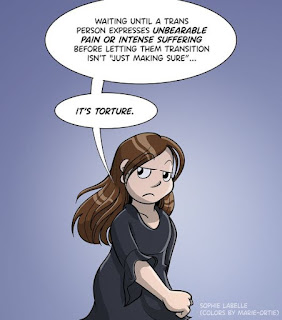
I came across a cartoon this week on my Facebook feed*. It was drawn by Sophie Labelle at Serious Trans Vibes. She also has a Facebook feed called Assigned Male Comics. Some of her comics have been anthologised into printed volumes which are available from her website store in both English and French.

According to the Wikipedia page, the comics have been produced since 2014, and have received positive reviews from critics. Certainly she seems to attract very positive and supportive comments on Facebook, although she has also occasionally been the target of hate. From my perspective, the medium of comics is a very effective way of communicating transgender topics, and I've written about this before, here and here.

Here's the cartoon which caught my eye*. I hadn't come across any of Labelle's work before. I did not recognise the character depicted (it turns out to be one of Labelle's main characters, a young trans-girl called Stephie).

As of today, 15th January 2022, this cartoon has had over 6,700 likes, 172 comments, and 1,700 shares, although these numbers seem to be par for the course for Labelle's cartoons on Facebook.

But what troubled me about it was the implication that that doctors are deliberately obstructive to trans people; deliberately causing them to experience "unbearable pain or intense suffering"; and deliberately inflicting "torture" upon them. This view struck me as unfair and I wanted to explore it further.

Being both a trans person myself, and a doctor, I'm aware of the tension that exists between the two groups. I'm aware (of course) of the frustration that exists from trans people who cannot get doctors to listen to them, believe them, or treat them. And I'm aware (of course) of the antics which some trans people sometimes resort to, such as lying or manipulation, to try to get their way. Others resort to hormones they buy online, or travel overseas to get surgery.

And I want to explain why I think "gatekeeper" is very much the wrong metaphor for what doctors are doing.

There is definitely a problem

Before I go further, I want to state that there is definitely a problem in the medical treatment of transgender people. I am, in my professional and online lives, trying to help to put it right, and I have discussed this matter before on this blog, for example here.

I wrote a long comment on Labelle's page, attempting to explain a more balanced view. She deleted it, and posted this:
Labelle: got a few truscums who wrote 10 pages long comments on how gatekeeping is essential to be truly trans, I got to delete their comments before anyone saw them, as a morning treat! I hope they didn't save their essays anywhere and they're lost forever.
I had no idea what a truscum is, although it's obviously intended to be an insult. You can find a discussion of its meaning here on Wikipedia. From what I have read, that description doesn't apply to me.

This exchange was not the most heartening opening to a discussion I've ever had. I contacted Sophie Labelle again for her comments, and she blocked me. But I nonetheless thought it was worth exploring the two aspects of it: why do (some) trans people feel that they are being tortured by doctors, and what could actually be going on from the doctors' point of view? And, most pertinently, can anything be done to fix it?

Why is it so hard to get good transgender medical care?

I want to begin this section by pointing out that I believe most doctors genuinely want to help transgender people, and that good gender treatment is fully in accordance with good medical practice. But there are several obstacles to achieving this, some larger than others.

Road ahead closed
First, most doctors have very little or no training in gender treatment. That means that few doctors have personal experience to draw upon. In addition, guidance from professional bodies is extremely sparse. When I was a medical student, in the last century, gender identity problems were not taught at all, though we did learn about intersex conditions in paediatrics. In endocrinology, we learned about people with hormone disorders: too much of this, or too little of that, and how to help, but none of this was in the context of people who want hormones to help with their gender.

Second, many (but not all) doctors are commonly faced with patients asking for (even demanding) treatments which could be potentially harmful. Strong painkillers are a great example, and I've seen patients who have resorted to ingenious methods to circumvent the system to obtain them. We've all been bitten, sometimes very hard, by such patients, and therefore many of us are understandably suspicious of people who don't seem genuine.

Put another way, if you are lying to your doctor, there is a very good chance that your doctor knows or suspects that, and this is likely to erode their sympathy and work against getting their cooperation. There is often a distrustful undertone to the relationship between the doctor and the transgender patient, where neither of them feels that the other is being completely open or completely helpful. The whole purpose of this post is to try to improve that situation.

Third, there is a very good rule of medicine: first, do no harm. This advice is so old and venerable that people think it was written by Hippocrates. (It wasn’t). But the meaning of the statement is clear: before you give a treatment you hope will help, you need to really make sure it isn’t going to make things worse. It encapsulates a theme of being cautious in the practice of medicine, which in general is a good thing (I believe). And its core is the patient’s wellbeing, which is paramount. If you are asking for a treatment which your doctor thinks may harm you, they are very unlikely to comply.

No doctor wants headlines like this.
Fourth, there is little good science in the field of gender treatment. What good science there is is drowned amid flag-waving, virtue-signalling, politics and wishful thinking. See my post here for a detailed discussion of these issues. This is especially true for gender treatment in children.

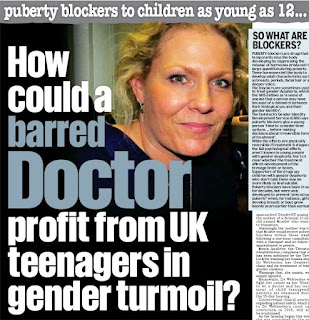
Fifth, those few doctors who have courageously taken on the treatment of transgender people sometimes run into serious professional trouble, threatening their career or livelihood.
Dr Helen Webberley (whom I interviewed here) has been treating thousands of transgender patients (including children) for some years, but has got into some serious hot water with medical authorities in the UK. (As I write, Webberley is still under suspension from practising as a doctor, and her tribunal is ongoing).

This sort of thing acts as a powerful disincentive to doctors to advocate for transgender people or treat them. Those doctors who are interested in training in gender issues will be looking at Webberley's case, and some will decide that the risk of getting into trouble is just too great. 

All of these things make it very difficult for doctors to effectively treat transgender patients.

The fictional case of "Bob"

I've created this fictional scenario to illustrate how an ordinary family doctor, without any training in gender treatments, might approach a consultation with a late-transitioning person. I'm not trying to suggest every transgender patient presents like this. I'm not trying to suggest every doctor would feel the same (and in particular, I would not). But hopefully this scenario will illustrate some potential ways of medical thinking.

Imagine you are that ordinary family doctor, and a patient comes to see you. You have known Bob and his family for 10 years. He is 52. He likes golf and fishing. He was a bank manager until last year, when he lost his job. Since then he has put on a lot of weight and begun to drink more heavily.

Bob tells you he is transgender. He is actually a woman inside, something he has felt for his whole life, but kept hidden from everyone, including his wife. He has been cross-dressing in secret for many years. But now he feels he cannot remain hidden any more, and wants to transition. He wants hormones. He wants surgery. He wants a legal name change.

Burdened: Bob
How do you react? You’ve been Bob’s doctor for years, but he has never mentioned this before. Nothing about him seems remotely feminine.

From one perspective, the story is true. Bobbie could have kept her feelings and behaviour hidden successfully for years, but could carry the burden no longer. This is her chance to be true to herself; to finally become a woman. You look up the referral pathway to the nearest gender clinic, which has a waiting list of two years. Bobbie says she can’t wait that long and wants to travel to Thailand for surgery. She asks you to prescribe female hormones for her, but you are not familiar with these treatments, their doses, or their side-effects. You really want to help Bobbie, and you tell her you will try talking to some colleagues for advice, and you will do what you can, but from Bobbie’s perspective, what you are offering is not enough, and far too slow.

Are you acting as a “gatekeeper” here? I argue not, though Bobbie might feel that you are. Who is right?

From another perspective, Bob’s story doesn’t ring true for you. Bob has always looked and acted like a man’s man: coaching the football team, golf, fishing, powerful cars. Losing his job hit him really hard. He is probably clinically depressed. He is certainly drinking too much, and you suspect his marriage is in trouble. He certainly isn’t the first middle-class, middle-aged guy who has had an unexpected mid-life crisis, even if most of them buy a motorbike or get a tattoo. You think that it would be better for Bob to sort himself out: cut down the drinking, get another job, lose a bit of weight, take more care of himself. You offer him antidepressants and recommend exercise. You tell him that if he still feels the same once those other things are sorted out, you will help him with his request to change sex, but you think in a year or so Bob’s feelings could well have changed and he might feel very differently.

Are you acting as a “gatekeeper” here? Maybe yes (Bob would certainly think so), but are you a bad doctor for doing so? For listening to your patient, making the very best, compassionate, objective assessment of what you think is really wrong, and trying to put it right? I would certainly argue no.

Aye, there's the rub!

And that's where the scissor-point is. Bob's story is fictional, of course, but there is enough truth to it that many elements are recognisable. A doctor, with either perspective of dealing with Bob, is practising good medicine. They are not being a bastard. They are not being cruel. They are not, in any way, deliberately attempting to hurt Bob or cause him distress. They are not torturing Bob! And they are not acting from a perspective that "gatekeeping is essential to be truly trans".

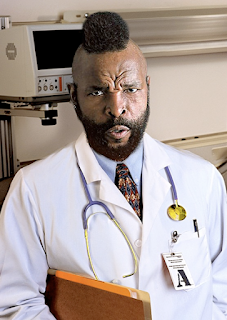
No way, sucka!
The image of the doctor as gatekeeper requires that there is this wondrous place, filled with bountiful hormones and surgery and unlimited gender treatments, but there's a huge steel door, and like a big mean bouncer, your doctor is looking you up and down and saying in a gravelly voice: Yer name's not down, yer not coming in.

But no such bounty exists! From a doctor's perspective, the official pathways are swamped and waiting lists are long. Some transgender people have other issues: depression, drug and alcohol use, self-harm, which can complicate the picture. (If you treat Bob’s depression, will his desire to transition go away?) Some transgender people point to gender as their one biggest problem, and play down other concerns, even though they seem important from the doctor's viewpoint. Some transgender people seem to have unrealistic expectations of how rosy their lives will be after treatment, even though this isn’t necessarily what happens. And some people change their minds about what’s best for them, as their lives unfold.

I'm not saying that trans people who are trying to get treatment are not suffering. I am not trying to suggest they should just suck it up and forget the whole thing. Instead I am trying to point out that what doctors do is not deliberate cruelty. The situation involving children is even more fraught. Gender services for children are even fewer than for adults, and a child who is growing rapidly creates even more pressure in an already pressured situation.

So what's the solution?

The solutions are clear, but none of them is easy. First we need good science to inform medical practice. That, in itself, is difficult, slow and expensive. As I've written here, if your science produces conclusions which some transgender people find unpalatable, you are likely to face powerful negative repercussions. That in turn provides powerful disincentives to scholars to pursue the science around transgenderism.

Second, we need better training for doctors in the treatment of gender conditions. The good news is that there is some evidence that this is starting to happen, although obviously it will take a while to work through the system.

Third, we need clear professional guidance from professional bodies to existing doctors, about treatment regimes, referral pathways, and so on. Again, this is happening, with organisations such as WPATH setting out standards of care (currently brewing up their 8th edition) for transgender people worldwide.

Fourth, we need better investment and funding for those systems which currently exist, to match the increasing demand for their services, cut waiting lists, and improve access to treatment. For these outcomes, you need to lobby your politicians, not your doctors.

Meanwhile, transgender people, and the doctors looking after them, will struggle to make anything successful happen with what already exists out there.

How can I get the best out of my doctor?

The first thing to say is that doctors are people, which means there are some who are brilliant, some who are dreadful (sadly I've met some of them), and most of the rest are perfectly OK in the middle somewhere. Most of us went into medicine because we actually want to help people, after all. We are also aware that the power-balance in the doctor-patient relationship very much favours the doctor. While medical paternalism is still (unfortunately) a thing, the old notion that "doctor knows best" is obsolete, and practised only by a few, aging doctors.

But if you understand how your doctor is thinking, it is likely to result in a better outcome all round. You will be able to reassure them and defuse some of their reluctance. You will be able to put forward your goals in a way which seem to be in accordance with good medical practice, not against it.

It doesn't have to be a conflict.
If you happen to run into a dreadful doctor, get another doctor! If your doctor is uncaring, brusque, unsympathetic, or otherwise unsuitable, vote with your feet. Change to another doctor in the practice, or change to another practice entirely. There is likely to be a social media page for trans people in your area. Ask around for recommendations about a supportive doctor near you.

If your doctor seems willing to help, but unsure what to do, point them to the WPATH website, which is positively bursting with resources to help: medical guidance, standards of care, a comprehensive reading list, a search facility for colleagues and experts around the world. If they really want to talk to an actual transgender doctor, I'm happy for them to contact me by email.

Try to work with your doctor, not against them. Try not to take it as a personal attack if they don't fall over themselves to do whatever you ask. It's fine to negotiate, with statements like "I know that if I start with the higher dose, I might have more side-effects, but I'm willing to accept that risk for myself, and I will cut down the dose if I start to run into problems". Most doctors will respond very well to this approach, and many doctors like it if you've done your homework first: "I know I will have to keep an eye on my blood pressure and my blood sugar too, but I've been losing weight and keeping fit".

Plain honesty is likely to work very positively. "Look, I know it wasn't very smart, but I'm desperate, and I've been taking these hormones I got from the Internet. I brought you the box so you can take a look at them. They don't seem to be working very well. I really want to be on something safer and more effective".

Manipulation, lies ("Oh no, doctor, I would never take anything that I bought online") and subtle threats ("If you don't prescribe these for me, I'm going to start getting them online anyway, so you might as well") are likely to make things very rocky.

The hardest part (understandably) is to be patient with your doctor if they seem too slow. You may well be that doctor's first ever transgender patient. Your interaction with them will likely colour all future interactions with trans patients. Most doctors (as I've said before) will be willing to work together with you toward you meeting your goals, which will be rewarding for you both, and will likely make things easier for the next trans person that doctor has to treat.

The situation is changing. I know it's too slow for many people, but it's going to be better. Meanwhile, let's all try to understand one another a little better.

===

* I believe that my sharing of this image on this page consitutes Fair Use. The original cartoon was published on a public forum (Facebook), where it has been viewed many thousands of times. I have not changed or altered the image in any way. I have attributed the artist, and added links to her Facebook stream, her website, and her Wikipedia page. I have not attacked the artist or the image, but used it to illustrate a discussion point which is very strongly in the interests of the trans community--in other words, my use is in alignment with the implied original purpose of the image. I do not earn money or other reward for this blog. The image has already been shared over 1800 times without apparent objection from the artist, which indicates implied permission for its being shared online.

Sunday, 27 November 2016

If I Was Your Girl

I was browsing in an airport bookshop lately, and noticed the cover of this book, If I Was Your Girl, by Meredith Russo. The book was displayed reasonably prominently, and was featured as part of the Zoella book club, as a work of fiction for young adults (which is what they are calling teenagers these days, apparently).

If I were your girl: subjunctive, people!
Normally I wouldn't be too interested in fiction for young adults. When I was a young adult myself, I just read fiction for adults. My sister used to read books by Judy Blume, and she would usually show me the juicy parts. These astonished me in two ways. They astonished me because these were books marketed at teenagers, containing detailed descriptions of sexual activity that would likely cause many parents (including ours) to have conniptions. Second, they astonished me because they were depicting a world where teenagers seemed to have no trouble having sex; lots of sex. This seemed like a glimpse into some alien world. As a teenager who was having real trouble finding someone willing even to snog me, reading the books made me feel envious and uncomfortable.

Now that I am an adult, I don't see any reason to read young adult fiction at all. Unless it seems to feature the transgender flag on the cover, which is what drew my eye.

Naturally I bought it, and read it on the flight, all the way through. And now I thought I would write a review of it.

The book centres around the life of Amanda, an 18-yr old girl in her final year of high school. She joins a new school, and falls in love with Grant, a football player. The hook (at least from a transgender point of view) is that Amanda used to be Andrew. Their relationship goes through some ups and downs, before the big reveal, and the aftermath.

I read to the end of the book before I realised that the author herself, Meredith Russo, is a transwoman. She even includes a page of comments for cisgendered readers, as well as another page of comments for transgendered readers. She explains some of the fictional devices she required to use to make the story work. One obvious one is that nobody ever doubts or guesses Amanda's trans nature, because she is already "fully formed": post-surgery, post-hormones, and with a completely realistic face and body. Russo admits this is pretty unrealistic, and I am pleased that she did; for me it was one of the most difficult parts of the story to accept.

Meredith Russo
Russo was raised in Tennessee, and sets the story in a district she is familiar with. I can't help associating that region of the southern United States with God-fearin', gun-totin', Republican-votin' good-ole-boys. To be a transgender child growing up in that environment would be, no doubt, exceptionally difficult, lonely and painful. Amanda, our protagonist, is exposed to a series of very unpleasant events: parental rejection, violent beatings at school (where she is considered to be gay by the other students), and a failed suicide attempt. These events are described starkly (in a series of flashbacks), and the writing is powerful. I dare say they will resonate with young adults who feel different (for any reason), isolated and desperate. Even I got a few pangs.
I brought my wrist up to my chest and looked down. The identification bracelet said my name was Andrew Hardy. If I died, I realized, Andrew would be the name they would put on my tombstone. I thought of the words I wrote down for the counsellor: I should have been a girl.
Amanda begins to settle into her new school, and begins to make friends. She is pleased and gratified to find that she is accepted, though this pleasure is tempered with the knowledge that, if the truth of her background were known, she would surely be rejected.
The cicadas buzzed persistently in the growing dusk. I had read once that they lived underground for most of their lives, only emerging as adults to live out their final days. Was that going to be me? Was I going to live underground for the better part of my life, never coming out into the world? (...) I wondered if joy could ever be felt by itself without being tainted with fear and confusion, or if some level of misery was a universal constant, like the speed of light.
Trans model Kira Conley on the US cover
The parts of the story with which I found most resonance are where Amanda discovers her trans identity, and meets other trans people for the first time. She is mentored in her early journey by Virginia, who introduces her to members of her local transgender support group.
A woman with broad shoulders and a faint shadow of a beard under her make-up entered next. She looked strong and stout, but the longer I looked, the more I saw the beauty in her--here a light step, here a brief touch of the hair, here a wide, open smile. Boone said, "Evening, Rhonda," to greet her.
This resonates with me because of my preoccupation with how people see Vivienne. Since I started my journey, I have come out to a couple of dozen people, and they have all been complimentary about my appearance, even the ones who met Vivienne face to face. But did they have to make an effort to see past the man in the dress to really see Vivienne? And how much of an effort did they make?
I looked Virginia up and down and saw two separate people. One was the beautiful, statuesque angel who had been there to guide me through some of the hardest steps of my transition. The other was a woman with a jaw just a little too strong, forehead just a little too high, shoulders just a little too wide, and hands just a little too big.
Without giving the story away, Amanda begins to find fulfilment and happiness in her new life. Her relationship with her parents improves. She realises other students have their secrets too: one girl takes drugs; another is a lesbian. For me, Amanda's parents and schoolmates are somewhat simple and one-dimensional. Grant, the love interest, is more interesting, though again he is cast as someone who is all goodness: good-looking, pleasant, sensitive, humble, hard-working, popular, kind to his family. The most interestingly subtle character (Amanda aside) is the villain, Parker, another student, whose complex feelings and motives are explored.
His shadow stretched out past mine. I remembered Mom telling me how frightening men were, all men really, how helpless it often felt to be a woman among men, and for the first time I understood what she meant.
The romantic aspects of the plot are well-drawn: the breathless first kiss, and other faltering steps as the relationship between Grant and Amanda begins to play out. I am relieved beyond measure to report that Judy Blume's intimate depictions are largely absent. Though the book doesn't insult its readers by pretending everyone is a virgin when they leave high school, the sexual content is handled deftly and with subtlety, just as (in my opinion) it ought to be.

So in summary, what can I say about the book? I cannot judge it as a piece of young adult fiction, since I have so little knowledge of that genre with which to compare it. I have a friend who writes romantic fiction for a living, and she tells me there is a remarkably strict pattern that her books are expected to follow. I hope the same is not true of young adult fiction, but I wouldn't be surprised (only disappointed) to find that there is. Overall, I think the story is compelling enough, and readable enough (certainly I didn't get bored or struggle to finish it). I think some of the characters are a bit flat. I think that the story of Amanda's life is told with enough sympathy and emotional resonance that transgendered readers (like me) will find much to resonate with, and there is a reasonably positive ending to look forward to.

Blazing the trail: Luna in 2004
Russo clearly hopes that cisgendered young adults will also read the book and come away with more awareness and more sympathy towards transgendered people (of all ages). And it's this, I think, which holds the book back slightly for me. It just has a hint of being slightly contrived for this purpose; as if Amanda's relationship with Grant is shown to be completely pure and perfect to show just how much of a real girl Amanda actually is.

Nonetheless, Russo deserves encouragement. I think this book represents one more snowflake in the blizzard of transgender-related material in the popular media, to which we are now exposed, and it can only do us good to get more exposure, more sympathy and more conversations started. This is Russo's first book, and I hope she writes many more. I also hope that she isn't the "token trans writer" when young adult fiction is considered.

And there are very few other similar books out there. One which Russo mentions is Luna, by Julie Anne Peters. Another is a book which I have touched on before on this blog, Boy2Girl by Terence Blacker. To my knowledge, neither Peters nor Blacker are transgendered, and both have had success with many other books; therefore they are not as brave as Russo. They can afford to experiment with new themes, while Russo has put all her chips on this debut novel. Thankfully it seems to have gone down very well, and it has favourable reviews on GoodReads and Amazon, but the Guardian reviewer (like me) had some reservations.

I haven't read Luna, but I will order it and let you know my thoughts in due course. Meanwhile, I recommend that you get hold of If I Was Your Girl and give it a read. Or perhaps wave it under the nose of a nearby young adult for their comments. And yours, of course, are always welcome below.

Thursday, 3 November 2016

The End of Days

This is a post which I have been dreading to write for a very long time: the one where I talk about the end of my marriage.

Despite my very best efforts, my marriage has ended. And the ultimate reason is my cross-dressing. I guess by posting this I can both help myself to go through the necessary grieving process, and also help other people out there who might be contemplating similar problems.

What it feels like when your marriage is ending
My wife and I met in continental Europe in the early nineties. I thought she was the most beautiful woman I had ever seen. She was living in another country, and spoke several languages. She was artistic and adventurous, where I was scholarly and conventional. We were both students at the time, and we were both seeing someone else. But there was definite chemistry. In the days before the Internet, we wrote long letters to one another. By a series of very unlikely steps, we saw each other again. I graduated, took a job, and in my first holiday, I went to visit her. By this time, she was living in the US, and we were both single.

I persuaded her to come to the UK, which she did, and we immediately moved in together. We married in the late nineties. My family adored her. My uncle (an academic) praised how clever she was. My grandfather said she was the most beautiful bride to walk down the aisle of our local church. Many people have, over many years, complimented me on how lucky I was to be married to someone like her.

I knew all along, of course, that my gender was not completely congruent with my apparent identity. I have known this ever since I can remember. I can remember wanting a pink blanket in kindergarten and being told I had to have a blue one. But I did not tell my wife any of these things.
Grotesque: Corporal Klinger

Partly I did not tell her because of shame: I was in my mid-twenties, and I knew next to nothing about my gender. Wherever I looked, crossdressers were figures of scorn, of ridicule. They seemed grotesque, repulsive. A great example would be Corporal Klinger, the MASH character who is trying to convince everyone he is crazy by dressing as a woman, so they will throw him out of the Army (har-har, what a wheeze). My internal identity was completely different to that. She already had a name in my mind. I pictured Vivienne as being like a wild animal, trapped and roaring in an unbreakable cage. Although I didn't quite know who Vivienne was, I knew that she and Klinger had nothing in common.

The other reason I didn't tell my wife was that I believed that being married to her would cure me. My trans feelings largely disappeared when I was with her, and I believed that I could choose to put crossdressing aside permanently. ("When I became a man, I put away childish things"). This was (I now realise) a very naïve belief, but nonetheless a fervent one. I was trying very hard not to be trans.

Of course it didn't last. About three years into the marriage, I broke down in tears, and told her my secret: that sometimes I like to dress in women's clothing. She was utterly shocked and horrified. That was the inflection point, the point which marked the start of the downward slope which has led to the end of the marriage.

At first things didn't really change. I purged. That didn't last. In all fairness, my wife tried to have a look at crossdressing, and see what it's about. One time we even went to a transvestite ball (I was in male mode) and she spoke to the other people to hear their stories. She was fascinated, sympathetic, charming. She made a very powerful impression on the people there. But as we came out, it was as if the door slammed. We got in the car to drive home. She didn't want to talk about it; didn't want to acknowledge it. Sitting in the darkness, I realised that she was probably shocked, digesting the implications of all of this. But she would come around. In a few days, we would be able to talk about it. But we never have; not one word from that day to this.
Never mentioned: crossdressing

And then there was the Dolly incident. My wife went to Manchester with her friend for a girly weekend. Unknown to them, their hotel was hosting an extravagant transvestite event in the ballroom. It was big, brash, loud and undeniable. My wife and her friend, both very attractive women, were cajoled to join the fun, and they did: laughing and dancing the night away with glamorous trannies. The following day, they got talking at breakfast to a few of them, and my wife said she was amazed by how normal they seemed: ordinary, pleasant guys. One of them, "Dolly", gave my wife his website details. She checked his website a day or so after coming home (without telling me) and was horrified to see pictures of him pouting in lingerie with his penis on display.

This one individual didn't intend to harm me, but did so very severely. What was he thinking? That she would be aroused? That she would think it was cool? Instead, she formed the very solid (and hard to dislodge) impression, that crossdressers, even the nice ones, even the "normal" ones, are not just after glamorous frocks, drinking and dancing, but are perverts behind closed doors. Thanks, Dolly.

It took me a while to realise how my wife has the ability to compartmentalise things in her life. It is as if she can take the idea of Vivienne, and all the trappings, all the accoutrements, and put them in a box, which is never acknowledged, never opened.

My wife came from a non-Western culture, where the behaviour of both men and women is rigidly proscribed. Even though she has lived in the West for decades, there are certain things which, to her, were not negotiable, and one of those things was that her husband mustn't wear a frock. It was even OK for other people to do that, as long as it wasn't her husband. She expected an alpha-male: indestructible, unshakeable, always in control. Never uncertain. Never vulnerable. Never tearful. Such a man would make her feel safe. That seems not wholly unreasonable, but there are two problems with it. The first is that I am not that man. I am not him today, and I have never been him. The second problem is that such a man doesn't actually exist.
Trapped: Vivienne

So she put Vivienne into that box, sealed the lid tightly, and pretended that Vivienne didn't exist. But it seemed that the harder my wife tried to suppress Vivienne, the harder Vivienne demanded to be expressed, to be heard, to be acknowledged. I searched for ways to explore Vivienne's identity without threatening my marriage. I joined the Beaumont Society, in the hope of opening a dialogue with like-minded people, but (as I say in my article) that didn't help much. I explored dressing, and had one or two makeovers. Eventually I started this blog.

What I wanted, most of all (and still do, I suppose) was simply acceptance. I wanted to be able to express this tender, vulnerable side of myself to the person who mattered most to me in the world. Vivienne wasn't just about the clothing; she was about the roles and expectations placed upon me because I happened to be born a boy. I wanted to have conversations with my wife about it, not strangers on the Internet. I wanted to dress at home, not in makeover shops in other cities. I wanted to be accepted for who I am, not for who she (and in fairness, everyone else during my upbringing) told me I ought to be. I wanted to enjoy being myself, being whole.

Instead, she insisted that this side of me was disgusting, unbearable. It must never be spoken of, never acknowledged, never accepted, never tolerated. But gradually that disgust, that poison, began to leak out of the box. It began to be aimed at aspects of me which were not associated with Vivienne. My wife began to gradually shut me out, to express John Gottman's Four Horsemen of the Apocalypse: the evocative name he gave to the behaviours which start to appear when the death-knell of a relationship is ringing loud and clear. We were four for four. And it was utter agony for me.

It didn't matter that I put rigid boundaries around my dressing. Four episodes a year, or less, and always, always in complete secrecy. We could not go shopping to a department store without her fearing that I was looking at the female mannequins and picturing myself in their clothing. She came to view Vivienne as the other woman, the one who came first in my affections.

It didn't matter that the other aspects of our lives were good: I had a good job and provided a good standard of living; we lived in a lovely house and had lovely kids and lovely friends. I didn't have any other obnoxious habits: gambling, drinking, drugs. That was all outweighed by the fact that I was not the alpha male that she thought she married.
Corrosive to relationships: fear

I see now that she was motivated by fear. Fear that I was going to start having sex with men. For the record, this was never my plan, and still isn't. Fear that I was going to start taking hormones and having surgery. Again, this was never the plan, and it still isn't. Fear that I was going to completely come out, and start showing up at the school parents' evening in a skirt and heels, where I would be a figure of contempt and ridicule (no matter how polite they might be to my face), and a cause for the kids to be mocked or bullied. Fear that other people would look down upon her: what on Earth possessed you to marry that freak?

The antidote to fear is communication, and this was another sticking point: she just would not communicate. The prospect, the existence of Vivienne, was so terrifying, so repugnant to her, that she could not have an ordinary conversation about it. I would talk, and she would not listen. I would listen, and she would not talk. It wasn't just that she didn't talk to me. She didn't talk to anyone: didn't confide in a close friend. Her fears were grinding around inside her, destroying her on the inside. On the outside, she began to shun me openly. The intimacy dried up years ago. To describe what happened, I can't do better than the words of Yoda:
"Fear leads to anger. Anger leads to hate. Hate leads to suffering".
But we still pretended, to the outside world, that everything was fine. For myself, I did everything I possibly could to keep the show on the road. I moved us here to New Zealand. But coming here permanently, we brought Vivienne, and all the other problems, right along with us.

Fabulous but unworn: shoes
In among all the agony were glimpses of hope. Just occasionally, she would buy me girly gifts, such as this pair of fabulous wedge heels. As soon as I opened the box, I was excited and I wanted to try them on. But the look of disgust on her face, as I did so, made me instantly take them off, and I have never worn them since. I think she was really trying to make it work. But in one sense, these glimpses of hope (she bought me the shoes; she must hope I liked them) were actually worse than nothing at all, because the false hope, and the let-down afterward, were especially difficult to bear.

I started to take antidepressants. They were not a solution, but they helped me cope with the daily grinding agony of my life. I am still on them. And I took us to counselling. Good counselling, with a highly-recommended professional psychologist, who saw us for two years, together and separately. But even with his help, we were unable to negotiate, to compromise. My intake of alcohol and comfort food jumped sharply upwards.

In order to illustrate my despair and agony at my situation, I often used the phrase burning to death to describe how I was feeling. I was trying to show how desperately miserable I was in my life: I was desperate to change, to move, to get out of where I was. But, in a very real way, I was also being consumed. Each time we had an argument; each time she stonewalled my feelings, I lost a bit more energy, a bit more commitment. I knew I could not hold on much longer. I knew that one day, the last bit of energy would be gone, and the marriage would be dead.

It didn't matter. My wife was unable to change. And I don't mean this harshly. I realise now that, whether she chose to or not, she could not change her feelings. As for me, I had played my last card. I had nothing left to offer.

I remember the exact moment I realised that the marriage was over. For years, there had been two paths in front of me: the path to stay and try to fix things (which was painful, and exhausting) and the path to leave and start again (which was painful, and exhausting). But always, when I looked at those two paths, the path to leave always seemed the more painful. But one day, the see-saw just tipped the other way, and it has never tipped back. I realised, with sudden clarity: I was never going to be happy if I stayed in this marriage. The realisation was terrible but inescapable.
I can't heeeeeear you!

When I told my wife it was over, she was astonished. Where did this come from? she wanted to know. Didn't you hear me when I said I was burning to death? I replied. But it turns out she didn't get it: she couldn't grasp it. She had denied it, pushed it away, in the same way she did with Vivienne: it's too painful to contemplate, so I will pretend it doesn't exist.

Since then, her anger has gone from being red hot to being blue hot, like a blowtorch. The thing she feared most, that her husband would leave, has come to pass. She cannot--yet--accept that she helped to bring this about. She cannot accept one iota of responsibility for what happened. It's all my fault; that's her truth. And it's OK.

I have called this post The End of Days, because it really feels like that from my point of view. I am losing my lovely home, and I now live in a small rental house. I will get shared custody of my children. That cosy image I once had, of having a nice job, a nice wife, a nice house, and nice kids, and being happy, has turned out to be an empty dream. And unfortunately that dream ends here.

This blog has been profoundly healing for me in so many ways. It has helped me to crystallise my feelings about myself, and my gender, and my identity. Although it's long, this article is only a drop in the bucket compared to thirty-odd volumes of hand-written journals. That banner at the top of the screen? That's one of my journals, and one of my collection of fountain pens. I write every day, when I get the chance, and I have used those journals to explore every possible avenue, every possible way, to keep the marriage on the road, to keep myself sane until the kids got a bit older, to conceptualise my wife's behaviour in different, more manageable ways. I know I am leaving this marriage having tried my absolute best to save it, using every resource I possess.

I also offer these experiences to you, my readers, in case some of you are in a similar position, and these insights help to crystallise your position.

I know that all is not lost; that there will be a new chapter in my life soon. But I don't know what it will look like, and that uncertainty is a fresh kind of agony for me. Where will I live? What will I look like? What will I wear? What will happen to the kids? What will happen to my wife? What role will Vivienne play in my life? I have no answers to any of this, and discussion will need to wait for another day, and another blog post. Meanwhile, let's close the book.

===
Addendum

Katie Robbins wrote a powerful and thought-provoking article, with a similar theme, which you can read here. And hers is a lot shorter!

Saturday, 9 April 2016

Outcomes of Sex Reassignment Surgery

My recent consideration of the book Galileo's Middle Finger and my previous interview with Helen Boyd have prompted me to think again about the science of sex and gender. As I have mentioned many times before, there isn't a lot of hard, reliable science out there.

You might consider that science isn't the best tool with which to view transgenderism. To me, that's a little like saying that counting isn't the best tool with which to view how much money you have.

Opposed: Prof Paul McHugh
Since the study of transgenderism is such a huge field, let's narrow it down to one, relatively well-delineated question: should genetic males be offered sex reassignment surgery? You might already have an answer to this question, one way or the other, but let's look a bit more closely.

Detransitioning is the process whereby someone post sex reassignment surgery, living as the opposite sex, regrets their decision, and returns to their original sex. We know it happens, and that means that sex reassignment surgery isn't for everyone.

Paul McHugh, an eminent psychiatrist, and University Distinguished Professor of Psychiatry at Johns Hopkins in Baltimore, went so far as to discontinue sex reassignment surgery at Johns Hopkins in 1979, after studying the outcomes. He wrote:
McHugh: We saw the results as demonstrating that just as these men enjoyed cross-dressing as women before the operation so they enjoyed cross-living after it. But they were no better in their psychological integration or any easier to live with. With these facts in hand I concluded that Hopkins was fundamentally cooperating with a mental illness. We psychiatrists, I thought, would do better to concentrate on trying to fix their minds and not their genitalia.
You can read his whole 2004 article here. I can see how some of his terminology could be inflammatory, but he comes across as someone who believes what he is doing is right. Before you dismiss him completely, read the whole article. In particular, his review (in the same article) of the previously-misguided surgical treatment of intersex children is very balanced and enlightened, and I find it very difficult to disagree with any of it.

Benefits and harms

Suppose you have heart disease. Your doctor suggests you take aspirin, because there is good evidence that aspirin prevents heart attacks. You take aspirin, confident that you will not have a heart attack, because you are doing the right thing.

But it isn't as simple as that. Not everyone with heart disease will suffer a heart attack, so not everybody needs to take aspirin. And some people who take aspirin will still suffer a heart attack, meaning that aspirin is incompletely successful at preventing heart attacks.

Balanced; benefits and harms
All we can say is that aspirin reduces the risk of heart attack. The actual reduction of risk per person is unexpectedly low. It's only when this small benefit is multiplied by thousands of people across a population that it becomes demonstrable. Multiplied across tens, or hundreds of thousands, aspirin can be shown to prevent hundreds of heart attacks.

But aspirin isn't harmless. As well as its benefits, aspirin causes harms. Again, per individual, these harms are tiny, but multiplied across a population, aspirin can be shown to cause an increased risk of bleeding events. We tend to think of these as risks, but to me (and others) this is an unhelpful word, as it implies that risks are avoidable, where in this case they are not: they are inevitable. It creates the irony that some people will take aspirin and experience only the harms (even though most people expect only the benefits!).

There is therefore a bargain to be struck, between the benefits and the harms of any treatment. In the case of aspirin, we can see that the benefits strongly outweigh the harms, and therefore it makes rational sense to take aspirin. For some treatments, the balance of benefit versus harm is not so clear-cut.

There are also people who are already at risk of having a bleeding event. Those people have a different balance of harm versus benefit. For some of them, it may still make sense to take aspirin; for others, it may make sense not to.

So aspirin is a simple example (there is an excellent discussion of aspirin in this context here on Alvin Lin's blog). This article is about the benefits and harms of sex reassignment surgery.

More complicated than aspirin

Once again, we are faced with a population: people born male who request sex reassignment surgery. It's clear that, if we provide that for all of our population, some will receive benefits, and some will receive harms. Some will receive a mixture of both benefits and harms.

Confusing: statistics
As ethical, and rational people, what we want to do is to maximise the benefits and minimise the harms. Our best efforts may mean that more people have benefit than harm, or more correctly that the total sum of benefit outweighs the total sum of harm. (But it may be hard to judge between a hundred people feeling better, but one person losing their life: which is the greater sum?) If we decide that the balance favours performing the surgery, that's an argument for offering the surgery. If, however, we decide that that the balance favours not performing the surgery, then that's an argument for not performing it.

This is the argument put forward by Paul McHugh, but he is missing one important point: that even if the balance of harm and benefit favours not performing the surgery, this applies to a population, and not individuals, and there may therefore be individuals for whom the benefit is greater. In other words, even if, on the whole, surgery is more harmful than beneficial, there will still be some individuals for whom surgery would be the right thing.

The corollary of all this is that, even if surgery is shown to be more beneficial than harmful, there will still be some people for whom surgery would not be the right thing; in other words, surgery still wouldn't be for everyone!

I'm sorry if I am making your head spin. What's the answer to this conundrum? Science, and plenty of it.

Counting your blessings: estimating benefits and harms

The first question is this: taken as a population seeking sex reassignment surgery, how does the sum of benefit compare to the sum of harm?

You might think that's easy: just find a load of post-op transsexuals and ask them if they are happier since they transitioned. Most of them will say yes. So there's your answer, surely? But a sceptic like me would say: hang on. You might not be counting everyone. Some people might have detransitioned. Some people might have taken their own lives (this number is non-trivial where gender dysphoria is concerned, as this study reminds us). Some people might be so miserable that they declined to answer the survey. This is sampling bias, just one of the many biases potentially associated with research.

I came across this useful paper here at the Bournemouth and Poole Joint Strategic Needs Assessment (JSNA) page. It seems to cover the whole UK, and it has a lot to recommend it: it's short; it contains excellent information including great statistics, and it seems to have a very good idea about the priorities in the care of transgender people. On the other hand, it doesn't say who its authors are; it gives no date, and no sources for its figures. I would really like to know if this is some sort of annual report, and if so, where it comes from.

What it says (in brief) is that sex-reassignment surgery is becoming a lot commoner in the UK, but that trans people face a lot of difficulties in schools, in the workplace, and in their personal and emotional lives. So does sex reassignment surgery result in a greater quality of life?

It's difficult to estimate quality of life. You can't measure it directly; you can only ask people to report it. As a result, it is very prone to error and bias, and people telling the researchers what they think they want to hear, or telling them what they wish were true.

Thankfully for us, Una over at Transas City has done the homework for us, and presents a magnificent, detailed meta-analysis of 34 studies from the literature, together with a very detailed discussion of the strengths and limitations of each study. To save you going through it, the bottom line is this: transsexual treatment (not just surgery) is usually (but not always) associated with a better quality of life afterward, though some problems (such as social integration, difficulties finding employment, and so on) persist. I can't praise Una's article highly enough; she has really put in a lot of hard work to bring this data together.

Meanwhile, Elizabeth Hungerford over at Sex Matters presents four different studies, which suggest increased risk of mortality (including suicide) in transsexuals, increased criminal behaviour, and a disconnect between the subjective reporting of outcomes (most people reported improvement) and the objective reporting of outcomes (a lot of complications were reported). She writes:
Hungerford: As this brief review of long term studies illustrates, positive patient satisfaction should be separated from objectively measurably negative outcomes in order to fully understand the efficacy and “success” of “sex reassignment” procedures. We must be skeptical and refuse to accept emotionally motivated claims of “necessity” that are not supported by long term evidence. We must subject these studies to rigorous, unflinching analysis.
And I really think she has a point. Sometimes, giving people what they want isn't the same as giving them what they need. What should a good doctor, using the principles of medical ethics to guide them, offer the person who asks for sex reassignment treatment?

So where does that leave us?

Cumbersome: scientific research
The ideal scientific study will never happen. In it, a large cohort of gender-dysphoric individuals will present for treatment. They will be subjected to an intense battery of psychological testing, designed to demonstrate every facet of psychological function, and every hint of psychiatric illness. They will then be randomised into at least two arms (preferably three). In one arm, they get full treatment: hormones, surgery, the works. In the second arm, they get the next best treatment: counselling, cognitive-behavioural therapy, maybe antidepressants. In the third arm, they get no treatment at all, but get observed to see what happens if you have no treatment at all. The three groups get followed up for a long period (e.g. a decade) to see what the outcomes are. We decide, based on the result, what the best possible treatment for gender dysphoria is.

The reason this study will never happen falls into several areas. First, to enrol patients in a study, you need to fully inform them of what might happen. Tell someone seeking sex reassignment surgery that they may be randomised to a group which doesn't receive it, and they will instantly withdraw from your study. Second, you need a large cohort of people to get robust results, and it's very difficult and expensive to conduct large studies on large groups of people. Third, the longitudinal followup required means that many researchers cannot devote the time required. A PhD, for example, would normally require all the research to be done in a few years. But unless we wait for a lot longer, we might only observe a "honeymoon period" where everything seems rosy (or potentially the opposite: a period of turmoil and unhappiness while settling into a new life which is ultimately more satisfying). Finally, as described here, nobody really wants to touch this sort of research any more.

One solution: real informed consent

By what means can we identify people, in advance, who will ultimately benefit from sex reassignment surgery? Or who won't? The answer is: we cannot. Nobody can tell the future. Doctors are no more able to tell the future than anyone else. And there are a lot of surgical procedures where the outcome is far from certain in advance. Coronary artery bypass grafting, for example, improves lives for many thousands, but opening someone's chest with a saw and plumbing their major blood vessels into a pump (in order to carry out the surgery) is risky, difficult, and expensive.

Informed: consent
Nonetheless, there is a solution, and it is the same as for any type of surgery. We fully inform the individual of the very best information we have, and let them make the choice. We make the assumption that the adult acting with capacity is the best judge of their own best interests. Note that Paul McHugh has already made up his mind--doctor knows best--and he is happy to make the decision that he knows better than his patients what is best for them. Having decided that transgenderism is a mental illness, he may possibly be more comfortable with the notion that transgender people lack capacity to judge their own best interests. This sort of medical paternalism is (thankfully) well on the wane.

Informed consent for surgery might look something like this:
Sex reassignment surgery is likely to be painful and leave you subject to several complications, including incontinence, scarring, bleeding, infection, wound breakdown, blood clots, and even your own death, though this is very rare. The surgery will be permanent and cannot be reversed. You may not have full sexual function afterward, and you may never be able to experience orgasm. Afterward, you are likely to feel better in yourself, but your risk of suicide will remain high, and you may still experience difficulty integrating into society. If you still want the surgery, sign here.
In my experience, most surgical consent forms tend to stress the negative. They need to be seen to make it clear to the patient that while everyone hopes the surgery will go well, and tries to bring about a great result, that might not actually happen.

But making people clearly aware that surgery might go wrong, and even if it goes right, it won't solve all their problems, is a big step forward from saying "no, you can't have surgery". People should be given this information early and often during the consent process for sex reassignment surgery, so that they can really weigh the decision.

I haven't had sex reassignment surgery, so I don't know what the consent process is like. Those of you who have, please post your experiences and comments below.

Meanwhile, we can only hope that particles of good science continue to be done, and that meta-analysis of those particles can clarify the picture for everyone.